“Should we do qualitative or quantitative research?” is one of the most common questions we hear — and it’s usually the wrong question. The better one is: what decision are you trying to make? Qualitative and quantitative research answer fundamentally different questions, and choosing well in a market as challenging as Myanmar can be the difference between insight you can act on and an expensive shrug. This guide explains what each method does, when to use which, and how to combine them.
The core difference, in one line
Quantitative research tells you how many and how much; qualitative research tells you why and how. One measures, the other explains. A survey can tell you that 40% of consumers switched to a cheaper brand last quarter; only a focus group or in-depth interview will tell you the reasoning, emotion and context behind that switch. You usually need both eventually — but rarely at the same moment.
Quantitative research: measuring the market
Quantitative research produces numbers you can project, compare and track — market sizes, awareness levels, usage rates, preference scores. In Myanmar it’s delivered mainly through:
Face-to-face surveys (CAPI) — the most representative method, because it reaches the large offline population.
Telephone surveys (CATI) — fast and broad, ideal for tracking and quick-turn questions.
Online surveys — economical and quick, but skewed toward a younger, more urban audience.
Use quantitative when you need to: size an opportunity, measure awareness or brand health, test concepts at scale, segment the market, or track change over time. If the question starts with “how many,” “what share,” or “how has it changed,” it’s a quantitative job.
Qualitative research: understanding the why
Qualitative research trades breadth for depth. Instead of many people answering fixed questions, a smaller number explore a topic in their own words. In Myanmar it usually means:
Focus group discussions (FGDs) — guided group conversations that surface shared attitudes, language and reactions.
In-depth interviews (IDIs) — one-on-one conversations for sensitive topics or detailed individual journeys.
Use qualitative when you need to: understand motivations, explore how people talk about a category, react to early ideas, diagnose a problem a survey flagged, or develop hypotheses before measuring them. If the question starts with “why,” “how,” or “what would happen if,” it’s a qualitative job.
In Myanmar, qualitative work is also where local moderation matters most. Nuance in Burmese, regional dialect and social context simply don’t survive a translated guide run by an outsider — a point worth weighing heavily when choosing a partner.
When to use which: a simple decision guide
You need a number to put in a plan or report → quantitative.
You need to understand a behaviour or attitude → qualitative.
You have a surprising survey result and don’t know why → qualitative follow-up.
You have a strong hunch and need to confirm it at scale → quantitative.
You’re developing something new from scratch → qualitative first, then quantitative to validate.
The real answer: combine them
In practice, the strongest research programmes use both in sequence. A common and powerful pattern: qualitative to explore, quantitative to measure, qualitative to explain. Explore a new category with focus groups to learn the language and the landscape; run a survey to size and quantify what you found; then return to qualitative to interpret the surprising numbers. Each method covers the other’s blind spot.
Social listening adds a valuable third layer here — the unprompted, real-time voice of the market — but it complements rather than replaces structured qualitative and quantitative work. For the full picture of methods and trade-offs in this market, see our guide to market research in Myanmar.
The bottom line
Don’t start by choosing a method. Start by naming the decision. Once you know whether you need to measure something or understand it, the choice between quantitative and qualitative makes itself — and in a market as nuanced as Myanmar, knowing which question you’re really asking is half the value.
Frequently asked questions
What’s the difference between qualitative and quantitative research? Quantitative research measures — how many, how much, what share — using surveys with larger samples. Qualitative research explains — why and how — using focus groups and in-depth interviews with smaller numbers of people.
Which should I use for my project? It depends on your decision. Use quantitative to measure, size, or track; use qualitative to understand motivations, explore ideas, or diagnose a problem. Many projects benefit from both in sequence.
Is qualitative research reliable if it uses so few people? Yes, for its purpose. Qualitative research isn’t meant to be statistically representative — it’s meant to explain and explore in depth. Use quantitative research when you need projectable numbers.
Why does local moderation matter in Myanmar? Because Burmese nuance, dialect and social context are easily lost in translation. Qualitative research run by people who understand the local culture produces far richer, more accurate insight.
About the author: [BYLINE PLACEHOLDER — Name, role, credential line, headshot, LinkedIn.]
Here is a fact about Myanmar e-commerce that breaks regional brand teams’ brains.
The country has somewhere between four and five billion US dollars of online shopping activity. It has 19 million people walking around with an active KBZPay wallet in their pocket. And the single most important e-commerce platform in the country, by a long margin, is not a marketplace app. It is a Facebook page. With a person on Messenger. Who takes cash on delivery.
If you came to this article from a regional dashboard expecting a Lazada and Shopee story, take a breath. Myanmar is doing its own thing. The major regional marketplace that did try, Shop.com.mm, the Daraz backed platform, has exited the market. The other early formal player, rgo47, has faded out of relevance. What is left of the formal marketplace layer is a small set of names that real Myanmar shoppers actually use, and a much larger informal layer that almost no regional dashboard captures.
This is a field report from where we sit, between Yangon and Mandalay, watching the carts fill up. Sources for every figure are at the bottom. Pour a coffee.
How Big, How Fast
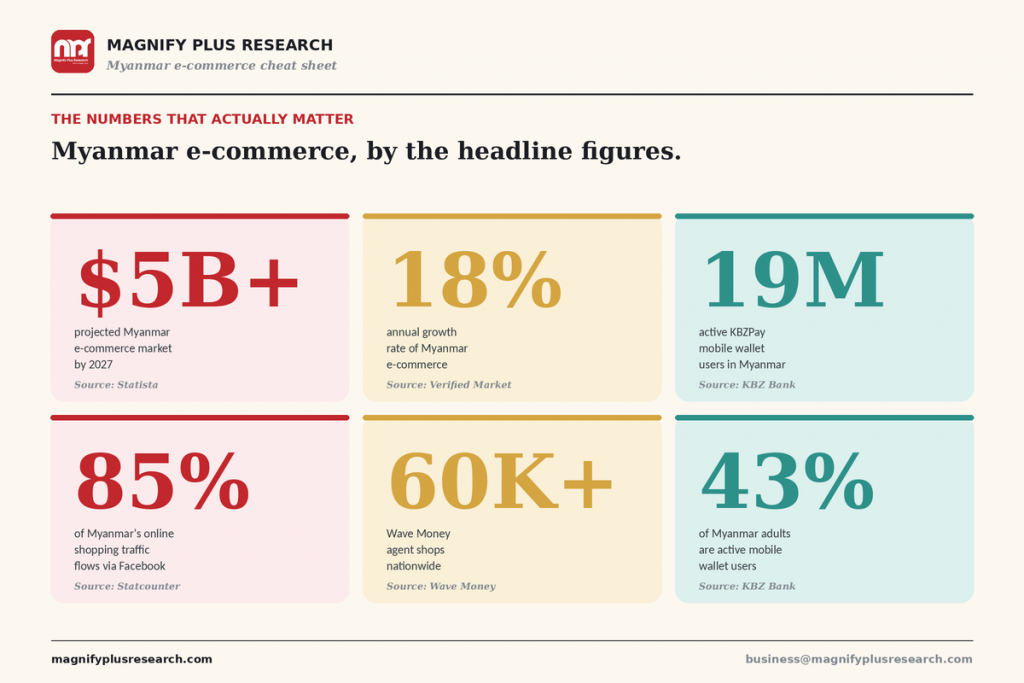
Start with the size. Different research houses count Myanmar’s online economy differently, but the consensus shape is the same. The Myanmar e-commerce market is projected to reach a valuation of approximately 4.5 billion US dollars by the end of 2025, growing at an annual rate of over 18%. Statista’s longer view pegs the eCommerce market in Myanmar to grow by 13.21% (2023 to 2027), resulting in a market volume of US 5.14 billion by 2027. The wider digital commerce category, including digital services, is projected to grow by 25.75% (2024 to 2029) resulting in a market volume of US 5.66 billion in 2029.
Translate the numbers. Myanmar online shopping is roughly doubling on a five year view, in a country where official GDP has been wrestling with currency volatility, inflation, and supply chain frictions the whole way through. That is not a small thing. Consumers are choosing to buy online faster than the macro environment would predict. That is a behavior shift worth paying attention to.
Two reasons it is happening, both at the same time.
One, the phones are everywhere. Myanmar is mobile first to a degree that still surprises foreign visitors. Browsing, comparing, paying, and conversing with sellers all happen on a phone screen. The desktop e-commerce experience, in the way it exists in Singapore or Bangkok, barely exists here.
Two, the wallets caught up to the phones. The number of active KBZPay users jumped by four million in 2024, to reach 19 million in total across Myanmar, representing 43% of the adult population. Add Wave Money on top of that, with over 60,000 Wave Shops nationwide and the Wave App as its dedicated mobile wallet, and you have the two giants moving most of the digital money. CB Pay and AYA Pay, the bank backed wallets, are pushing aggressively for share in 2026. Half the adult population is moving money digitally, every day, on rails that did not really exist a decade ago. E-commerce was waiting for this. The wallets unlocked it.
And then in 2025 the Central Bank of Myanmar dropped MMQR, the national QR code payment standard. Suddenly any wallet could pay any merchant through a single, standardized QR. That is a quiet, profound piece of infrastructure. It means the consumer no longer has to care which wallet the seller accepts. They scan the same code with whatever app they have. For e-commerce, that removes one of the last meaningful friction points at checkout.
The Plot Twist: This Whole Thing Runs on Facebook
The thing regional templates get most wrong about Myanmar is the channel mix.
In Indonesia, you talk about Shopee and Tokopedia. In Thailand, Lazada and Shopee. In Vietnam, Shopee and TikTok Shop. In Myanmar, you have to talk about Facebook first, Messenger second, and the marketplace apps a distant third. In fact, Facebook is one of the main platforms people use to sell their products, as it takes up 85% of online traffic per a statcounter study.
Walk this through. A consumer in Mandalay sees a product on a Facebook page. She messages the seller in Burmese. They negotiate price and delivery. She pays cash to a courier when the parcel arrives, or scans an MMQR code with whichever wallet she has if she trusts the seller. None of this transaction touches a marketplace platform’s shopping cart. None of it gets counted in the way Statista counts e-commerce in Jakarta. It still happens, millions of times a month, and it is the dominant model by a long way.
The implication for brands is direct. If your Myanmar e-commerce plan starts with a Lazada style fulfillment integration and ends with a programmatic ads buy, you are optimizing for a channel that does not really exist here. Building a Myanmar e-commerce strategy without a serious social commerce play is like opening a Bangkok restaurant without Line or a Jakarta one without WhatsApp. Technically possible. Strategically odd.
Where Myanmar Actually Shops
Here is the playing field, in plain language.
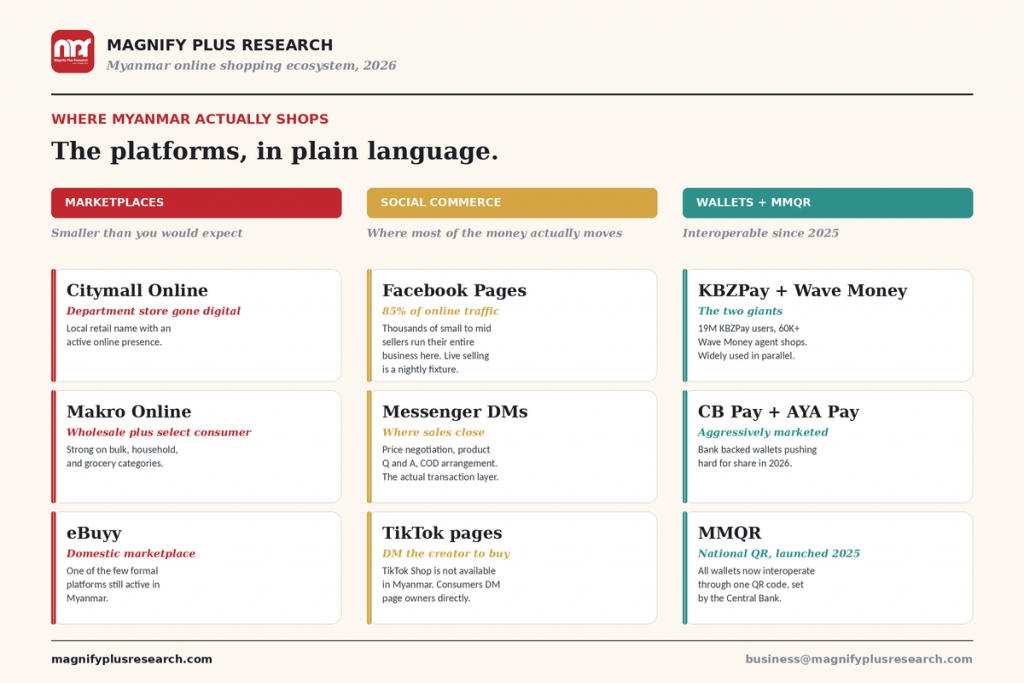
The formal marketplaces (smaller than you would expect). The list of formal marketplaces actively used by Myanmar consumers in 2026 is short. Citymall Online runs the digital arm of a recognized local department store. Makro Online serves bulk, household, and grocery categories. eBuyy is one of the few remaining domestic marketplace platforms with active traffic. That is roughly the picture. Shop.com.mm has exited Myanmar, rgo47 has lost relevance, and TikTok Shop is not available in this market. The clean formal marketplace experience that exists across the rest of the region simply has not consolidated here.
The social commerce layer (where most of the money moves). Facebook pages, Messenger DMs, and TikTok creator pages, with DMs as the actual transaction layer. A Myanmar brand without a social commerce operation is leaving most of the addressable e-commerce market on the table. A foreign brand without a social commerce partner is, depending on category, leaving an even bigger share. Important detail on TikTok, since the regional template gets this wrong: TikTok Shop is not live in Myanmar. Consumers discover products on creator pages and TikTok lives, then DM the page owner to buy. The actual purchase happens the same way Facebook commerce does, in a chat thread, with COD or a wallet payment at the end.
The wallets and MMQR. KBZPay and Wave Money are the two giants, with 19 million active KBZPay users and 60,000 plus Wave Money agent shops nationwide. They are used in parallel by most consumers. CB Pay and AYA Pay are the bank backed wallets being aggressively marketed in 2026. And sitting on top of all of them, MMQR, the national QR payment system launched in 2025 by the Central Bank, makes every wallet interoperate. One QR, any wallet, any merchant. For e-commerce this is the unlock the market has been waiting for.
Last mile. Foodpanda still operates in food, with a long tail of local couriers, motorbike networks, and bus express services handling parcels. Last mile remains the weakest part of the experience, which is also where the differentiation is for any brand willing to invest.
What Categories Are Winning
Different shapes of online demand are emerging across categories in Myanmar, and a few patterns are clear enough to call out.
Mobile and electronics. The category that grew up online first in Myanmar, and still the comfort zone for high ticket online shopping. Consumers compare specs and prices across multiple Facebook sellers before deciding. Brand and seller trust both matter.
Fashion and beauty. Heavily social, heavily live. Live selling sessions on Facebook Live for Burmese audiences are now a routine evening fixture. TikTok creator pages are increasingly important for product discovery, with the actual sale happening in DM. Influencer driven product launches in fashion and beauty regularly outperform traditional retail launches in reach, if not yet in conversion.
Groceries and FMCG. Slower to migrate online for habitual purchases, but accelerating. Makro Online has taken a share of the bulk and household category. The grocery story is partly a city story (Yangon ahead, Mandalay catching up, rural townships still firmly traditional trade) and partly a logistics story.
Home and appliances. A surprising bright spot. Consumers willing to commit to higher ticket online purchases when the brand and seller credibility line up, and when COD or an installment option is on the table.
Buy Now Pay Later style options. Still nascent in Myanmar relative to the rest of the region, but the conditions for it are in place. The brand or fintech that gets this right will unlock a meaningful slug of higher ticket online demand.
What Works and What Does Not
A few observations from the field, blunt edition.
Cash on delivery still rules. It is not the future. It is the present. Brands that try to force prepaid only checkout flows on Myanmar consumers, often because their regional template assumes a different trust environment, leave conversion on the floor. Build for COD as the primary path. Treat digital prepay as the upgrade, helped along by the MMQR interoperability.
Delivery promises kept beat delivery promises made. Overpromising delivery windows is the single most common consumer complaint in Myanmar online shopping, and it shows up in our social listening every week. Quiet, reliable, twice as long as you would brag about is better than fast, public, and frequently late.
Live selling beats static product pages. A Facebook Live with a seller talking through a product in Burmese, taking questions in real time, and dropping a price for the next ten minutes, outsells a polished static product card by margins that surprise regional brand teams every time we share the data. Live is not a tactic in Myanmar. It is a channel.
Burmese language descriptions matter more than you think. Product titles, descriptions, and customer service in Burmese convert dramatically better than the same content in English. Even on platforms where consumers can read both, Burmese signals trust and seriousness. English signals “I do not really care about you.”
Returns are the trust battleground. Myanmar consumers have learned to be cautious about online quality because they were burned in the early years of formal e-commerce. Generous, visible, fast return policies disproportionately reward the brands that offer them.
The Influencer and Live Commerce Boom
Live commerce, the blend of live streaming and instant purchase that took China by storm, has quietly become a big deal in Myanmar over the last two years. The format suits the market structurally. Burmese consumers like to ask questions before buying, like to see a product demonstrated by a real person, and like the social proof of watching other viewers buy in real time. Live selling delivers all three.
The interesting variant is that Myanmar live commerce is less centralized than China or Thailand. It is not dominated by a handful of mega influencers on a single platform. It is a wide layer of small to mid scale sellers running their own Facebook Live sessions, three to five nights a week, with audiences of a few hundred to a few thousand each. TikTok creators run a similar playbook on their own pages, with the buy happening in DM rather than through a built in shop button. The aggregate is enormous. The visibility, for foreign brand teams looking at platform dashboards, is low.
Which is exactly the kind of asymmetry that makes Myanmar market research valuable. The signal is there. You just have to look at it through Burmese eyes.
Why This Should Matter to Your Brand Plan
A few practical takeaways.
For foreign brands considering Myanmar, accept that the channel mix you planned for is probably wrong. A Myanmar e-commerce play should over index on social commerce, Facebook Live capability, Messenger conversational sales, TikTok creator partnerships with DM driven conversion, and reliable COD logistics. Marketplace presence is optional. Social commerce capability is not.
For Myanmar brand owners, the structural advantage is on your side. You speak Burmese. You can run live sessions in language. Your team is one Messenger thread away from any consumer in the country. Most of the unsolved problems in Myanmar e-commerce, returns, delivery reliability, trust at the high ticket end, are problems where a smart local brand outperforms a heavyweight foreign one every time.
For investors and consulting firms watching the market, the data you need probably does not exist yet in a form you can buy off a regional dashboard. It exists in the fieldwork that captures actual Burmese consumer behavior, the social listening that surfaces the unprompted conversation in Burmese, and the channel mapping that follows real money through real platforms. Which is the kind of market research in Myanmar that MPR exists to do.
How MPR Helps
We are Magnify Plus Research, the market research arm of the Magnify Group, based in Yangon. We field consumer studies across Myanmar, run brand health and category tracking, and integrate with Magnify Group social listening built on Burmese language natural language processing. We work with foreign entrants, regional consulting firms, Myanmar brand owners, and investors.
If you are figuring out an e-commerce or category play in Myanmar and want fieldwork, sizing, or social signal that actually reflects how Burmese consumers behave, we should talk.
Get in touch: business@magnifyplusresearch.com
Frequently Asked Questions
How big is Myanmar’s e-commerce market in 2026? Estimates from Verified Market Research put the market at around 4.5 billion US dollars by end of 2025, growing 18% annually. Statista forecasts roughly 5.14 billion by 2027 and 5.66 billion in digital commerce overall by 2029.
What is the most popular online shopping platform in Myanmar? By transaction volume, it is not a platform in the formal sense. Around 85% of online shopping traffic flows through Facebook, with the actual sale closing in Messenger. Among the formal marketplaces still active in Myanmar, Citymall Online, Makro Online, and eBuyy are the names that get used. Shop.com.mm has exited the market and rgo47 has lost relevance.
Is TikTok Shop available in Myanmar? No. TikTok Shop is not live in Myanmar. Myanmar consumers use TikTok as a discovery and live selling channel, then DM the creator or page owner directly to arrange the purchase, much like Facebook commerce.
What payment methods do Myanmar online shoppers use? Cash on delivery is still the dominant payment method. KBZPay (around 19 million active users) and Wave Money (over 60,000 agent shops) are the leading mobile wallets and are widely used in parallel. CB Pay and AYA Pay, the bank backed wallets, are being aggressively marketed in 2026. MMQR, the national QR code system launched in 2025 by the Central Bank, now lets any wallet pay any MMQR enabled merchant through one standardized code.
Is Myanmar e-commerce mobile first? Yes, decisively. Browsing, purchasing, paying, and customer conversations all happen on mobile. Desktop e-commerce in Myanmar barely exists at scale.
What sectors are growing fastest in Myanmar online shopping? Mobile and electronics, fashion and beauty (heavily via live selling on Facebook and TikTok pages), home and appliances, and increasingly groceries and household via Makro Online and social sellers in urban centers.
Does live commerce work in Myanmar? Yes, especially Facebook Live and TikTok creator lives. Myanmar live commerce is less dominated by mega influencers than China or Thailand, with a wide base of small to mid scale sellers running regular live sessions in Burmese. The purchase typically happens in a DM thread after the live.
How can I research the Myanmar e-commerce market reliably? Through primary fieldwork in Burmese, social listening with Burmese natural language processing, and channel mapping that captures both the small formal marketplace layer and the much larger informal social commerce layer. Magnify Plus Research designs research programmes around exactly these questions. Reach us at business@magnifyplusresearch.com.
About the author: [BYLINE PLACEHOLDER, Name, role, credential line, headshot, LinkedIn.]
Get started: Want a sharper view of Myanmar’s e-commerce opportunity for your category? Email business@magnifyplusresearch.com.
Sources, DataReportal Digital 2026 Myanmar, Verified Market Research Myanmar ICT Market, Statista Myanmar eCommerce, 6Wresearch Myanmar E-commerce Market, FinanceAsia KBZ Bank 2025, Wave Money Myanmar, Central Bank of Myanmar MyanmarPay, Statcounter Myanmar traffic data, MPR field intelligence.
Most of the worst decisions we have watched brands make in Myanmar were made with research on the table.
That is the uncomfortable part of this business. Bad market research in Myanmar is not the absence of data. It is the presence of confident, polished, technically valid looking data that turns out to have been answering the wrong question, with the wrong sample, in the wrong language. By the time the launch curve flatlines or the partnership underperforms, the deck is filed and the team has moved on. The lesson, if it gets learned at all, gets learned the hard way.
This is a field note, not a guide. We have written the guide separately. What follows are five mistakes we see repeatedly in Myanmar market research, in roughly the order of frequency they cost brands real money, and the discipline that fixes each. Some of this will be uncomfortable reading for anyone who has commissioned a study in this market in the last few years. That is the point.
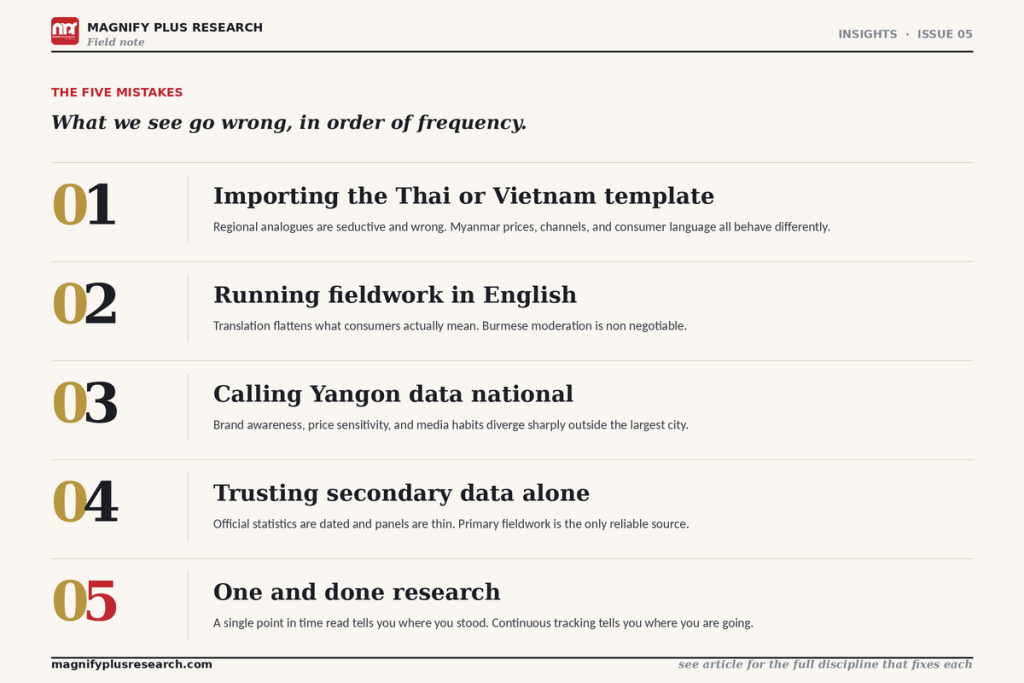
The Five Mistakes
01. Importing the Thai or Vietnam template
This is the most common mistake and the most expensive. A regional consumer team produces a beautiful study run across five ASEAN markets, gives Myanmar a 200 person online sample because it is hard to field, and treats the result as comparable to the 2000 person face to face study in Thailand.
It is not comparable. Myanmar consumers price categories differently, talk about brands differently, buy through different channels, and respond to different cues. Treating regional templates as transferable produces numbers that look reassuringly similar to the rest of the region because they were measured the same way. They are not similar. The instrument flattened the difference.
The discipline that fixes it. Design the Myanmar study around the Myanmar question. Where regional comparability matters, build it in with parallel benchmarks rather than a copy paste template. Where it does not, drop the template entirely.
02. Running fieldwork in English
The fastest way to commission unreliable research in Myanmar is to insist that interviews, surveys, or focus groups happen in English because the global team needs to read the transcripts. We see this more often than we should.
Burmese is a language of indirectness, politeness, and hierarchical cues. A respondent talking to a researcher in English will simplify, soften, and self edit in ways they would not in Burmese. The resulting transcript is technically a transcript. It is also a smoothed out, agreed upon, slightly false version of what the consumer actually thinks.
The discipline that fixes it. Fieldwork in Burmese, moderated and analyzed in Burmese, with English language reporting and verbatims translated by the same team that ran the work. The transcript layer in English is a deliverable, not the research itself.
03. Calling Yangon data national
Yangon is around 12% of Myanmar’s population. It is the easiest place to recruit, the densest market for any consumer category, and the part of the country that looks most like the regional analogues most teams have benchmarks for. None of which makes it a representative read of the national consumer.
We have seen Yangon only studies used to size national markets, set national pricing, and validate national distribution strategies. The numbers were not wrong about Yangon. They were just wrong about the country. Brand awareness, category penetration, price sensitivity, and media habits diverge sharply between Yangon, Mandalay, Naypyitaw, and the secondary cities. A national conclusion drawn from one city is structurally biased.
The discipline that fixes it. Multi metro fieldwork as the default. Yangon, Mandalay, and Naypyitaw as the standard floor, with extended coverage to secondary cities and selected rural townships when the question requires it. If a study cannot afford to go outside Yangon, say so on the cover slide, and limit the conclusions to Yangon.
04. Trusting secondary data alone
The Myanmar secondary data environment is thin. Government statistics are dated. Syndicated panels are limited. Global research databases under cover the country. A small handful of headline figures get recycled across reports until they look like established truth.
A surprising number of strategic decisions in this market are still made on the back of those recycled figures, sometimes through expensive consulting reports that turn out to be re packaging the same secondary sources. Secondary data is useful for framing a question. It is not enough to answer one in Myanmar.
The discipline that fixes it. Treat secondary data as the literature review, not the answer. Every meaningful strategic conclusion in this market should be triangulated against primary fieldwork or fresh stakeholder validation.
A single point in time study tells you where your brand stood on the days the fieldwork ran. In a stable category in a slow moving market, that may be enough for a year. Myanmar is neither.
Inflation reshapes price elasticity. Distributors re align. Platforms shift. A Gen Z trend matures into a millennial habit. Brands that commissioned an annual U and A study three years ago and have not refreshed it since are operating on a snapshot that no longer matches the market. Sometimes the snapshot was correct. The market moved.
The discipline that fixes it. Pair annual deep dives with continuous tracking and social listening. A quarterly read on the metrics that matter beats a once a year photo. Our flagship Consumer Pulse runs on this premise, and so do most credible brand health programmes.
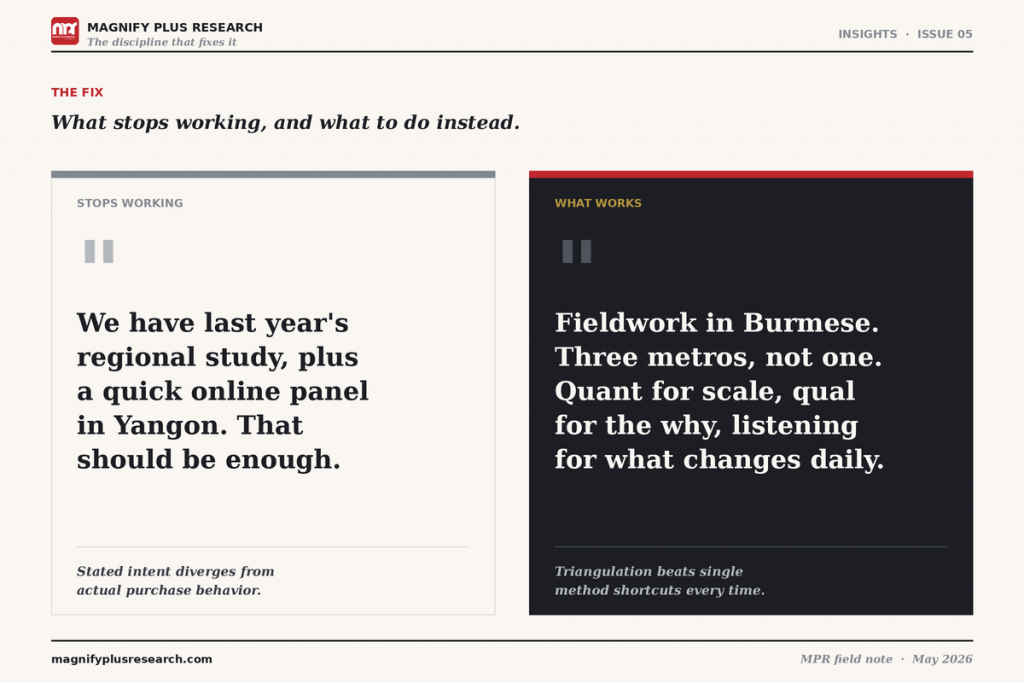
What Stops Working, and What Works Instead
Read those five mistakes together and a pattern shows up. The mistakes share a logic, which is the logic of shortcut. Use the regional template, skip the language layer, sample only where it is easy, lean on what already exists, do it once and move on. Each shortcut looks reasonable on a project timeline and reasonable on a budget. Together, they produce a body of research that systematically tells brands what they want to hear.
The discipline that fixes all five is roughly the same. Slow down at the design stage, frame the question carefully, field in the language and the regions where the consumer actually lives, and treat market intelligence as a continuous capability rather than a one off purchase. None of that is exotic. It is just harder than the shortcut, and the firms that do it are the ones whose research holds up when the launch is in market and the questions get sharper.
What This Looks Like for Foreign Entrants and Local Brand Owners
For foreign entrants, the fix usually means resisting the regional research team’s instinct to treat Myanmar as a slot in an ASEAN template. The market either deserves a custom design or it deserves an honest disclaimer on the regional study. There is no defensible middle.
For Myanmar brand owners, the fix is different and more interesting. You have a structural advantage your foreign competitors do not have, which is proximity to the consumer you serve. Most local brands underuse it. A modest continuous tracking programme, a quarterly Burmese language listening read, and an annual qualitative deep dive will give you a clearer picture of your category than the consultant report your foreign competitor is buying. The data is closer. Use it.
How We Think About This at MPR
MPR exists because we kept watching the five mistakes above happen, and because the response we wanted to give clients was “this study was always going to mislead you, here is what the design should have been.” That is not a comfortable conversation to have after the fact. It is a much better conversation to have at the brief stage.
Our standard programmes field in Burmese across Yangon, Mandalay, and Naypyitaw, with extended coverage available. We triangulate quantitative scale with qualitative depth and Magnify Group social listening in Burmese natural language processing. We report sample, methodology, and limitations openly on every deliverable. And we say no to study designs that we believe will not survive contact with the question being asked, even when saying yes would be easier commercially.
If that sounds like the kind of research partner your next decision needs, you know where to find us.
Frequently Asked Questions
What is the biggest mistake brands make with market research in Myanmar? Treating Myanmar as a sub market of a regional template. The market is different enough in pricing, channels, language, and consumer behavior that regional analogues mislead more often than they help.
Is desk research enough for a Myanmar decision? No. Secondary data is useful for framing a question. Primary fieldwork is what answers it reliably in this market, because the secondary data environment is thin and dated.
Why does Burmese language fieldwork matter so much? Burmese politeness and indirectness norms shape how consumers express opinions. Research conducted in English flattens what people actually mean. Burmese moderation and analysis surfaces the truth that translation misses.
Can I trust a study that only covers Yangon? For a Yangon decision, yes. For a national decision, no. Brand awareness, price sensitivity, and consumer behavior diverge meaningfully outside Yangon. National conclusions drawn from Yangon only data are structurally biased.
How often should we re research the Myanmar market? Pair an annual deep dive with continuous tracking and social listening. The Myanmar consumer and category environment moves quickly enough that a one and done study is rarely sufficient for more than twelve months.
What does MPR do differently? Burmese language fieldwork as standard, multi metro coverage by default, methodological transparency on every deliverable, and a willingness to say no to study designs that will not answer the question being asked.
Get started: Planning a Myanmar research programme and want a sharper second opinion before you brief. Talk to MPR.
Sources, World Bank Myanmar overview, Asian Development Bank Myanmar economy, DataReportal Digital 2026 Myanmar. Field note draws on MPR engagements and Magnify Group social listening across Myanmar consumer categories.