We’ve always believed the same thing about market research: the technology and the data matter, but the value comes from what a capable team does with them. The best decisions in Myanmar aren’t made by the companies with the most data — they’re made by the ones who turn that data into clear, confident action. That’s why we’re introducing MPR Professional Services: a set of capabilities designed to help your team get more out of every study, every dataset, and every decision.
Why we built it
Working with brands across Myanmar, we kept seeing the same pattern. The organisations getting the most from research weren’t necessarily the biggest spenders — they were the ones with the right support at the right moments: help executing studies cleanly under pressure, and a strategic partner to connect the findings to the decisions that actually mattered.
But not every team has the time or in-house bandwidth to do both well. Fieldwork is demanding, timelines are tight, and the leap from “we have the data” to “we know what to do” is exactly where good intentions stall. MPR Professional Services exists to close that gap — to put our experience to work as an extension of your team.
Two ways we support you
MPR Professional Services is built on two pillars: Project Services and Strategic Services.
Project Services — an extra set of expert hands
When your team is stretched and the deadline is real, we take the load. Project Services make sure your research is set up well and delivered cleanly, so you can focus on the decisions rather than the logistics.
Study design and setup — We partner with you to scope the study, design the questionnaire, and configure fieldwork so it answers the real question, not an approximate one. (Disciplined questionnaire design — keeping studies tight and respondent-friendly — is something we hold a hard line on.)
Fieldwork execution and quality control — Our field network and QC processes handle the hard part of Myanmar research: reaching the right respondents and standing behind the data.
Analysis and reporting — We turn raw data into clear, decision-ready findings, so the insight arrives usable rather than as a spreadsheet to wrestle.
Strategic Services — connecting insight to impact
Individual studies are useful. Connected insight is transformative. Strategic Services help you move from collecting data to building a genuine, compounding understanding of your market.
Strategic consultancy — Experienced researchers work with you to make sure every study ties back to a real business objective and a real decision.
Connected learnings — By reading patterns across multiple studies and waves, we surface the bigger picture that single projects miss.
Local-language and listening expertise — Burmese-language analysis and social listening, validated by people who actually understand the market, layered into your strategic picture.
Set up to get it right from the start
A recurring frustration we hear is teams feeling they never quite got their research function set up properly. So Professional Services includes a structured onboarding: we help you get questionnaire frameworks, reporting structures, audience definitions and benchmarks right from day one, so the value compounds instead of being rebuilt each time.
For teams that want more, we offer tailored add-ons — bespoke study designs for unusual research needs, custom benchmarking against the right competitive set, and specific audience builds so your insight comes from exactly the consumers who matter to you.
Why it matters
This isn’t about selling extra services. It’s about making sure your investment in research actually moves the business. Every study you commission should bring you closer to a sharper strategy, a stronger campaign, or a better-informed decision. MPR Professional Services is how we make that more reliable — by giving your team time back, or by sharpening the strategic value of what you already have.
Insight shouldn’t be a bottleneck. It should be the thing that gives you the edge in a market most competitors are still guessing at. We’d love to show you what that looks like for your team.
Frequently asked questions
What is MPR Professional Services? A set of capabilities — Project Services and Strategic Services — designed to help teams get more value from their research, whether that’s extra hands to execute studies or strategic guidance to connect insight to decisions.
Who is it for? Brands and teams operating in Myanmar that want to run high-quality research without the full in-house burden, or that have data and want help turning it into strategy.
How is this different from a standard research project? A standard project delivers a study. Professional Services wraps that in support — from setup and quality control through to cross-study strategic interpretation — so research becomes a compounding asset rather than a series of one-offs.
Can you support ongoing programmes, not just one-off studies? Yes. Strategic Services are built for continuity — brand tracking, connected learnings across waves, and programme management for more complex insights needs.
Let’s talk: Want to see what MPR Professional Services could do for your team? Get in touch →
Every major decision a brand makes in Myanmar rests on data it cannot personally verify. You didn’t knock on the doors or make the calls — you’re trusting that someone did, properly, and reported it honestly. That trust is the entire product of a research firm. And in an era when a convincing-looking chart can be generated in seconds, knowing whether to trust the number behind it has never mattered more. This article is about how to tell trustworthy research from the kind that just looks trustworthy.
Why trust is the real deliverable
Strip away the decks and dashboards and what a research firm actually sells is confidence — the right to act on a number without re-checking it yourself. If that confidence is misplaced, everything built on top of it is too: the budget, the launch, the market-entry decision. In Myanmar the stakes are higher than usual, because there’s little public data to cross-check against. When the research is the only window onto the market, the integrity of that window is non-negotiable.
The AI-era risk: data that looks right but isn’t
It has never been easier to produce numbers that look authoritative. Synthetic charts, plausible-sounding percentages, AI-summarised “findings” with no fieldwork underneath — all of it can be generated fast and presented cleanly. The danger isn’t that this data is obviously fake; it’s that it’s superficially convincing and quietly hollow. For a market research firm, fabricated or unverifiable numbers aren’t a shortcut — they’re a fatal credibility risk, because the moment a client catches one, every other number is suspect too. The defence is the same as it’s always been, just more important now: real fieldwork, transparent method, and honest limitations.
How to tell trustworthy research from the rest
Here’s what to look for — and what should make you pause.
Transparent methodology
Trustworthy research shows its working. You should be able to see the method (face-to-face, telephone, online, qualitative), the sample size, the geography, the fieldwork dates, and how the data was weighted. Red flag: a confident headline with no methodology section, or a vague one you can’t interrogate.
Honest sampling and coverage
A credible partner tells you exactly who was and wasn’t reached — including the regions a Myanmar sample couldn’t cover this wave. Red flag: national claims with no detail on regional coverage, or an online sample presented as if it represents the whole country.
Real first-party fieldwork
The strongest signal of all is primary data the firm actually collected, with the method to prove it. Red flag: secondary statistics recycled from the internet and dressed up as original insight.
Stated limitations
Counter-intuitively, a report that admits what it can’t tell you is more trustworthy than one that claims certainty about everything. Red flag: no caveats at all. In a market as complex as Myanmar, that’s not confidence — it’s a tell.
Traceable sources
Every external figure should trace back to a named, primary source you can check. Red flag: numbers with no provenance, or citations that lead nowhere.
Trust is harder — and more valuable — in Myanmar
Two local realities raise the bar. First, the scarcity of public data means you often can’t fact-check a finding against an independent source, so the firm’s own integrity carries more weight. Second, the operating environment is genuinely difficult — access varies, conditions change — which makes it tempting for less scrupulous providers to paper over gaps rather than disclose them. The firms worth trusting do the opposite: they’re most transparent precisely where the data is hardest to get. That candour is the signal. (It’s also why we’re explicit about method throughout our guide to market research in Myanmar.)
How we earn it
We’d rather tell you what we don’t know than pretend to certainty we haven’t earned. In practice that means every study states its method and sample plainly; first-party data is labelled as such, and external figures are sourced and linked; coverage limits are disclosed wave by wave; and Burmese-language analysis — in surveys and social listening alike — is validated by people, not just models. [MPR DATA → insert your specific quality-control and validation steps, e.g. back-checking, interviewer audits, dual-coding.] None of this is glamorous. It’s just what makes a number worth acting on.
The bottom line
Anyone can produce a confident chart. The question that matters is whether there’s real, honestly-reported fieldwork underneath it. In Myanmar, where you often can’t check the market yourself, that’s not a technicality — it’s the whole basis on which you’re betting your budget. Trust isn’t a soft value in research. It’s the product.
Frequently asked questions
How do I know if market research data is trustworthy? Look for transparent methodology (method, sample size, geography, dates, weighting), honest coverage disclosure, genuine first-party fieldwork, stated limitations, and traceable sources. Absence of these is the warning sign.
Why is data integrity a bigger issue now? Because convincing-looking numbers and AI-generated summaries are easy to produce without any real fieldwork behind them. The risk isn’t obvious fakery — it’s polished data that’s quietly hollow.
Why is trustworthy research especially important in Myanmar? Public data is scarce, so you often can’t independently verify findings. That puts more weight on the research firm’s own integrity and transparency.
Is AI bad for market research? Not inherently — used well, it speeds up analysis. The danger is using it to manufacture findings without real data. The safeguard is human-validated fieldwork and transparent method.
About the author: [BYLINE PLACEHOLDER — Name, role, credential line, headshot, LinkedIn.]
Work with a firm that shows its working:Talk to MPR →
“Should we do qualitative or quantitative research?” is one of the most common questions we hear — and it’s usually the wrong question. The better one is: what decision are you trying to make? Qualitative and quantitative research answer fundamentally different questions, and choosing well in a market as challenging as Myanmar can be the difference between insight you can act on and an expensive shrug. This guide explains what each method does, when to use which, and how to combine them.
The core difference, in one line
Quantitative research tells you how many and how much; qualitative research tells you why and how. One measures, the other explains. A survey can tell you that 40% of consumers switched to a cheaper brand last quarter; only a focus group or in-depth interview will tell you the reasoning, emotion and context behind that switch. You usually need both eventually — but rarely at the same moment.
Quantitative research: measuring the market
Quantitative research produces numbers you can project, compare and track — market sizes, awareness levels, usage rates, preference scores. In Myanmar it’s delivered mainly through:
Face-to-face surveys (CAPI) — the most representative method, because it reaches the large offline population.
Telephone surveys (CATI) — fast and broad, ideal for tracking and quick-turn questions.
Online surveys — economical and quick, but skewed toward a younger, more urban audience.
Use quantitative when you need to: size an opportunity, measure awareness or brand health, test concepts at scale, segment the market, or track change over time. If the question starts with “how many,” “what share,” or “how has it changed,” it’s a quantitative job.
Qualitative research: understanding the why
Qualitative research trades breadth for depth. Instead of many people answering fixed questions, a smaller number explore a topic in their own words. In Myanmar it usually means:
Focus group discussions (FGDs) — guided group conversations that surface shared attitudes, language and reactions.
In-depth interviews (IDIs) — one-on-one conversations for sensitive topics or detailed individual journeys.
Use qualitative when you need to: understand motivations, explore how people talk about a category, react to early ideas, diagnose a problem a survey flagged, or develop hypotheses before measuring them. If the question starts with “why,” “how,” or “what would happen if,” it’s a qualitative job.
In Myanmar, qualitative work is also where local moderation matters most. Nuance in Burmese, regional dialect and social context simply don’t survive a translated guide run by an outsider — a point worth weighing heavily when choosing a partner.
When to use which: a simple decision guide
You need a number to put in a plan or report → quantitative.
You need to understand a behaviour or attitude → qualitative.
You have a surprising survey result and don’t know why → qualitative follow-up.
You have a strong hunch and need to confirm it at scale → quantitative.
You’re developing something new from scratch → qualitative first, then quantitative to validate.
The real answer: combine them
In practice, the strongest research programmes use both in sequence. A common and powerful pattern: qualitative to explore, quantitative to measure, qualitative to explain. Explore a new category with focus groups to learn the language and the landscape; run a survey to size and quantify what you found; then return to qualitative to interpret the surprising numbers. Each method covers the other’s blind spot.
Social listening adds a valuable third layer here — the unprompted, real-time voice of the market — but it complements rather than replaces structured qualitative and quantitative work. For the full picture of methods and trade-offs in this market, see our guide to market research in Myanmar.
The bottom line
Don’t start by choosing a method. Start by naming the decision. Once you know whether you need to measure something or understand it, the choice between quantitative and qualitative makes itself — and in a market as nuanced as Myanmar, knowing which question you’re really asking is half the value.
Frequently asked questions
What’s the difference between qualitative and quantitative research? Quantitative research measures — how many, how much, what share — using surveys with larger samples. Qualitative research explains — why and how — using focus groups and in-depth interviews with smaller numbers of people.
Which should I use for my project? It depends on your decision. Use quantitative to measure, size, or track; use qualitative to understand motivations, explore ideas, or diagnose a problem. Many projects benefit from both in sequence.
Is qualitative research reliable if it uses so few people? Yes, for its purpose. Qualitative research isn’t meant to be statistically representative — it’s meant to explain and explore in depth. Use quantitative research when you need projectable numbers.
Why does local moderation matter in Myanmar? Because Burmese nuance, dialect and social context are easily lost in translation. Qualitative research run by people who understand the local culture produces far richer, more accurate insight.
About the author: [BYLINE PLACEHOLDER — Name, role, credential line, headshot, LinkedIn.]
Myanmar’s small business landscape continues to evolve in response to an unstable business and economic environment. While inflation, currency depreciation, rising operating costs, foreign exchange challenges, and supply chain disruptions continue to pressure businesses, many small and medium-sized enterprises (SMEs) have demonstrated remarkable resilience by embracing digital technologies, mobile payments, social commerce, and innovative business models.
Looking ahead to 2027, businesses that prioritize operational efficiency, digital transformation, customer-centric strategies, and financial resilience are expected to be better positioned to capture emerging opportunities despite continued market uncertainty.
This article explores the most important small business trends shaping Myanmar in 2026 and 2027 and provides practical insights for entrepreneurs, business owners, and investors.
Myanmar’s Economic and Business Environment
Myanmar’s economy is showing gradual signs of stabilization, although businesses continue to operate in a challenging environment. According to international financial institutions, economic growth is expected to improve modestly in 2026 and 2027. However, inflation remains elevated due to currency depreciation, higher fuel prices, increasing logistics costs, and imported inflation.
Over the past several years, businesses have adapted to an evolving economic environment characterized by changing regulations, foreign exchange volatility, supply chain disruptions, and cautious consumer spending. As a result, many SMEs are prioritizing business continuity, operational efficiency, and sustainable growth instead of rapid expansion.
Although consumer spending remains constrained, demand continues to exist for businesses that provide value, affordability, convenience, and trusted products.
Trend 1: Social Commerce Continues to Dominate
Social commerce remains one of the strongest growth drivers for Myanmar’s SMEs.
Facebook continues to be the country’s largest digital marketplace, while TikTok has become an increasingly influential platform for product discovery, entertainment, and live selling. Messenger and Viber remain important communication channels for customer inquiries, order management, and after-sales support.
Consumers are increasingly comfortable purchasing products directly through social media without visiting traditional websites.
Businesses that consistently create engaging content, respond quickly to customer inquiries, and build strong online communities are gaining competitive advantages.
What businesses should do
Invest in high-quality short-form video content.
Build consistent brand presence across multiple social platforms.
Use live selling to increase customer engagement.
Strengthen customer service through messaging platforms.
Encourage user-generated content and customer reviews.
Trend 2: Mobile Payments Become Standard
Myanmar’s digital payment ecosystem continues to expand.
Mobile wallets and QR payment systems have become essential for businesses of all sizes. Customers increasingly expect cashless payment options that are fast, convenient, and secure.
Digital payments also improve operational efficiency by reducing cash handling, improving transaction records, and simplifying financial management.
Business opportunities
Faster payment collection
Better financial tracking
Improved customer convenience
Stronger customer loyalty
Businesses that have not yet adopted digital payment systems risk losing customers to more convenient competitors.
Trend 3: Customers Are Becoming More Price Sensitive
Inflation and rising living costs continue to influence purchasing behavior.
Consumers are spending more carefully and comparing prices before making purchasing decisions. Value for money has become one of the most important factors affecting purchase decisions.
Many customers now prioritize:
Essential products
Affordable alternatives
Promotions and discounts
Smaller package sizes
Trusted local brands
Businesses that clearly communicate value, quality, and affordability are more likely to retain customers.
Trend 4: Digital Marketing Is Becoming More Data Driven
Marketing based on intuition alone is becoming less effective.
Businesses are increasingly using customer insights, social listening, and digital analytics to understand consumer preferences, monitor competitors, and evaluate campaign performance.
Data-driven marketing enables businesses to:
Understand changing customer behavior.
Identify emerging market trends.
Measure marketing effectiveness.
Improve return on investment.
Make faster business decisions.
For SMEs with limited marketing budgets, investing in analytics often delivers greater long-term value than increasing advertising spend.
Trend 5: Artificial Intelligence Is Becoming More Accessible
Artificial Intelligence (AI) is no longer limited to large corporations.
Affordable AI-powered tools now help small businesses improve productivity, reduce costs, and automate repetitive tasks.
Common applications include:
Content creation
Customer service chatbots
Translation
Graphic design
Sales forecasting
Inventory management
Marketing automation
Rather than replacing employees, AI is increasingly supporting teams by improving efficiency and enabling staff to focus on higher-value work.
Trend 6: Local Brands Continue to Gain Consumer Trust
Consumers are increasingly supporting local businesses that offer reliable quality, competitive pricing, and strong customer service.
Many SMEs are successfully competing with imported products by:
Offering locally relevant products.
Responding quickly to customer feedback.
Building authentic brand identities.
Providing personalized customer experiences.
Businesses that invest in brand trust and long-term customer relationships are expected to outperform competitors focused solely on pricing.
Trend 7: Diversified Sales Channels Improve Business Resilience
Businesses are reducing dependence on a single sales channel.
Successful SMEs now combine:
Physical retail stores
Facebook Shops
TikTok Shop
Messaging applications
Online marketplaces
Wholesale partnerships
A diversified sales strategy helps businesses manage demand fluctuations and reach different customer segments.
Trend 8: Operational Efficiency Becomes a Competitive Advantage
Rising operating costs are encouraging businesses to improve efficiency.
SMEs are investing in:
Inventory management systems
Digital accounting
Customer relationship management (CRM)
Process automation
Staff training
Better financial planning
Businesses that effectively control costs while maintaining product quality are better positioned to remain competitive.
Trend 9: Sustainability Is Becoming a Business Opportunity
Consumers are becoming more aware of environmental responsibility.
Although sustainability remains an emerging trend in Myanmar, many businesses are beginning to adopt practices such as:
Eco-friendly packaging
Reduced plastic usage
Energy-efficient operations
Waste reduction
Responsible sourcing
These initiatives not only strengthen brand reputation but can also reduce long-term operating costs.
Trend 10: Customer Experience Is a Key Differentiator
Products alone are no longer enough to build customer loyalty.
Customers increasingly value:
Fast response times
Reliable delivery
Clear communication
Personalized service
Easy purchasing experiences
Consistent product quality
Businesses that consistently deliver positive customer experiences generate stronger repeat purchases and word-of-mouth referrals.
Key Challenges Facing Myanmar SMEs
Despite positive opportunities, businesses continue to face several challenges:
Inflation and rising operating costs
Foreign exchange volatility
Supply chain disruptions
Logistics and transportation challenges
Changing regulatory requirements
Limited access to financing
Increasing digital competition
Skilled workforce shortages
Global economic uncertainty
Businesses that proactively plan for these risks will be more resilient over the long term.
Opportunities for Growth in 2027
Several sectors are expected to offer promising opportunities, including:
Digital services
E-commerce and social commerce
Food and beverage
Health and wellness
Education and online learning
Tourism and hospitality
Agriculture and agribusiness
Financial technology
Renewable energy solutions
Business consulting and professional services
Companies that combine innovation with operational discipline are likely to benefit from these emerging opportunities.
Recommendations for Small Business Owners
To remain competitive in 2027, SMEs should consider the following priorities:
Strengthen digital marketing capabilities.
Adopt data-driven decision making.
Expand digital payment options.
Diversify sales channels.
Invest in customer experience.
Improve operational efficiency.
Explore practical AI applications.
Build financial resilience through careful cash flow management.
Strengthen supplier relationships.
Continuously monitor changing consumer behavior.
Conclusion
Myanmar’s small business sector has demonstrated remarkable adaptability despite operating in a challenging business environment. Businesses that continue investing in digital transformation, customer experience, operational efficiency, financial resilience, and sustainable growth strategies are expected to be best positioned for long-term success.
While market conditions remain uncertain, innovation, agility, and data-driven decision making will continue to shape the next phase of SME growth in Myanmar. SMEs that embrace these trends today will be better equipped to navigate future challenges and seize new opportunities in 2027 and beyond.
About Magnify Plus Research
Magnify Plus Research provides market research, consumer insights, social listening, and strategic intelligence to help organizations make informed business decisions. By combining advanced analytics with local market expertise, we empower businesses to understand changing consumer behavior, identify emerging trends, and uncover new opportunities for sustainable growth in Myanmar.
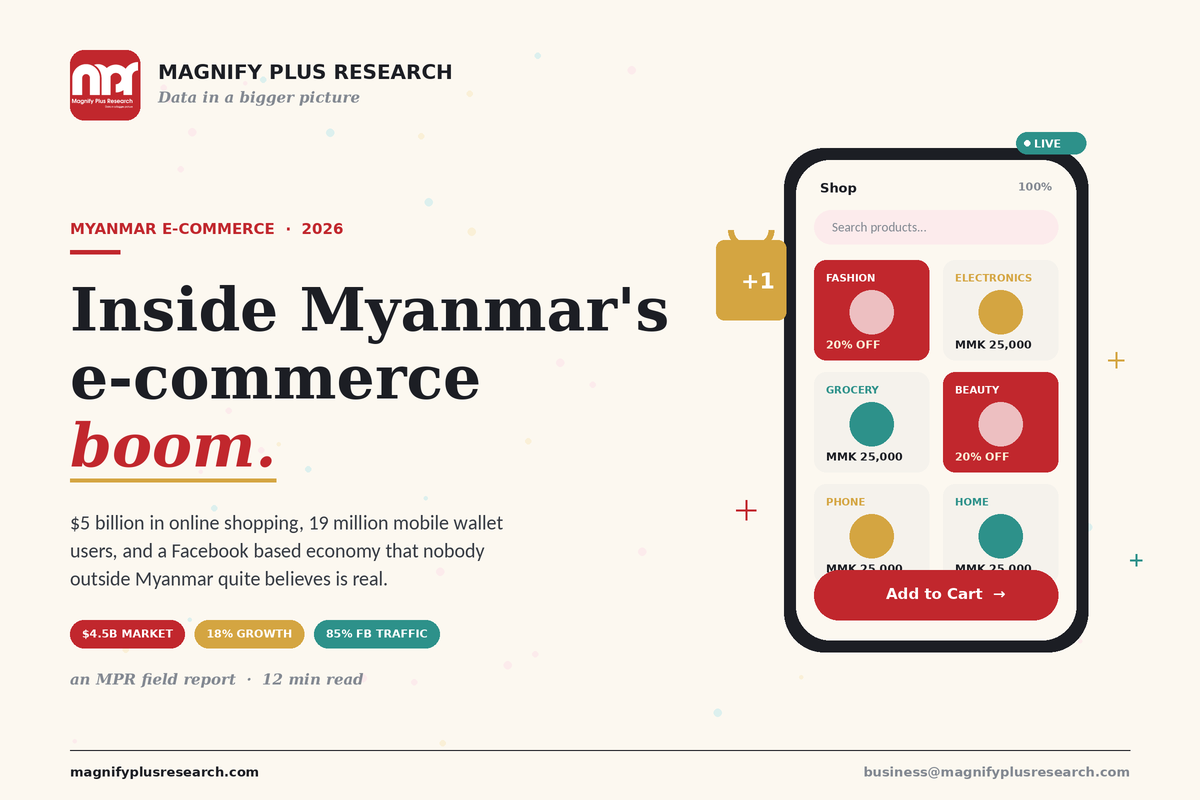
Here is a fact about Myanmar e-commerce that breaks regional brand teams’ brains.
The country has somewhere between four and five billion US dollars of online shopping activity. It has 19 million people walking around with an active KBZPay wallet in their pocket. And the single most important e-commerce platform in the country, by a long margin, is not a marketplace app. It is a Facebook page. With a person on Messenger. Who takes cash on delivery.
If you came to this article from a regional dashboard expecting a Lazada and Shopee story, take a breath. Myanmar is doing its own thing. The major regional marketplace that did try, Shop.com.mm, the Daraz backed platform, has exited the market. The other early formal player, rgo47, has faded out of relevance. What is left of the formal marketplace layer is a small set of names that real Myanmar shoppers actually use, and a much larger informal layer that almost no regional dashboard captures.
This is a field report from where we sit, between Yangon and Mandalay, watching the carts fill up. Sources for every figure are at the bottom. Pour a coffee.
How Big, How Fast
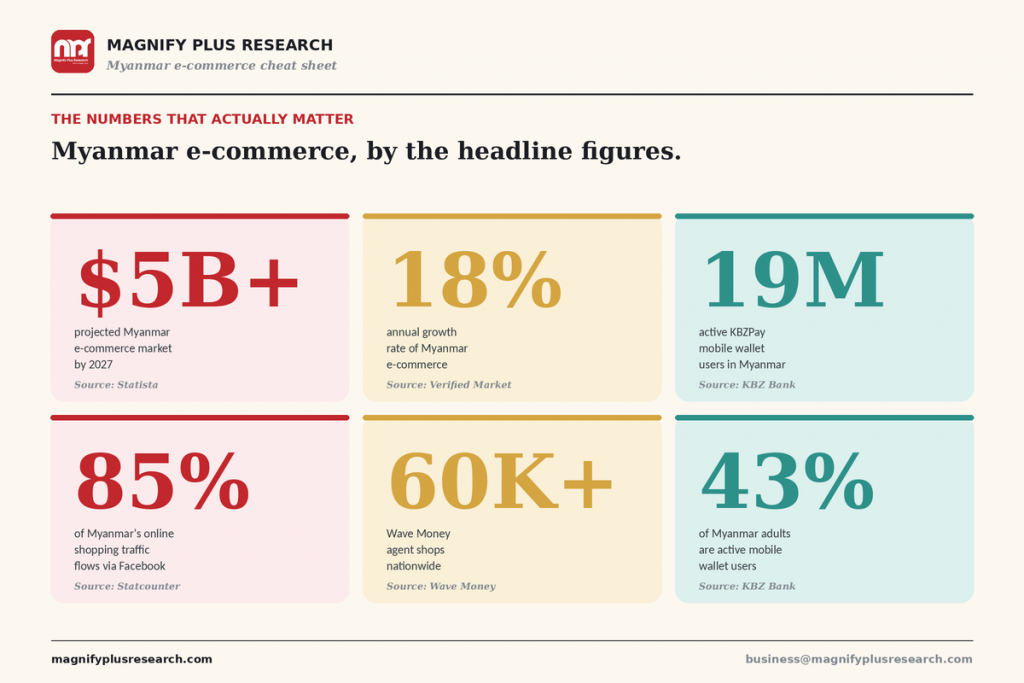
Start with the size. Different research houses count Myanmar’s online economy differently, but the consensus shape is the same. The Myanmar e-commerce market is projected to reach a valuation of approximately 4.5 billion US dollars by the end of 2025, growing at an annual rate of over 18%. Statista’s longer view pegs the eCommerce market in Myanmar to grow by 13.21% (2023 to 2027), resulting in a market volume of US 5.14 billion by 2027. The wider digital commerce category, including digital services, is projected to grow by 25.75% (2024 to 2029) resulting in a market volume of US 5.66 billion in 2029.
Translate the numbers. Myanmar online shopping is roughly doubling on a five year view, in a country where official GDP has been wrestling with currency volatility, inflation, and supply chain frictions the whole way through. That is not a small thing. Consumers are choosing to buy online faster than the macro environment would predict. That is a behavior shift worth paying attention to.
Two reasons it is happening, both at the same time.
One, the phones are everywhere. Myanmar is mobile first to a degree that still surprises foreign visitors. Browsing, comparing, paying, and conversing with sellers all happen on a phone screen. The desktop e-commerce experience, in the way it exists in Singapore or Bangkok, barely exists here.
Two, the wallets caught up to the phones. The number of active KBZPay users jumped by four million in 2024, to reach 19 million in total across Myanmar, representing 43% of the adult population. Add Wave Money on top of that, with over 60,000 Wave Shops nationwide and the Wave App as its dedicated mobile wallet, and you have the two giants moving most of the digital money. CB Pay and AYA Pay, the bank backed wallets, are pushing aggressively for share in 2026. Half the adult population is moving money digitally, every day, on rails that did not really exist a decade ago. E-commerce was waiting for this. The wallets unlocked it.
And then in 2025 the Central Bank of Myanmar dropped MMQR, the national QR code payment standard. Suddenly any wallet could pay any merchant through a single, standardized QR. That is a quiet, profound piece of infrastructure. It means the consumer no longer has to care which wallet the seller accepts. They scan the same code with whatever app they have. For e-commerce, that removes one of the last meaningful friction points at checkout.
The Plot Twist: This Whole Thing Runs on Facebook
The thing regional templates get most wrong about Myanmar is the channel mix.
In Indonesia, you talk about Shopee and Tokopedia. In Thailand, Lazada and Shopee. In Vietnam, Shopee and TikTok Shop. In Myanmar, you have to talk about Facebook first, Messenger second, and the marketplace apps a distant third. In fact, Facebook is one of the main platforms people use to sell their products, as it takes up 85% of online traffic per a statcounter study.
Walk this through. A consumer in Mandalay sees a product on a Facebook page. She messages the seller in Burmese. They negotiate price and delivery. She pays cash to a courier when the parcel arrives, or scans an MMQR code with whichever wallet she has if she trusts the seller. None of this transaction touches a marketplace platform’s shopping cart. None of it gets counted in the way Statista counts e-commerce in Jakarta. It still happens, millions of times a month, and it is the dominant model by a long way.
The implication for brands is direct. If your Myanmar e-commerce plan starts with a Lazada style fulfillment integration and ends with a programmatic ads buy, you are optimizing for a channel that does not really exist here. Building a Myanmar e-commerce strategy without a serious social commerce play is like opening a Bangkok restaurant without Line or a Jakarta one without WhatsApp. Technically possible. Strategically odd.
Where Myanmar Actually Shops
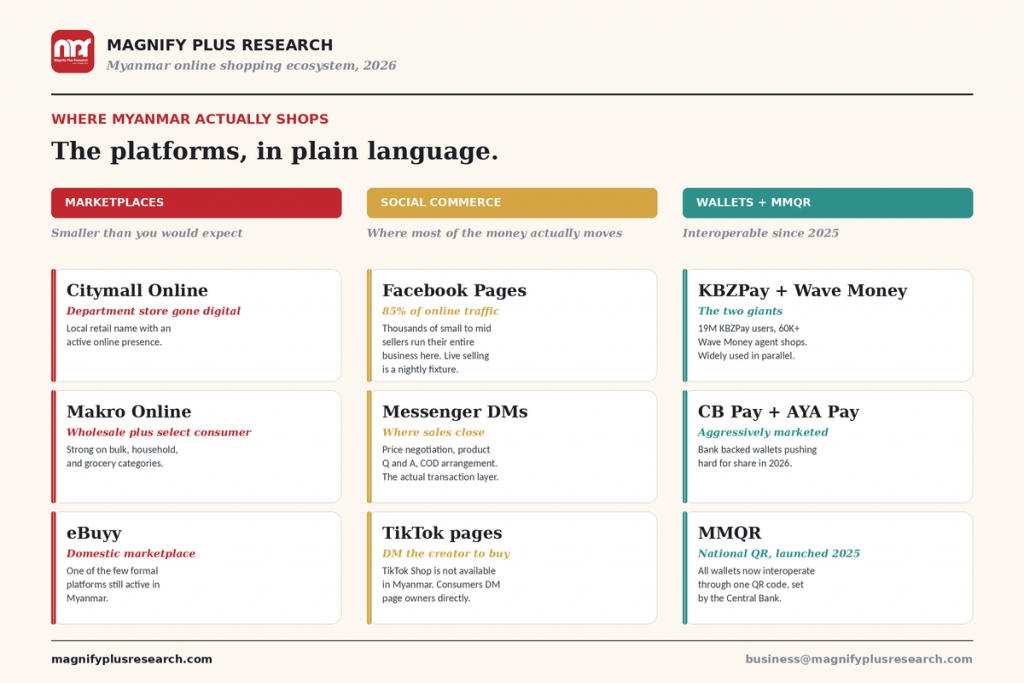
Here is the playing field, in plain language.
The formal marketplaces (smaller than you would expect). The list of formal marketplaces actively used by Myanmar consumers in 2026 is short. Citymall Online runs the digital arm of a recognized local department store. Makro Online serves bulk, household, and grocery categories. eBuyy is one of the few remaining domestic marketplace platforms with active traffic. That is roughly the picture. Shop.com.mm has exited Myanmar, rgo47 has lost relevance, and TikTok Shop is not available in this market. The clean formal marketplace experience that exists across the rest of the region simply has not consolidated here.
The social commerce layer (where most of the money moves). Facebook pages, Messenger DMs, and TikTok creator pages, with DMs as the actual transaction layer. A Myanmar brand without a social commerce operation is leaving most of the addressable e-commerce market on the table. A foreign brand without a social commerce partner is, depending on category, leaving an even bigger share. Important detail on TikTok, since the regional template gets this wrong: TikTok Shop is not live in Myanmar. Consumers discover products on creator pages and TikTok lives, then DM the page owner to buy. The actual purchase happens the same way Facebook commerce does, in a chat thread, with COD or a wallet payment at the end.
The wallets and MMQR. KBZPay and Wave Money are the two giants, with 19 million active KBZPay users and 60,000 plus Wave Money agent shops nationwide. They are used in parallel by most consumers. CB Pay and AYA Pay are the bank backed wallets being aggressively marketed in 2026. And sitting on top of all of them, MMQR, the national QR payment system launched in 2025 by the Central Bank, makes every wallet interoperate. One QR, any wallet, any merchant. For e-commerce this is the unlock the market has been waiting for.
Last mile. Foodpanda still operates in food, with a long tail of local couriers, motorbike networks, and bus express services handling parcels. Last mile remains the weakest part of the experience, which is also where the differentiation is for any brand willing to invest.
What Categories Are Winning
Different shapes of online demand are emerging across categories in Myanmar, and a few patterns are clear enough to call out.
Mobile and electronics. The category that grew up online first in Myanmar, and still the comfort zone for high ticket online shopping. Consumers compare specs and prices across multiple Facebook sellers before deciding. Brand and seller trust both matter.
Fashion and beauty. Heavily social, heavily live. Live selling sessions on Facebook Live for Burmese audiences are now a routine evening fixture. TikTok creator pages are increasingly important for product discovery, with the actual sale happening in DM. Influencer driven product launches in fashion and beauty regularly outperform traditional retail launches in reach, if not yet in conversion.
Groceries and FMCG. Slower to migrate online for habitual purchases, but accelerating. Makro Online has taken a share of the bulk and household category. The grocery story is partly a city story (Yangon ahead, Mandalay catching up, rural townships still firmly traditional trade) and partly a logistics story.
Home and appliances. A surprising bright spot. Consumers willing to commit to higher ticket online purchases when the brand and seller credibility line up, and when COD or an installment option is on the table.
Buy Now Pay Later style options. Still nascent in Myanmar relative to the rest of the region, but the conditions for it are in place. The brand or fintech that gets this right will unlock a meaningful slug of higher ticket online demand.
What Works and What Does Not
A few observations from the field, blunt edition.
Cash on delivery still rules. It is not the future. It is the present. Brands that try to force prepaid only checkout flows on Myanmar consumers, often because their regional template assumes a different trust environment, leave conversion on the floor. Build for COD as the primary path. Treat digital prepay as the upgrade, helped along by the MMQR interoperability.
Delivery promises kept beat delivery promises made. Overpromising delivery windows is the single most common consumer complaint in Myanmar online shopping, and it shows up in our social listening every week. Quiet, reliable, twice as long as you would brag about is better than fast, public, and frequently late.
Live selling beats static product pages. A Facebook Live with a seller talking through a product in Burmese, taking questions in real time, and dropping a price for the next ten minutes, outsells a polished static product card by margins that surprise regional brand teams every time we share the data. Live is not a tactic in Myanmar. It is a channel.
Burmese language descriptions matter more than you think. Product titles, descriptions, and customer service in Burmese convert dramatically better than the same content in English. Even on platforms where consumers can read both, Burmese signals trust and seriousness. English signals “I do not really care about you.”
Returns are the trust battleground. Myanmar consumers have learned to be cautious about online quality because they were burned in the early years of formal e-commerce. Generous, visible, fast return policies disproportionately reward the brands that offer them.
The Influencer and Live Commerce Boom
Live commerce, the blend of live streaming and instant purchase that took China by storm, has quietly become a big deal in Myanmar over the last two years. The format suits the market structurally. Burmese consumers like to ask questions before buying, like to see a product demonstrated by a real person, and like the social proof of watching other viewers buy in real time. Live selling delivers all three.
The interesting variant is that Myanmar live commerce is less centralized than China or Thailand. It is not dominated by a handful of mega influencers on a single platform. It is a wide layer of small to mid scale sellers running their own Facebook Live sessions, three to five nights a week, with audiences of a few hundred to a few thousand each. TikTok creators run a similar playbook on their own pages, with the buy happening in DM rather than through a built in shop button. The aggregate is enormous. The visibility, for foreign brand teams looking at platform dashboards, is low.
Which is exactly the kind of asymmetry that makes Myanmar market research valuable. The signal is there. You just have to look at it through Burmese eyes.
Why This Should Matter to Your Brand Plan
A few practical takeaways.
For foreign brands considering Myanmar, accept that the channel mix you planned for is probably wrong. A Myanmar e-commerce play should over index on social commerce, Facebook Live capability, Messenger conversational sales, TikTok creator partnerships with DM driven conversion, and reliable COD logistics. Marketplace presence is optional. Social commerce capability is not.
For Myanmar brand owners, the structural advantage is on your side. You speak Burmese. You can run live sessions in language. Your team is one Messenger thread away from any consumer in the country. Most of the unsolved problems in Myanmar e-commerce, returns, delivery reliability, trust at the high ticket end, are problems where a smart local brand outperforms a heavyweight foreign one every time.
For investors and consulting firms watching the market, the data you need probably does not exist yet in a form you can buy off a regional dashboard. It exists in the fieldwork that captures actual Burmese consumer behavior, the social listening that surfaces the unprompted conversation in Burmese, and the channel mapping that follows real money through real platforms. Which is the kind of market research in Myanmar that MPR exists to do.
How MPR Helps
We are Magnify Plus Research, the market research arm of the Magnify Group, based in Yangon. We field consumer studies across Myanmar, run brand health and category tracking, and integrate with Magnify Group social listening built on Burmese language natural language processing. We work with foreign entrants, regional consulting firms, Myanmar brand owners, and investors.
If you are figuring out an e-commerce or category play in Myanmar and want fieldwork, sizing, or social signal that actually reflects how Burmese consumers behave, we should talk.
Get in touch: business@magnifyplusresearch.com
Frequently Asked Questions
How big is Myanmar’s e-commerce market in 2026? Estimates from Verified Market Research put the market at around 4.5 billion US dollars by end of 2025, growing 18% annually. Statista forecasts roughly 5.14 billion by 2027 and 5.66 billion in digital commerce overall by 2029.
What is the most popular online shopping platform in Myanmar? By transaction volume, it is not a platform in the formal sense. Around 85% of online shopping traffic flows through Facebook, with the actual sale closing in Messenger. Among the formal marketplaces still active in Myanmar, Citymall Online, Makro Online, and eBuyy are the names that get used. Shop.com.mm has exited the market and rgo47 has lost relevance.
Is TikTok Shop available in Myanmar? No. TikTok Shop is not live in Myanmar. Myanmar consumers use TikTok as a discovery and live selling channel, then DM the creator or page owner directly to arrange the purchase, much like Facebook commerce.
What payment methods do Myanmar online shoppers use? Cash on delivery is still the dominant payment method. KBZPay (around 19 million active users) and Wave Money (over 60,000 agent shops) are the leading mobile wallets and are widely used in parallel. CB Pay and AYA Pay, the bank backed wallets, are being aggressively marketed in 2026. MMQR, the national QR code system launched in 2025 by the Central Bank, now lets any wallet pay any MMQR enabled merchant through one standardized code.
Is Myanmar e-commerce mobile first? Yes, decisively. Browsing, purchasing, paying, and customer conversations all happen on mobile. Desktop e-commerce in Myanmar barely exists at scale.
What sectors are growing fastest in Myanmar online shopping? Mobile and electronics, fashion and beauty (heavily via live selling on Facebook and TikTok pages), home and appliances, and increasingly groceries and household via Makro Online and social sellers in urban centers.
Does live commerce work in Myanmar? Yes, especially Facebook Live and TikTok creator lives. Myanmar live commerce is less dominated by mega influencers than China or Thailand, with a wide base of small to mid scale sellers running regular live sessions in Burmese. The purchase typically happens in a DM thread after the live.
How can I research the Myanmar e-commerce market reliably? Through primary fieldwork in Burmese, social listening with Burmese natural language processing, and channel mapping that captures both the small formal marketplace layer and the much larger informal social commerce layer. Magnify Plus Research designs research programmes around exactly these questions. Reach us at business@magnifyplusresearch.com.
About the author: [BYLINE PLACEHOLDER, Name, role, credential line, headshot, LinkedIn.]
Get started: Want a sharper view of Myanmar’s e-commerce opportunity for your category? Email business@magnifyplusresearch.com.
Sources, DataReportal Digital 2026 Myanmar, Verified Market Research Myanmar ICT Market, Statista Myanmar eCommerce, 6Wresearch Myanmar E-commerce Market, FinanceAsia KBZ Bank 2025, Wave Money Myanmar, Central Bank of Myanmar MyanmarPay, Statcounter Myanmar traffic data, MPR field intelligence.