

Most of the worst decisions we have watched brands make in Myanmar were made with research on the table.
That is the uncomfortable part of this business. Bad market research in Myanmar is not the absence of data. It is the presence of confident, polished, technically valid looking data that turns out to have been answering the wrong question, with the wrong sample, in the wrong language. By the time the launch curve flatlines or the partnership underperforms, the deck is filed and the team has moved on. The lesson, if it gets learned at all, gets learned the hard way.
This is a field note, not a guide. We have written the guide separately. What follows are five mistakes we see repeatedly in Myanmar market research, in roughly the order of frequency they cost brands real money, and the discipline that fixes each. Some of this will be uncomfortable reading for anyone who has commissioned a study in this market in the last few years. That is the point.
The Five Mistakes
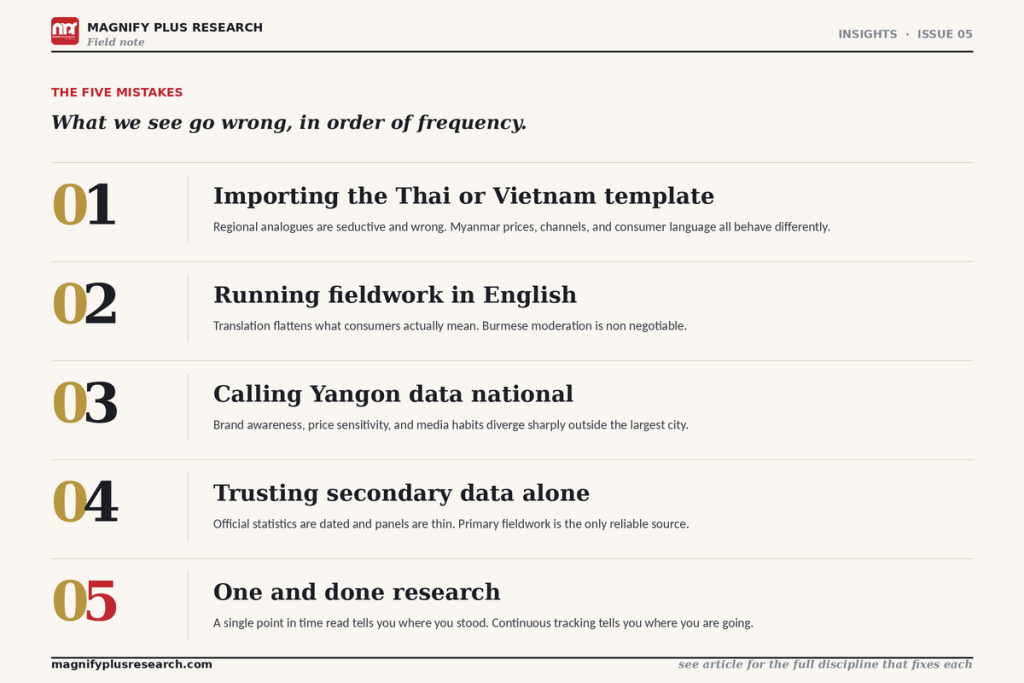
01. Importing the Thai or Vietnam template
This is the most common mistake and the most expensive. A regional consumer team produces a beautiful study run across five ASEAN markets, gives Myanmar a 200 person online sample because it is hard to field, and treats the result as comparable to the 2000 person face to face study in Thailand.
It is not comparable. Myanmar consumers price categories differently, talk about brands differently, buy through different channels, and respond to different cues. Treating regional templates as transferable produces numbers that look reassuringly similar to the rest of the region because they were measured the same way. They are not similar. The instrument flattened the difference.
The discipline that fixes it. Design the Myanmar study around the Myanmar question. Where regional comparability matters, build it in with parallel benchmarks rather than a copy paste template. Where it does not, drop the template entirely.
02. Running fieldwork in English
The fastest way to commission unreliable research in Myanmar is to insist that interviews, surveys, or focus groups happen in English because the global team needs to read the transcripts. We see this more often than we should.
Burmese is a language of indirectness, politeness, and hierarchical cues. A respondent talking to a researcher in English will simplify, soften, and self edit in ways they would not in Burmese. The resulting transcript is technically a transcript. It is also a smoothed out, agreed upon, slightly false version of what the consumer actually thinks.
The discipline that fixes it. Fieldwork in Burmese, moderated and analyzed in Burmese, with English language reporting and verbatims translated by the same team that ran the work. The transcript layer in English is a deliverable, not the research itself.
03. Calling Yangon data national
Yangon is around 12% of Myanmar’s population. It is the easiest place to recruit, the densest market for any consumer category, and the part of the country that looks most like the regional analogues most teams have benchmarks for. None of which makes it a representative read of the national consumer.
We have seen Yangon only studies used to size national markets, set national pricing, and validate national distribution strategies. The numbers were not wrong about Yangon. They were just wrong about the country. Brand awareness, category penetration, price sensitivity, and media habits diverge sharply between Yangon, Mandalay, Naypyitaw, and the secondary cities. A national conclusion drawn from one city is structurally biased.
The discipline that fixes it. Multi metro fieldwork as the default. Yangon, Mandalay, and Naypyitaw as the standard floor, with extended coverage to secondary cities and selected rural townships when the question requires it. If a study cannot afford to go outside Yangon, say so on the cover slide, and limit the conclusions to Yangon.
04. Trusting secondary data alone
The Myanmar secondary data environment is thin. Government statistics are dated. Syndicated panels are limited. Global research databases under cover the country. A small handful of headline figures get recycled across reports until they look like established truth.
A surprising number of strategic decisions in this market are still made on the back of those recycled figures, sometimes through expensive consulting reports that turn out to be re packaging the same secondary sources. Secondary data is useful for framing a question. It is not enough to answer one in Myanmar.
The discipline that fixes it. Treat secondary data as the literature review, not the answer. Every meaningful strategic conclusion in this market should be triangulated against primary fieldwork or fresh stakeholder validation.
05. One and done research
A single point in time study tells you where your brand stood on the days the fieldwork ran. In a stable category in a slow moving market, that may be enough for a year. Myanmar is neither.
Inflation reshapes price elasticity. Distributors re align. Platforms shift. A Gen Z trend matures into a millennial habit. Brands that commissioned an annual U and A study three years ago and have not refreshed it since are operating on a snapshot that no longer matches the market. Sometimes the snapshot was correct. The market moved.
The discipline that fixes it. Pair annual deep dives with continuous tracking and social listening. A quarterly read on the metrics that matter beats a once a year photo. Our flagship Consumer Pulse runs on this premise, and so do most credible brand health programmes.
What Stops Working, and What Works Instead
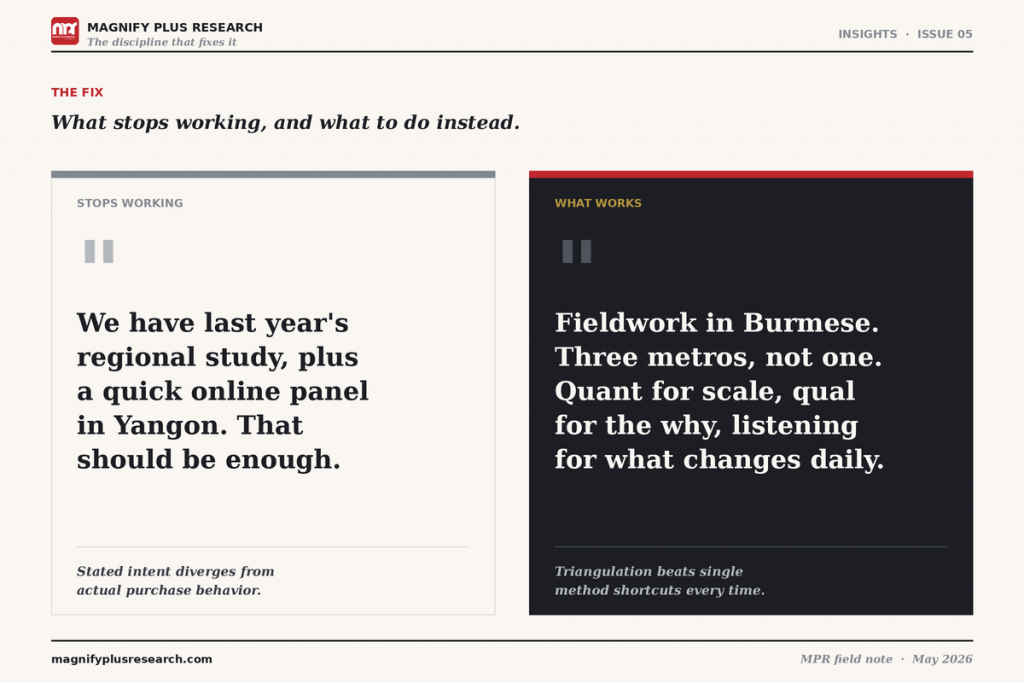
Read those five mistakes together and a pattern shows up. The mistakes share a logic, which is the logic of shortcut. Use the regional template, skip the language layer, sample only where it is easy, lean on what already exists, do it once and move on. Each shortcut looks reasonable on a project timeline and reasonable on a budget. Together, they produce a body of research that systematically tells brands what they want to hear.
The discipline that fixes all five is roughly the same. Slow down at the design stage, frame the question carefully, field in the language and the regions where the consumer actually lives, and treat market intelligence as a continuous capability rather than a one off purchase. None of that is exotic. It is just harder than the shortcut, and the firms that do it are the ones whose research holds up when the launch is in market and the questions get sharper.
What This Looks Like for Foreign Entrants and Local Brand Owners
For foreign entrants, the fix usually means resisting the regional research team’s instinct to treat Myanmar as a slot in an ASEAN template. The market either deserves a custom design or it deserves an honest disclaimer on the regional study. There is no defensible middle.
For Myanmar brand owners, the fix is different and more interesting. You have a structural advantage your foreign competitors do not have, which is proximity to the consumer you serve. Most local brands underuse it. A modest continuous tracking programme, a quarterly Burmese language listening read, and an annual qualitative deep dive will give you a clearer picture of your category than the consultant report your foreign competitor is buying. The data is closer. Use it.
How We Think About This at MPR
MPR exists because we kept watching the five mistakes above happen, and because the response we wanted to give clients was “this study was always going to mislead you, here is what the design should have been.” That is not a comfortable conversation to have after the fact. It is a much better conversation to have at the brief stage.
Our standard programmes field in Burmese across Yangon, Mandalay, and Naypyitaw, with extended coverage available. We triangulate quantitative scale with qualitative depth and Magnify Group social listening in Burmese natural language processing. We report sample, methodology, and limitations openly on every deliverable. And we say no to study designs that we believe will not survive contact with the question being asked, even when saying yes would be easier commercially.
If that sounds like the kind of research partner your next decision needs, you know where to find us.
Frequently Asked Questions
What is the biggest mistake brands make with market research in Myanmar? Treating Myanmar as a sub market of a regional template. The market is different enough in pricing, channels, language, and consumer behavior that regional analogues mislead more often than they help.
Is desk research enough for a Myanmar decision? No. Secondary data is useful for framing a question. Primary fieldwork is what answers it reliably in this market, because the secondary data environment is thin and dated.
Why does Burmese language fieldwork matter so much? Burmese politeness and indirectness norms shape how consumers express opinions. Research conducted in English flattens what people actually mean. Burmese moderation and analysis surfaces the truth that translation misses.
Can I trust a study that only covers Yangon? For a Yangon decision, yes. For a national decision, no. Brand awareness, price sensitivity, and consumer behavior diverge meaningfully outside Yangon. National conclusions drawn from Yangon only data are structurally biased.
How often should we re research the Myanmar market? Pair an annual deep dive with continuous tracking and social listening. The Myanmar consumer and category environment moves quickly enough that a one and done study is rarely sufficient for more than twelve months.
What does MPR do differently? Burmese language fieldwork as standard, multi metro coverage by default, methodological transparency on every deliverable, and a willingness to say no to study designs that will not answer the question being asked.
Get started: Planning a Myanmar research programme and want a sharper second opinion before you brief. Talk to MPR.
Sources, World Bank Myanmar overview, Asian Development Bank Myanmar economy, DataReportal Digital 2026 Myanmar. Field note draws on MPR engagements and Magnify Group social listening across Myanmar consumer categories.