Publications

Myanmar Market Entry Strategy: Navigating Business Culture & Consumer Behavior

Smart, grounded market entry strategy for Myanmar , built from real fieldwork, not slides. At Magnify Plus Research (MPR), we help companies assess and enter the Myanmar market by combining strategic sizing, key-informant interviews, and behavioral consumer insight. Our work is tuned for an environment where official data is thin, informal networks matter more than org charts, and the distance between Yangon and the rest of the country, economically and culturally, is wider than any map suggests.

Understanding the challenges of doing business in Myanmar requires more than desktop research. It demands local perspective and on-the-ground intelligence. Foreign companies in Myanmar succeed when they adapt their approach to the realities of Myanmar business culture and consumer behavior, and local brand owners win when they understand their own market with the same rigor a well-funded foreign entrant would bring.

The Challenge

Entering, or expanding within, the Myanmar market presents challenges that punish assumption. The upside is real: a young, mobile-first population of roughly 55 million, a consumer class concentrated in Yangon and Mandalay that is digitally fluent and brand-aware, and category after category where modern trade and organized competition remain shallow. But the operating environment is genuinely complex. Companies face elevated inflation and currency volatility (ADB; World Bank), fragmented distribution dominated by traditional trade, regulatory and import frictions, and consumer preferences that differ sharply by region, income tier, and language.

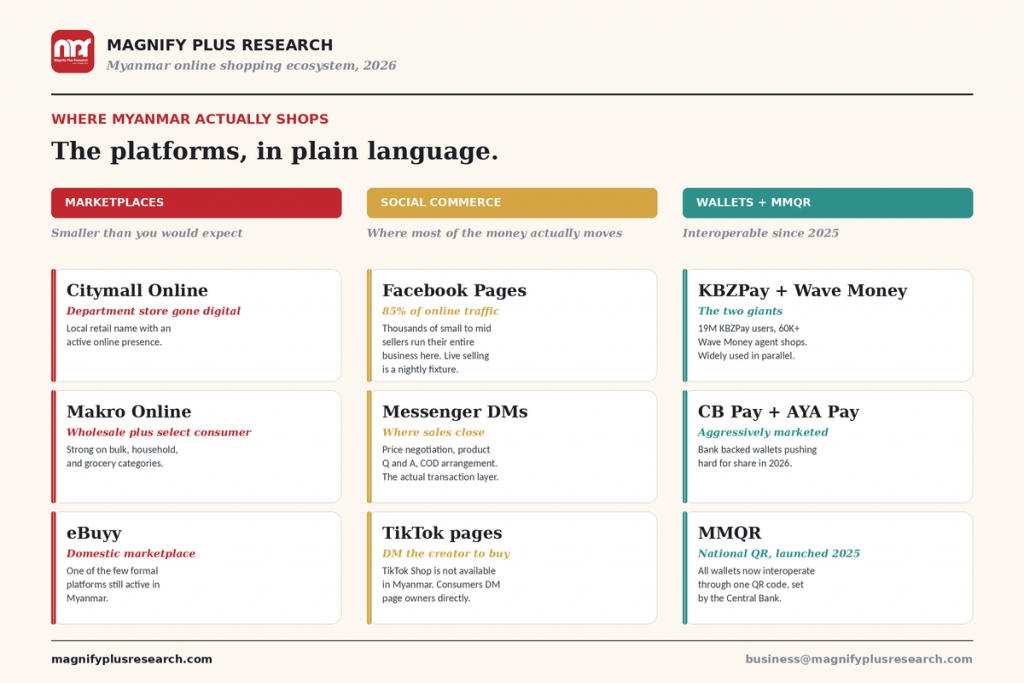
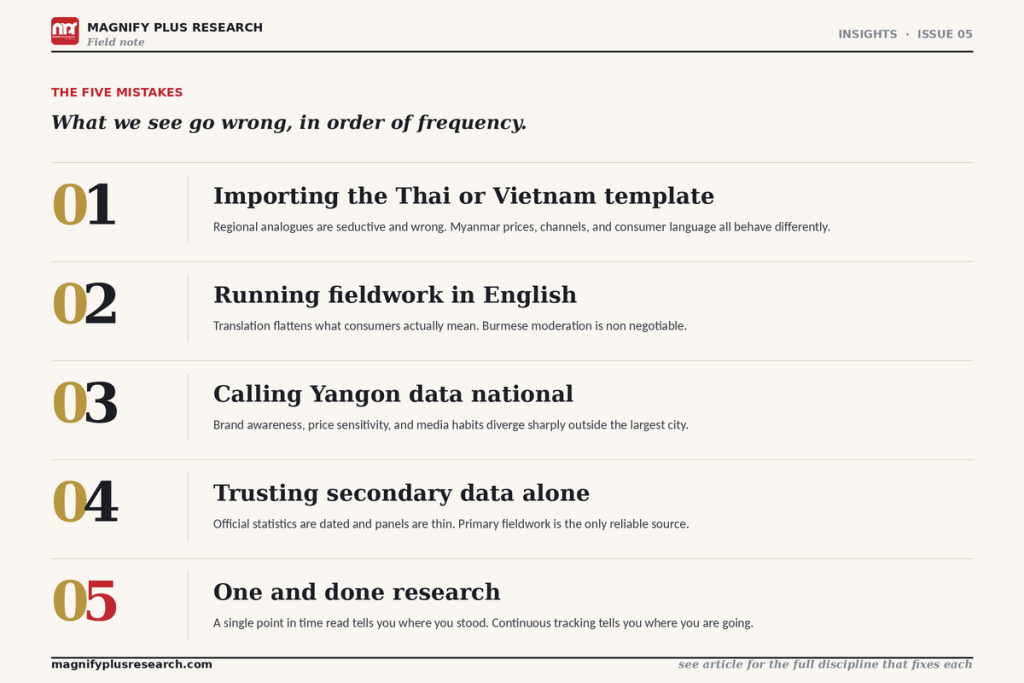
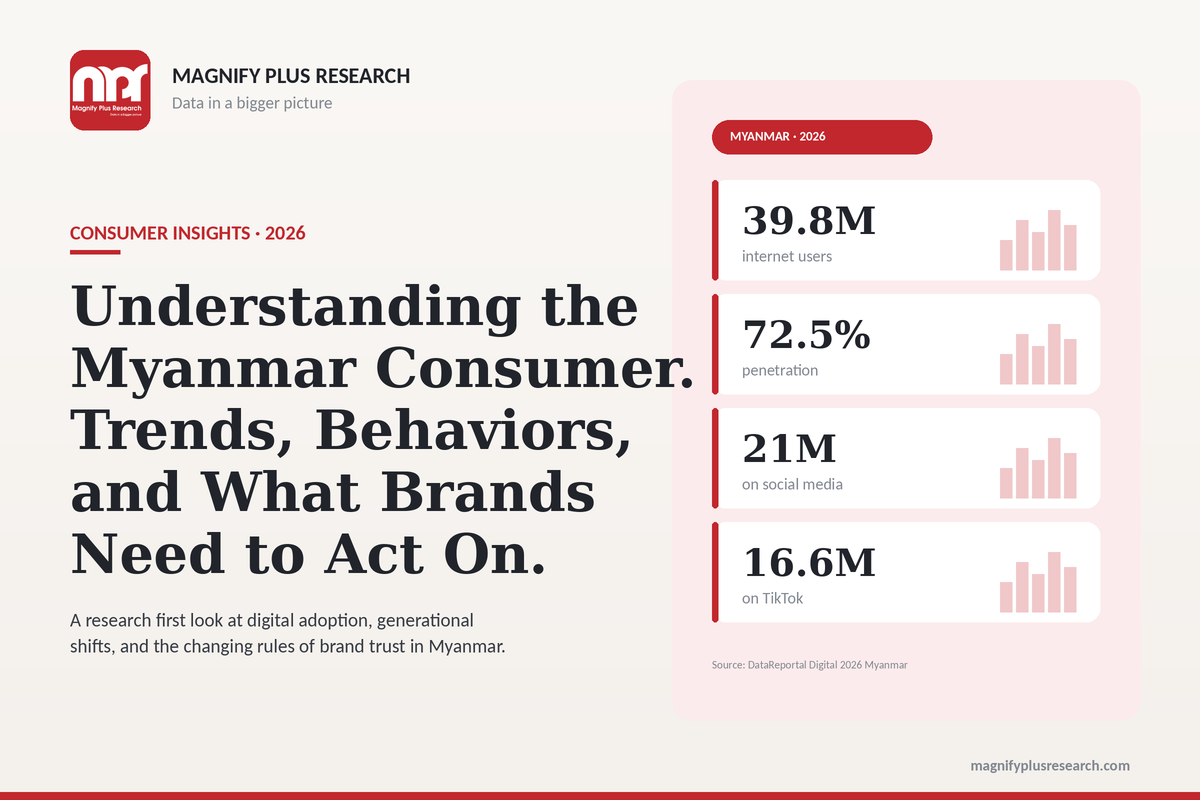
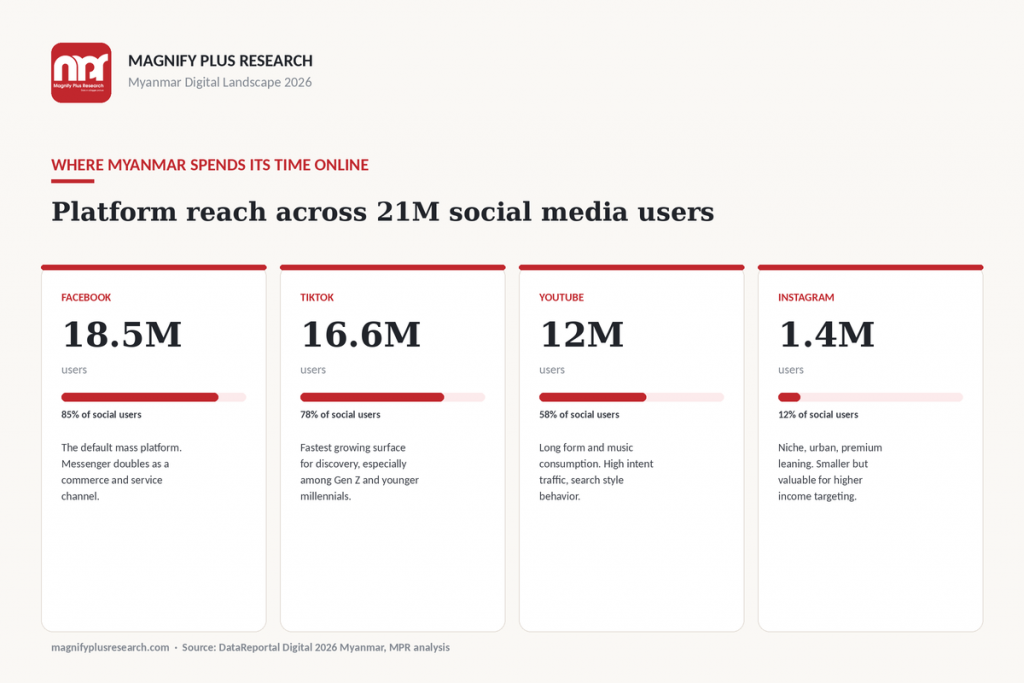
Many market entries in Myanmar underperform for a predictable reason: the plan was built on benchmarks imported from Thailand, Vietnam, or Indonesia, markets that look superficially similar but behave differently. Pricing logic that works in Bangkok breaks against Myanmar’s kyat volatility. A modern-trade-first channel strategy stalls in a market where the neighborhood shop and the wholesale township distributor still move the majority of volume in most FMCG categories. A social media plan built for Instagram misses a population that lives overwhelmingly on Facebook, Messenger, Viber, and TikTok (DataRportal , Digital 2026 Myanmar).

Whether you’re a regional FMCG group assessing distribution partnerships out of Yangon, an Asian consumer-electronics brand testing price elasticity in Mandalay, or a consulting firm mapping potential local partners for a client, the entry decision is only as good as the evidence underneath it.

What Myanmar Business Culture Means for Your Strategy

Myanmar business culture is relationship-led, hierarchy-aware, and trust-based. Several practical implications follow:

Relationships precede transactions. Distribution agreements, retail listings, and B2B sales in Myanmar are rarely won on a deck alone. Introductions, repeated face-to-face contact, and demonstrated long-term commitment carry weight. Key-informant interviews with distributors, wholesalers, and category veterans are often the fastest way to understand who actually controls access to shelf and territory, information no desk report contains.

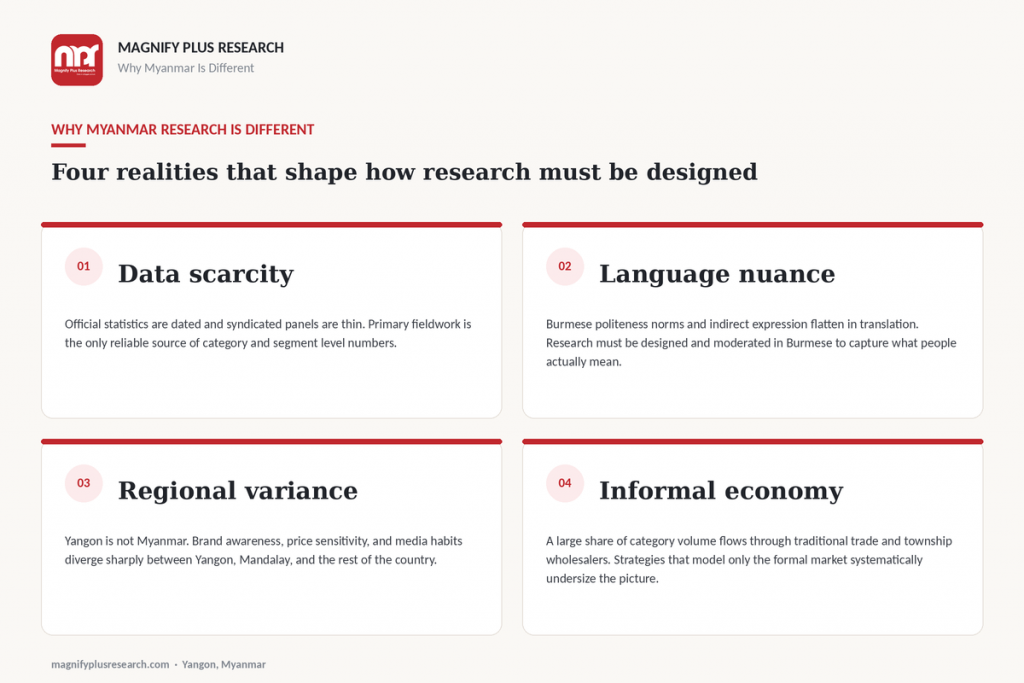
The informal economy is the economy. A large share of commerce runs through informal and semi-formal channels: traditional trade, township wholesalers, cross-border flows, and cash or mobile-money settlement. Entry strategies that only model the formal, documented market systematically undersize the opportunity, and miss the competitors who matter.

Trust is earned in Burmese. Brand communication, packaging, customer service, and research itself work better in Burmese. Consumers express opinions differently in their own language, with indirectness and politeness norms that flatten naive sentiment readings, one reason MPR built Burmese-language NLP for social listening rather than relying on translation layers.

Yangon is not Myanmar. Income, media habits, brand awareness, and price sensitivity diverge significantly between Yangon, Mandalay, secondary urban centers, and rural townships. A strategy validated only in Yangon is a strategy validated for perhaps a tenth of the population.

What This Means for Myanmar Brand Owners

Market entry strategy is not only a foreign-brand topic. If you own or run a Myanmar brand, the same toolkit applies in three situations , and acting on it early is a competitive advantage:

1. When foreign entrants are coming into your category. The best defense is knowing your consumer better than the entrant can. A current brand health read, awareness, consideration, loyalty drivers, and switching triggers by segment, tells you exactly where your franchise is defensible and where a well-funded newcomer could cut in on price, distribution, or image.

2. When you’re expanding into new regions or segments. Moving from Yangon into Mandalay and Upper Myanmar, or from mass into premium, is itself a market entry. Run the same discipline: size the segment, test concept and price with real consumers in that region, and map the distributor landscape before committing inventory.

3. When you want to partner with a foreign brand. Foreign entrants increasingly look for local partners who bring market intelligence, not just licenses and warehouses. A local owner who arrives with credible category data, market size, channel economics, consumer segmentation, negotiates from strength and is a more attractive partner.

An Actionable Pre-Entry Checklist

Before committing significant budget to entering or expanding in Myanmar, you should be able to answer these with evidence, not opinion:

  1. Size: What is the realistic addressable market , TAM, SAM, and a defensible SOM , using local data rather than regional analogues?
  2. Demand: Have real Myanmar consumers, in the target regions and income tiers, evaluated your concept, product, and price point?
  3. Channels: Which distributors and wholesalers control your category in each region, what margins do they expect, and who are they loyal to today?
  4. Competition: Who are the formal and informal competitors , including grey-market and cross-border supply , and at what price points?
  5. Communication: Where does your target consumer actually spend attention, and what does the conversation about your category sound like in Burmese?
  6. Risk: What are the regulatory, currency, and supply-chain exposures, and what trigger points would change your go/no-go decision?

If two or more of these answers rest on assumption, that is precisely the gap entry research exists to close, usually at a fraction of the cost of a failed launch.

Our Value

MPR’s Myanmar market entry research is especially valuable if you’re unsure how to enter or expand in the market, if you need something more grounded than recycled secondary reports, or if a previous attempt didn’t deliver what the projections promised.

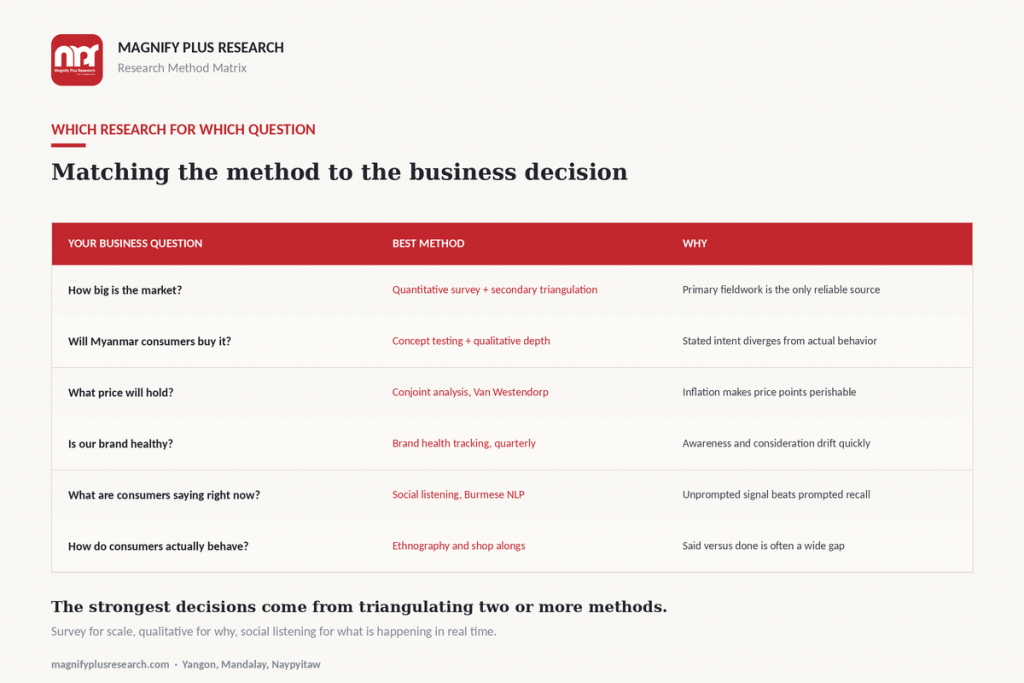
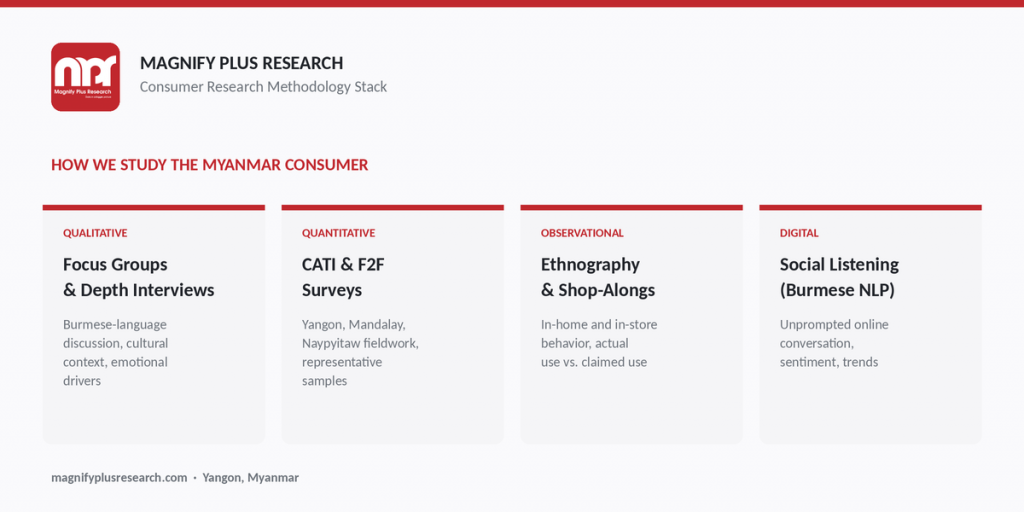
Each step in our process is informed by key-informant interviews and primary fieldwork , not guesswork. Our methodology mix is built for Myanmar’s data environment: CATI and face-to-face quantitative surveys across Yangon, Mandalay, and Naypyitaw; qualitative depth interviews and focus groups in Burmese; retail and channel mapping; and AI-assisted social listening with Burmese-language NLP to read the unprompted consumer conversation. Methodology, sample, and fieldwork dates are reported transparently on every study.

Unlike generic market reports, our approach integrates local expertise with international research standards. Having supported clients across FMCG, telecoms, financial services, gaming, and consumer durables, we understand both the formal and informal sides of doing business in Myanmar. Our bilingual team bridges the cultural gap so your strategy aligns with Myanmar business norms while protecting your brand’s core proposition.

Our market entry research serves as the foundation for strategic decision-making. Consulting firms and regional strategy teams partner with us to augment their advisory work with deep local intelligence: we don’t write your entry strategy for you , we provide the reliable, defensible evidence your strategists need to write it well. For businesses still at the sizing stage, our market entry research guide covers how to build a defensible market size calculation before committing to a full entry study. And before any entry strategy is defined, segmentation determines which consumers you are actually entering for , a question our Myanmar consumer trends analysis helps answer.

Frequently Asked Questions

How long does Myanmar market entry research take? A focused sizing-and-demand study typically runs 6,10 weeks from kickoff to report, depending on regional coverage and method mix. Channel and stakeholder mapping can run in parallel.

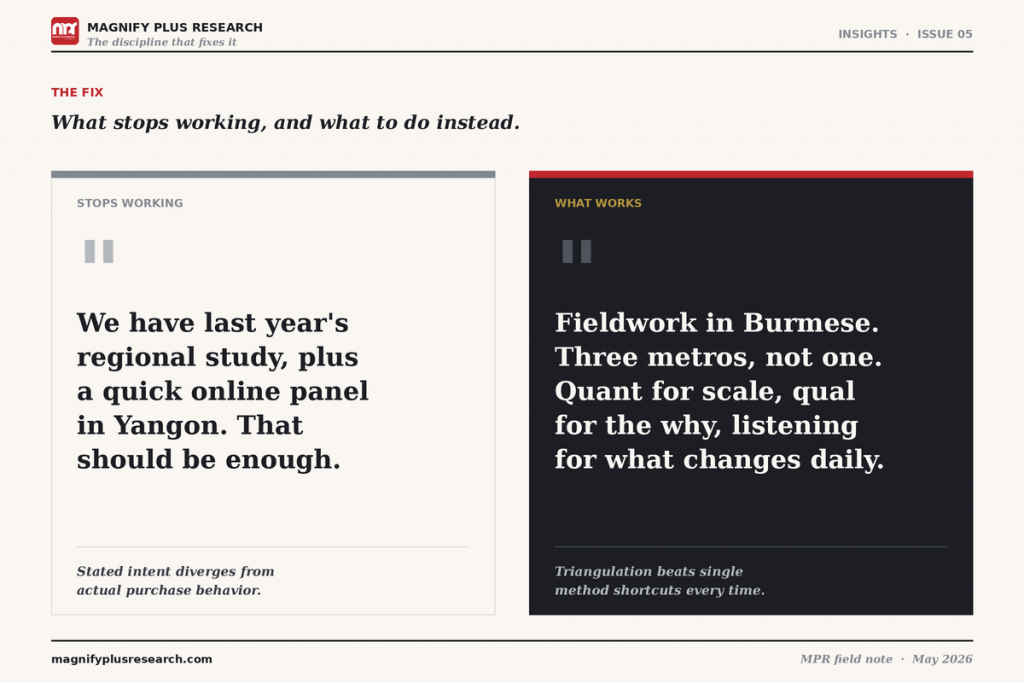
Can we rely on secondary data alone for an entry decision? Not in Myanmar. Official statistics are dated, the informal economy is large, and conditions change quickly. Secondary data frames the question; primary fieldwork answers it.

Does MPR research markets outside Yangon? Yes. Our fieldwork network covers Yangon, Mandalay, and Naypyitaw as standard, with extended coverage available for secondary urban and rural townships depending on study design.

We’re a local brand, not a foreign entrant , is this relevant to us? Directly. Regional expansion, premiumization, new category launches, and defending against incoming foreign brands all use the same entry-research toolkit.

Sources: World Bank Myanmar overview; Asian Development Bank Myanmar economy; DataReportal Digital 2026 Myanmar. Refresh all figures at publication.

Market Feasibility Study in Myanmar: The Go or No Go Validation

A feasibility study is the essential filter between ambition and reality. While a market entry strategy defines how you will enter Myanmar, through distribution partnerships, joint ventures, acquisitions, or a direct setup, a feasibility study answers a more fundamental question. Should this project proceed at all?

At Magnify Plus Research (MPR), we provide the objective, tactical validation required to make that decision with confidence. We act as the Go or No Go gate, stress testing your project against the economic, regulatory, and cultural realities of the Myanmar market before you commit significant capital, inventory, or partnership equity.

Too many companies launch in Myanmar on the back of optimistic projections, only to discover late, expensive friction points. Pricing resistance in a high inflation environment. Distribution dependence on a small set of established wholesalers. Concept features that translate poorly to Burmese consumer expectations. Each of these is identifiable in advance. That is what feasibility research is for.

Why Feasibility Studies Matter More in Myanmar

Three market conditions make rigorous feasibility validation especially important in Myanmar.

First, capital is expensive and the kyat is volatile. Currency swings and inflation, which the Asian Development Bank and World Bank both flag in their recent Myanmar updates, mean that a launch built on stale price assumptions can lose its margin before it ships its first batch. Pricing and unit economics need to be tested against current consumer willingness to pay, not against last year’s benchmarks.

Second, the data environment is thin. Official statistics are dated, syndicated panels are limited, and secondary reports often recycle the same handful of headline figures. A feasibility study built only on desk research is a feasibility study built on assumption. Primary fieldwork is the only reliable source of category and segment level numbers in Myanmar.

Third, the country is operationally complex. Distribution is fragmented across modern trade, traditional trade, township wholesalers, and informal channels. Regulation can shift. Logistics costs and lead times need to be modeled honestly. None of this is a reason to avoid Myanmar. It is a reason to validate before you commit.

The Three Pillars of a Myanmar Feasibility Study

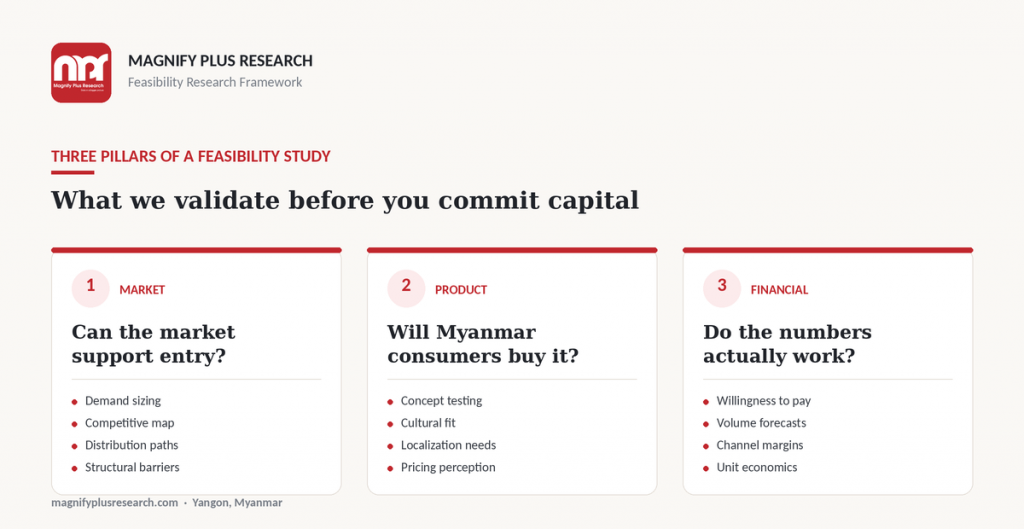
Three pillars of an MPR feasibility study

We focus on commercial viability and remove speculation by replacing it with primary, verified evidence. Every feasibility programme at MPR is built on three pillars.

1. Market and Project Feasibility

We evaluate the structural environment to determine whether the Myanmar market can realistically support a new entrant in your category.

Demand quantification. Calculating actual market appetite through consumer surveys and purchase intent modeling, not just regional analogues or secondary estimates. We size the addressable market, the segments inside it that are realistically reachable, and the share of that opportunity a credible entrant can capture in years one through three.

Competitive landscape. Identifying where the real service gaps lie and which consumer pain points remain unaddressed. The output of this is binary in practice. You are either entering a saturated space or finding genuine white space, and the answer changes everything downstream.

Structural barriers. Evaluating distribution bottlenecks, regulatory complexity, import friction, and the informal rules of access that govern success in Myanmar. Foreign brands often discover these the slow way. Feasibility research surfaces them in weeks, not quarters.

2. Product Feasibility

We validate product market fit inside Myanmar’s cultural and consumer context before you commit to launch volumes.

Concept and experience validation. Testing whether your product’s features and benefits align with how Myanmar consumers actually think about your category. Priorities that look universal from a regional HQ often invert in Yangon and Mandalay. What matters most to a Bangkok or Jakarta consumer may be a tertiary consideration locally, and the reverse.

Localization requirements. Identifying necessary adjustments in packaging size, formulation, language, payment options, or feature set. Burmese consumers respond to specific signals around value, quality cues, and trust. Our product feasibility work pinpoints exactly which adjustments are required and which are over engineering.

Cultural friction points. Uncovering the psychological or behavioral barriers that can quietly suppress adoption. Family approval dynamics in higher consideration purchases. Cash versus mobile money behavior at the point of sale. Habits around brand trial, recommendation, and word of mouth that are stronger here than digital analytics will ever show.

Price and value perception. Testing whether your proposed pricing aligns with perceived value. Premium positioning, mainstream value, and accessible entry tiers each require different validation, and the gap between what consumers say they will pay and what they actually pay narrows considerably with the right instrument design.

3. Financial and Commercial Feasibility

We deliver the market intelligence that drives realistic financial projections. A financial feasibility study built on optimistic inputs creates false confidence and protects no one.

Willingness to pay analysis. Determining optimal price points through conjoint analysis, pricing sensitivity research, and Van Westendorp style modeling. We identify the ceiling at which consumer demand collapses and the floor below which margin disappears.

Revenue modeling inputs. Providing realistic volume forecasts based on intent to buy data, adoption curve assumptions appropriate to your category, and segment level conversion benchmarks. The output is a revenue model your finance team can actually defend, not a hopeful projection.

Customer acquisition economics. Evaluating acquisition costs against projected lifetime value under Myanmar conditions. Distribution costs, retailer margins, and media costs differ meaningfully from regional norms. The same campaign that works in Bangkok will rarely have the same unit economics in Yangon.

The MPR Feasibility Process

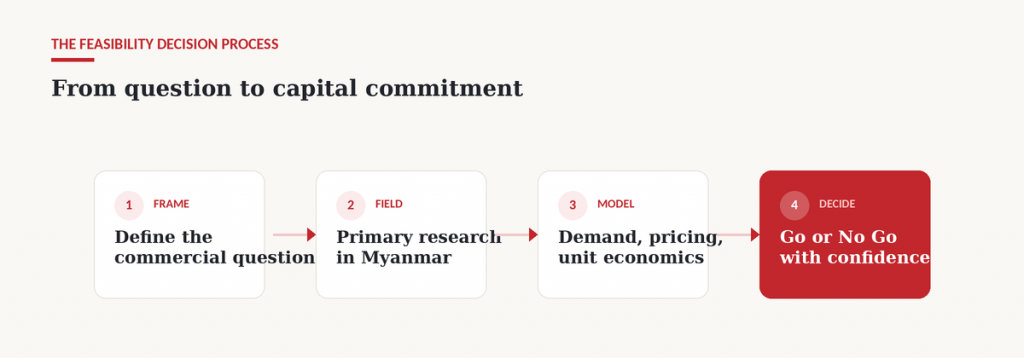
MPR feasibility decision process

Every MPR feasibility programme runs through the same four stages, scoped to the size and complexity of the decision being made.

Frame. A short scoping phase to define the commercial question precisely. Are we testing whether the market exists, whether the product fits, whether the price holds, or all three? The clearer the question, the cleaner the answer.

Field. Primary research in Myanmar, designed around the question. Typically a mix of qualitative depth in Burmese, a representative quantitative read across Yangon, Mandalay, and Naypyitaw, and, where appropriate, retail and distributor mapping or social listening to validate the demand signal against unprompted conversation.

Model. Translating fieldwork into demand sizing, price elasticity ranges, and the unit economic inputs your finance team needs. We provide the numbers and the reasoning behind them, so the model holds up under scrutiny.

Decide. A clear, written recommendation. Go, No Go, or Go conditional on specific changes, with the evidence behind it and the trigger points that would change the recommendation if the market shifts.

When a Feasibility Study Pays for Itself

Three commercial scenarios where feasibility research is the highest leverage research a brand can buy in Myanmar.

Before a new market launch. The cost of a failed launch, written off inventory, exited distributor relationships, and brand damage, is many times the cost of validating the launch first. This is the classic feasibility use case.

Before a category extension or premium move. Stretching an existing brand into a new segment or price tier is a launch in everything but name. The same validation discipline applies, and skipping it tends to be more costly because internal teams over rely on existing brand equity.

Before a partnership or acquisition. If you are acquiring a local brand or signing an exclusive distribution agreement in Myanmar, independent feasibility research gives you a defensible read on the asset’s actual market position, not the position the seller is presenting.

What This Means for Myanmar Brand Owners

Feasibility research is not only for foreign entrants. If you are a Myanmar brand owner, three uses apply directly.

  1. Validate before you scale. Before you commit production volume to a new SKU, regional expansion, or premium line, run a focused feasibility study. The investment is small relative to the cost of getting it wrong.
  2. Pressure test partnership offers. When a regional player approaches you about distribution or co branding, an independent feasibility read tells you what the deal is actually worth.
  3. Defend pricing. In an inflationary environment, willingness to pay research lets you reprice with evidence rather than hope.

Frequently Asked Questions

How long does a feasibility study in Myanmar take? A focused feasibility programme typically runs six to ten weeks from kickoff to final report, depending on the number of pillars in scope and the geographic coverage required.

Is a feasibility study the same as a market entry strategy? No. A market entry strategy defines how to enter. A feasibility study decides whether to enter. The two are sequential. Feasibility comes first.

Can MPR run feasibility research outside Yangon? Yes. Yangon, Mandalay, and Naypyitaw are standard. Secondary urban and selected rural coverage is available depending on study design.

What does MPR deliver at the end of a feasibility study? A written recommendation, a market sizing model, a pricing and unit economics input pack, a competitive and distribution map, and the underlying fieldwork data. Everything your strategy and finance teams need to act.

Get started: Considering a launch, an expansion, or a partnership in Myanmar? Talk to MPR about a feasibility study before you commit.

Sources, World Bank Myanmar overview, Asian Development Bank Myanmar economy. Refresh all macroeconomic figures at publication.

What Is Consumer Research (And Why Most Brands Skip It)

What Is Consumer Research?

Consumer research is a systematic process of collecting and analyzing information to understand:

  • Who buys your product
  • Why they buy
  • Why they don’t buy
  • How they choose between brands

It replaces guessing with structured evidence. It turns opinions into insights.

What Is the “Systematic Process”?

Many people think research is just “asking some questions.”It’s not. A proper research process usually follows these steps:

1.Define the Objective

What exactly do you want to know? (Not “How is our brand?” — that’s too vague.)

Example:

  • Why is sales declining in Mandalay?
  • Why are young consumers not choosing our brand?

2.Design the Research

Choose the right method:

  • Qualitative (to explore reasons)
  • Quantitative (to measure scale)

3.Select the Right Respondents

Wrong respondents = wrong answers.

4.Collect Data Properly

Neutral questions, No leading, No influencing, Comfortable environment

5.Analyze & Interpret

Not just numbers — meaning.

Research should answer the original business question.

Why Do Most Brands Skip It?

Because:

  • “We already know the market.”
  • “Research is expensive.”
  • “We don’t have time.”
  • “Our sales team already gave feedback.”

So they rely on internal opinion instead of consumer evidence.

Case Study

A local beverage brand launched a new sweet milk drink targeting young adults.

Internal assumption: “Young people love sweeter taste.”

They produced large volume.But after launch:

  • Slow movement in retail shops
  • High return stock
  • Low repeat purchase

When research was later conducted:

Findings showed:

  • Urban youth preferred less sweet, lighter drinks
  • Many associated overly sweet drinks with “low quality”
  • Packaging looked outdated compared to competitors

The issue wasn’t distribution.It wasn’t price.It was misunderstanding consumer preference. If they had done research before launch, they could have:

  • Tested taste level
  • Tested packaging
  • Measured purchase intention

Instead, they relied on internal belief.

The Business Truth

Consumer research doesn’t guarantee success.But it reduces costly mistakes.

It helps you:

✔ Minimize risk ✔ Identify real opportunity ✔ Understand unmet needs ✔ Build products people actually want

In competitive markets like Myanmar — where consumers are becoming more exposed and selective — guessing is expensive.Understanding is strategic.

What does a research company actually do?

Yesterday, an MBA student messaged us after reading one of our white papers. Her question was simple, but it stopped us in our tracks: “I have never heard of a research company before. What exactly do you do?”

Here is the thing. She is not alone. Not even close.

In Myanmar, when people hear the word “research,” their minds tend to go straight to the same few places: academic theses, student assignments, thick reports gathering dust on a shelf, something that lives in a university or a lab, or simply “running surveys and collecting data.” Even seasoned professionals often struggle to see how research connects to a real business decision they have to make on a Monday morning.

So let us reset the idea, in plain language.

What is research, really?

Research is not just collecting data. Anyone can collect data. You can run a poll, count some clicks, and end up with a spreadsheet full of numbers that tell you nothing useful.

Real research is a structured way to understand reality so that people can make better decisions. It is about solving problems that actually matter, and it follows a discipline:

  • Asking the right question in the first place.
  • Using systematic, unbiased methods rather than convenient ones.
  • Collecting evidence you can actually trust.
  • Analysing it honestly, even when the answer is not the one you were hoping for.
  • Turning all that complexity into a few clear, usable insights.

That last step is the one people forget. A number is not an insight. An insight is a number that tells you what to do next.

So what does a research company actually do?

The short version: a research company helps organisations make better decisions using evidence, not guesses.

We like to think of it as being a bridge between people and decisions. On one side are your customers, users, and audiences, with all their real needs, habits, and frustrations. On the other side are the choices a business has to make: what to launch, how to price it, which message will land, where to invest. Research is what connects the two. In practice, that means we:

  • Listen to people, properly, not just the loudest voices.
  • Measure real behaviour, not only what people say they do, which is often very different.
  • Turn raw data into meaning, finding the story in the noise.
  • Translate insight into action, so the findings change a decision instead of decorating a report.

At its core, good research is not academic. It is practical, it is strategic, and in an uncertain world, it is essential.

Why this matters even more in Myanmar

There is a local twist worth adding. In many markets, you can look up reliable data about almost anything. In Myanmar, that public data is often thin, dated, or simply missing. That makes the guesswork more tempting, and also more dangerous. When you cannot look the answer up, the businesses that go and find it, carefully and honestly, gain a real advantage over the ones that rely on hunches.

That is the whole job. Not surveys for their own sake. Not reports for the shelf. Just a clearer view of reality, so the next decision is a little less of a gamble.

So, to the MBA student who asked: thank you for the question. It is a better one than most people think to ask. And the answer is that we help people swap guessing for knowing. If you have ever had to make a big call without enough information, you already understand exactly why that matters.

New to all of this? Our plain-English guide to market research in Myanmar is a friendly place to start.z


Curious what research could answer for you? Magnify Plus Research helps businesses across Myanmar and Asia trade guesswork for evidence.

Why Brands Need Up-to-Date Research, Not Old Assumption

Myanmar 2026: The Vibes Have Changed

In Myanmar, two years is a lifetime.

If you are still making decisions based on what used to work, you are basically driving while staring into the rearview mirror. You will stay on the road for a little while, sure. But you are going to miss every turn coming up.

So here is the 2025/2026 reality, straight from our latest research at Magnify Plus Research. The customer you think you know has quietly changed the rules.

Facebook is the utility. TikTok is the discovery.

Facebook has not died in Myanmar, but its role has shifted. Our data shows it lost around 5.4 million users amid VPN friction, while TikTok surged by roughly 18%. Facebook has become the utility people keep for messaging and groups; TikTok is where discovery now happens.

The implication is blunt: if you are not showing up in short-form video, you are close to invisible to the 71% of the population who are under 30. That is not a niche you can afford to skip. That is most of the market.

The 77% trust deficit

We are not in a hype market anymore. When we asked, only 1% of consumers said they had high confidence in online shopping. Sit with that number for a second.

This changes what actually sells. Glossy, high-budget advertising does not close the deal in a low-trust market. Reviews close it. Seller credibility closes it. Proof closes it. If your marketing is loud but your credibility is thin, you are spending money to be ignored.

Cash on delivery is a physical insurance policy

Roughly 76% of people still insist on cash on delivery. It is tempting to read that as a technology gap, but it is not. It is a trust gap.

Cash on delivery lets people pay only once the product is physically in their hands. It is their insurance policy against being let down. Until a seller has earned trust, “pay when it arrives” is not a preference. It is a condition.

Resilience is the real metric

Here is the number that reframes everything. People in Myanmar are spending around 9 US dollars a month just to stay connected. They treat the internet the way they treat electricity: a non-negotiable expense, paid for no matter what.

That tells you the demand is absolutely there. People are online, and they are ready to spend. But the 87% who shop on social platforms are only buying from sellers they trust. The appetite has not gone anywhere. The patience for brands that have not earned it has.

The bottom line

People in Myanmar have not stopped buying. They have become incredibly selective about who they trust.

So in 2026, the answer is not a bigger marketing budget. It is better credibility. The brands that win will be the ones that choose transparency over noise, proof over polish, and trust over reach. Everyone else will keep driving forward while looking backward, wondering where the customers went.

They did not go anywhere. They are just watching to see who they can believe.

Frequently asked questions

Is Facebook still relevant in Myanmar in 2026? Yes, but its role has changed. It remains a core utility for messaging and communities, while TikTok has become the main channel for discovery, especially among the under-30 majority.

Why do so many people in Myanmar still use cash on delivery? Because it is a trust mechanism, not a technology limitation. Cash on delivery lets shoppers pay only when the product arrives, protecting them in a market where confidence in online sellers is low.

What matters most for selling online in Myanmar right now? Credibility. With very low confidence in online shopping, reviews, seller reputation, and transparency drive sales far more than high-budget advertising.


Want the full picture behind these numbers? Magnify Plus Research tracks how Myanmar’s consumers really behave, so you can build on trust instead of guesswork. Learn more at magnifyplusresearch.com.

The State of Digital Consumers in Myanmar 2025

Myanmar’s digital consumer market in 2025 has transitioned from rapid expansion to a phase of behavioral maturity. Growth is no longer driven by new internet users, but by how people use digital platforms, how much time they spend, and how digital tools integrate into their daily lives.

61.1% of the population is online, and 98% of internet users actively engage with social media. Myanmar is a social media-first market, where digital life primarily occurs on a small number of mobile platforms, especially TikTok, Facebook, YouTube, Telegram, and Viber, rather than on standalone websites or apps.

Demographics shape everything. With 71% of the population under 30, consumer attention is increasingly favoring short-form video, visual storytelling, and emotionally relevant content. TikTok is the fastest-growing platform, while Facebook remains critical for functional use cases such as buying, selling, and direct communication, even as entertainment time shifts elsewhere.

Internet access has become a non-negotiable monthly expense, averaging USD 7–9 per user, creating a USD 3+ billion annual connectivity market. This stable spending underpins the entire digital economy, from media consumption to e-commerce.

Social media engagement patterns reveal a notable shift in structure. Attention has moved away from generic entertainment toward issue-driven, event-based, and narrative content. At the same time, participation remains cautious, with reactions dominating while comments and public sharing are limited. This reflects a preference for emotional response over visible opinion. Online shopping is now mainstream. 87% of users have made purchases via social platforms in recent months. Facebook is the backbone of social commerce, while TikTok is emerging as a discovery and influence channel. However, growth is constrained by trust and execution, not demand. Most consumers report neutral trust, rely heavily on Cash on Delivery, and cite late delivery as the biggest pain point.

Is Your Brand Truly Recognized?

Why Brand Awareness Is the Foundation of Growth in Myanmar

In today’s crowded marketplace, customers don’t just buy products; they buy brands they recognize, trust, and remember.

So here’s the question every business owner and marketer should ask:

“Is my brand truly known? When people see it, do they notice it?”

If the answer is unclear, your brand may be invisible in the market, even if you’re running ads and posting daily.

What Is Brand Awareness and Why Does It Matter?

Brand awareness is not just about being “known.”
It’s about being top-of-mind when customers are ready to purchase.

When people recognize your brand instantly, they are more likely to:

  • Choose you over competitors
  • Trust your product quality
  • Feel confident in buying
  • Recommend your brand to others

In short, brand awareness creates familiarity, shapes perception, and builds emotional connection.

Why Awareness Is the Foundation of Sustainable Growth

Many businesses focus on short-term sales and immediate ROI. But without awareness, these efforts often fail.

Here’s why brand awareness is the foundation for long-term growth:

Awareness Drives Sales Later

Customers may not buy immediately, but they remember your brand when they’re ready.

Awareness Builds Trust

When your brand is familiar, customers feel safer buying from you.

Awareness Supports Loyalty

Recognition leads to repeat purchases and referrals.

Why Tracking Brand Awareness Is Essential

Tracking awareness is not optional. It’s a strategic necessity for businesses that want to grow consistently.

If you don’t measure awareness, you won’t know:

  • How your brand compares to competitors
  • Which campaigns truly build recognition
  • Where your marketing budget is best spent
  • How to strengthen your brand equity over time

Launching a New Product or Refreshing Your Brand?

Even if your product is excellent or your branding is beautiful, no one will notice you without awareness.

If people don’t recognize your brand, they won’t buy, and your efforts will go unnoticed.

Brand awareness is the key point in every industry, especially in Myanmar’s competitive market.

The Bottom Line

Brand awareness is not a luxury, it’s a necessity.

If you want long-term growth, a stronger market presence, and customer loyalty, you must prioritize awareness in your marketing strategy.

Want to know how strong your brand awareness is in Myanmar?

Magnify Plus Research can help you measure brand awareness, track performance, and guide smarter marketing decisions.

U&A Studies: A Strategic Tool, Not a Tactical Panacea

In our pursuit of consumer understanding, we must ensure our methodologies match our objectives. The Usage & Attitude (U&A) study is a powerful tool in our research arsenal, but its misapplication remains a common and costly pitfall.

A U&A is designed to establish a comprehensive, foundational understanding of a market: the what, how, and why of consumer behavior, needs, and perceptions. However, deploying it to answer specific, tactical questions is often an inefficient use of resources that yields underwhelming results.

To clarify its application, consider this framework:


Deploy a U&A for Foundational Intelligence:
This is its core strength. Initiate a U&A when you require a robust, evidence-based platform for long-term strategy.


Market Entry: Mapping a new category’s landscape, including usage occasions, drivers, and competitive perceptions.

Strategic Formulation: Informing master brand strategy, market segmentation, and positioning.

Innovation Pipelines: Identifying white spaces and unmet needs to guide portfolio development.

Knowledge Currency: Updating a market model that has become stale or incomplete.

Employ Alternative Methods for Tactical Objectives:
When your questions are narrow, your tools should be too.

For specific asset evaluation (e.g., a concept, price point, or packaging), a focused monadic or concept test provides cleaner, more direct diagnostic data.

For measuring brand health or campaign impact, a structured brand tracking study is purpose-built to monitor KPIs over time.

For optimizing a user interface or journey, UX/usability testing offers the behavioral granularity needed for design iteration.

The Researcher’s Mandate:
Our role extends beyond fielding studies; it is to be strategic advisors on insight generation. Recommending a U&A when a tactical test is warranted—or vice versa—undermines the integrity of our function and the impact of our work.

Let’s champion methodological rigor. The right tool, applied at the right time, is what separates data from genuine, decision-driving insight.

I’m curious to hear from fellow insights professionals. How do you guide your stakeholders on the U&A versus focused study decision?

hashtag#MarketResearch hashtag#ConsumerInsights hashtag#UXResearch hashtag#BrandStrategy hashtag#ProductDevelopment hashtag#DataDriven hashtag#ResearchMethods hashtag#StrategicPlanning

Customized Market Research for SMEs in Myanmar: Small Budgets, Big Impact

Marketing can feel like a gamble, especially when you’re running a small business and every kyat matters.
Many SMEs in Myanmar spend money on marketing without knowing what will truly work. And that’s why they often don’t see results.

But you don’t have to be one of them.

Before you spend another kyat on ads, promotions, or content, ask yourself these three simple questions:

1. Who are my customers?

This is the most important question and the one most businesses don’t answer clearly.

Who is your customer really?
Not “everyone.” Not “people who need this.”
But specific people with specific needs.

If you don’t know who you’re selling to, your marketing will always miss the target.

2. What problem am I solving for them?

People don’t buy products.
They buy solutions.

Your customers are not buying your product because it’s “good.”
They are buying it because it helps them in some way.

So ask yourself:
What problem does my product solve?
How does it make life easier for my customer?

3. Why would they choose my competitor?

This one is hard but it’s also the most valuable.

Your customer always has choices.
So why would they choose you?

What is your unique advantage?
What makes your product or service better than others?

If you can answer this clearly, you can build marketing that actually works.

Why These Questions Matter (Even With a Small Budget

You don’t need a huge budget to learn about your customers.
You can gain strong insights from:

  • A short survey
  • A few quick interviews
  • Observing social media comments
  • Checking competitor pages

Even small research efforts can help you spend your marketing money smartly.

Start with these 3 questions, and your marketing decisions will improve today.

Question for you: Which of these 3 questions do you find the hardest to answer?

Where and Why Myanmar Travel Agencies are loosing their Customer

Why Do Customers Ask “How Much?” but Never Book?

Understanding the Trust Gap in Myanmar’s Travel Industry

Many travel agencies in Myanmar are facing the same frustrating challenge:
a high number of inquiries, but very few actual bookings.

Most agencies assume the problem is price.
However, Magnify Plus Research’s market insights reveal a different truth: the real issue is a Trust Gap.

Customers are not walking away because packages are expensive.
They walk away because they don’t feel confident enough to commit.

The 5-Stage Travel Decision Journey

Based on consumer behavior research, a traveler goes through five critical stages before making a booking decision:

1. Awareness – “I want to travel.”

This is the emotional stage.
The desire to travel is triggered by holidays, stress, or the need for a break.

Emotion-driven, not price-driven.

2. Consideration – “Where should I go, and with whom?”

Travelers start comparing destinations, agencies, and packages.

When there are too many options, decision fatigue sets in, leading customers to delay or abandon decisions entirely.

3. Trust – “Is this agency reliable?” (Highest Drop-Off Point)

This is where most potential customers disappear.

Common concerns include:

  • Are these hotel photos real?
  • Will the transport be as promised?
  • What happens after I transfer the money?
  • What if I get scammed?

If trust is not established, discounts won’t work.
No matter how low the price is, customers will not proceed without confidence.

4. Booking – “Is now the right time?”

Even after trust is built, customers may still delay due to:

  • Leave approvals
  • Family discussions
  • Budget timing

This stage requires gentle follow-ups and reassurance, not pressure.

5. Post-Trip – “Would I recommend this agency?”

After the trip, customers decide whether to:

  • Recommend your agency
  • Leave reviews
  • Book again

This stage fuels word-of-mouth marketing, the most powerful and cost-effective form of promotion.

Research-Backed Insights for Travel Agencies in Myanmar

Our consumer research shows that customers value Confidence and Clarity more than Price.

Here’s what agencies should focus on:

✔ Show reality, not just beauty
Use real hotel photos, actual vehicles, and past trip documentation instead of overly polished images.

✔ Make itineraries easy to understand
Clearly explain where customers will go, at what time, and what is included, preferably in a simple table format.

✔ Respond fast and professionally
Quick, clear replies on Messenger or Viber are often the first trust-building moment.

✔ Be transparent about refunds and cancellations
Clear policies reduce fear and hesitation around payments.

✔ Take feedback seriously
Customer reviews are not just opinions; they are trust signals for future travelers.

Key Takeaway: Trust Converts Better Than Promotions

Running promotions and boosting ads alone is not enough.

If you want higher booking rates, you must first close the Trust Gap in your customer journey.
When trust is strong, bookings increase naturally even without heavy discounts.

At which stage do your customers drop off the most?
Let’s discuss and turn insights into action.