Market research in Myanmar is not a translated version of market research anywhere else. The data environment is thinner. The consumer is more digitally concentrated. The informal economy is larger. The language carries nuance that flattens in translation, and the distance between Yangon and the rest of the country is wider than any map suggests. Brands that get this right move faster and make sharper decisions. Brands that import a regional template tend to learn the same expensive lessons their predecessors learned.
This guide is built for brand owners, marketers, investors, and entry teams who need to commission research in Myanmar and want to understand what reliable looks like before they sign a brief. It covers what market research in Myanmar actually is, why it requires a market specific approach, the methods that work, the sectors we cover, and how to choose a research partner.
What Market Research in Myanmar Actually Is
Market research in Myanmar is the systematic collection and analysis of primary and secondary information about Myanmar consumers, categories, channels, and competitors, designed to support a specific business decision.
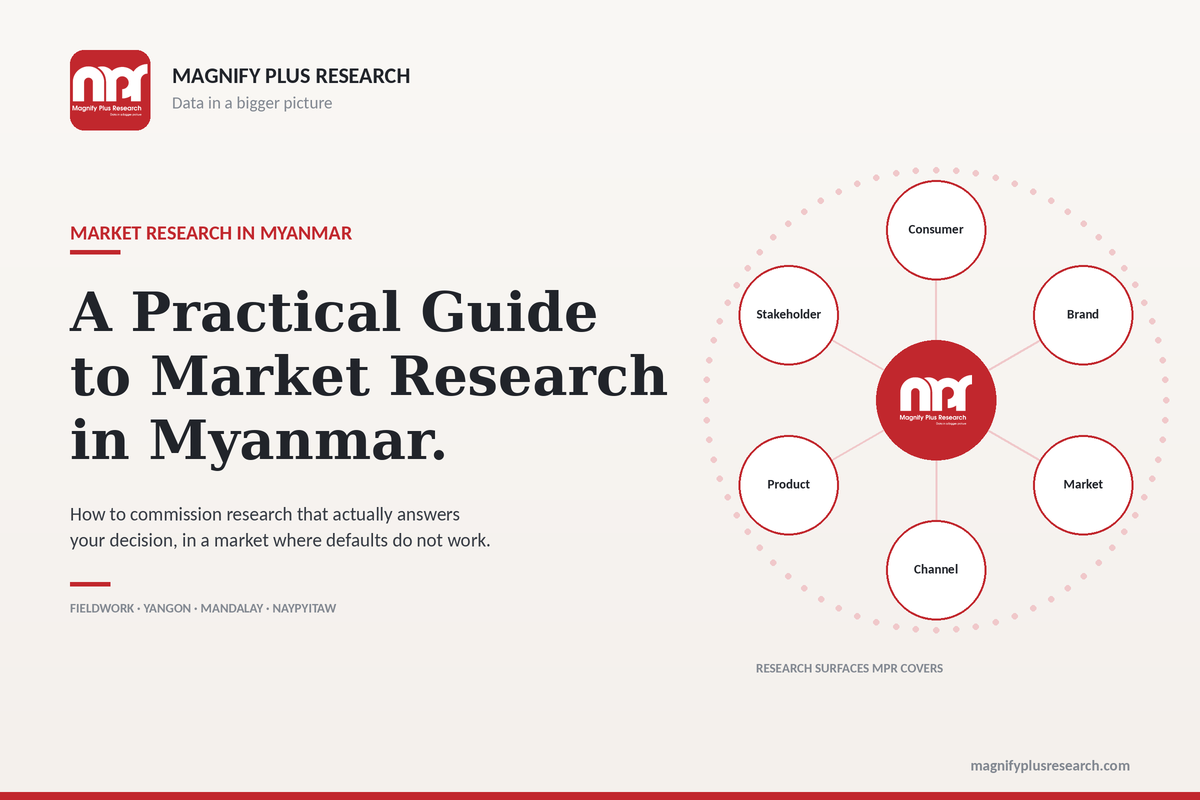
The phrase covers a wide spectrum. Consumer research surfaces the motivations, preferences, and behaviors behind purchase decisions. Brand health tracking measures awareness, consideration, usage, and loyalty over time. Market sizing and feasibility research informs entry and expansion. Concept and product testing reduces launch risk before production commitments are made. Channel and distribution mapping reveals who actually controls access to shelf and territory. Stakeholder and policy research surfaces the institutional context. Social listening captures the unprompted conversation in real time.
What ties all of these together in Myanmar is a single requirement. Reliable answers come from primary, locally designed fieldwork, not from desk research alone. The data simply is not there to be looked up.
Why Research in Myanmar Requires a Market Specific Approach
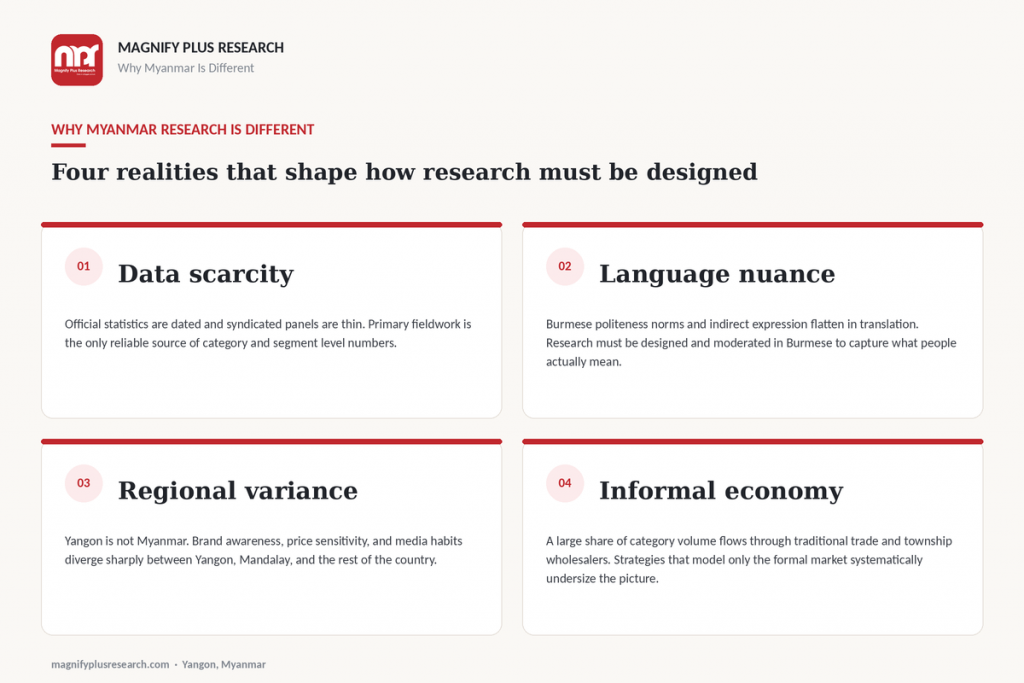
Four realities make market research in Myanmar different from running studies elsewhere in Southeast Asia.
Data scarcity. Official statistics are limited and dated. Syndicated panels are thin across most consumer categories. Global research databases under cover Myanmar. The implication is direct. Primary fieldwork is the only reliable source of category and segment level numbers in this market.
Language and cultural nuance. Burmese is a language of politeness, hierarchy, and indirectness. Stated preferences and opinions carry coded meaning that flattens in translation. A “quite good” in a Yangon focus group means different things depending on tone, age dynamics in the room, and who else is speaking. Burmese language moderation, in Burmese language analysis, is what surfaces the truth that translation misses. The same logic applies to social listening. Burmese language natural language processing is fundamentally different from sentiment models built on English language data.
Regional variance. Yangon is not Myanmar. Brand awareness, category penetration, price sensitivity, and media habits diverge sharply between Yangon, Mandalay, Naypyitaw, secondary cities, and the rural townships. A consumer truth validated only in Yangon is a consumer truth validated for a fraction of the population. National conclusions drawn from Yangon only fieldwork are systematically biased.
Informal economy. A large share of category volume flows through traditional trade and township wholesalers rather than modern trade. Cross border supply and informal channels matter in categories where regional analogues would suggest otherwise. Studies that model only the formal market consistently undersize the picture and miss the competitors who actually move volume.
These four realities do not make research in Myanmar harder than it needs to be. They make it different, and they reward firms designed for those differences.
The Myanmar Market in Numbers
A few baseline numbers worth carrying into any research conversation about Myanmar in 2026. The country has approximately 39.8 million internet users, around 72.5% internet penetration, 21 million social media users, and 62.5 million mobile connections according to DataReportal’s Digital 2026 Myanmar report. Facebook remains the gravitational center of the digital lives of most adults at around 18.5 million users, with TikTok now at over 16.6 million and the fastest growing discovery surface for under 35 audiences. YouTube reaches roughly 12 million. Instagram, at around 1.4 million, is a niche urban premium leaning audience.
These numbers do not answer any specific brand’s question. They frame the answer. Any research design for Myanmar in 2026 should account for the fact that the consumer is mobile first, social first, conversational, and increasingly video led.
Core Research Methods in Myanmar
The most reliable market research programmes in Myanmar combine more than one method. Each method answers a different kind of question, and the strongest decisions come from triangulating across them.
Quantitative research. Representative surveys using CATI and face to face fieldwork, scaled across Yangon, Mandalay, and Naypyitaw, with extended coverage available for secondary cities and selected rural townships. Quantitative work is the foundation for market sizing, brand health, usage and attitude studies, segmentation, concept testing, and pricing research. Sample design and instrument design matter enormously in this market because urban only or convenience samples produce systematically misleading numbers.
Qualitative research. Focus groups, in depth interviews, and ethnographic observation conducted in Burmese by local moderators. Qualitative research is where motivations, emotional drivers, cultural friction points, and the language consumers actually use about your category come out. This is the “why” behind the numbers.
Social listening with Burmese language NLP. AI assisted monitoring of Facebook, TikTok, YouTube, and forums to capture the unprompted, real time consumer conversation about your category, brand, and competitors. Social listening surfaces signal that surveys cannot, because it captures what people say when no researcher is in the room. In Myanmar, doing this well requires Burmese language natural language processing, not translated proxies.
Ethnography and shop alongs. In home visits, in store observation, and shadowing of actual consumer behavior. This method is particularly valuable in categories where the gap between what consumers say they do and what they actually do is wide. Personal care, beverages, household goods, and informal channel categories all benefit.
Stakeholder and key informant interviews. Structured conversations with distributors, wholesalers, retailers, category veterans, regulators, and institutional players. KII work is often the fastest way to understand who actually controls access to shelf, territory, and decision making in a Myanmar category.
Matching the Method to the Decision
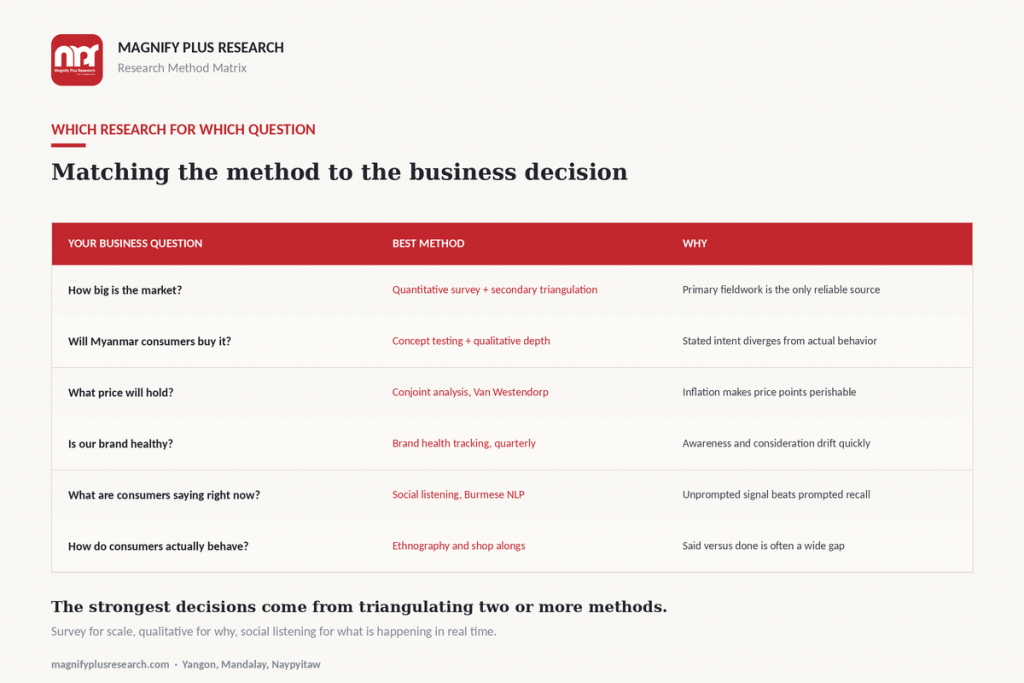
Research Method Decision Matrix
The right research method is the one that produces the most reliable answer to the question being asked, not the fastest or the cheapest. A few useful pairings.
If the question is about market size, the answer comes from primary quantitative fieldwork triangulated with secondary sources and stakeholder validation. Secondary alone in Myanmar is not enough.
If the question is whether consumers will buy a new product, concept testing combined with qualitative depth gives you both the score and the reason. Stated intent in this market diverges from actual purchase behavior more than it does in many regional analogues, so designing the instrument to reduce that gap matters.
If the question is about pricing, conjoint analysis and Van Westendorp style pricing sensitivity research are the standard tools, validated against real consumer trade off behavior. In an inflationary environment like Myanmar’s in 2026, price points are perishable and should be re tested rather than carried forward from older studies.
If the question is whether your brand is healthy, the answer is brand health tracking, run quarterly or in continuous waves, measuring awareness, consideration, usage, loyalty, and image attributes by segment and region. A single point in time read tells you where you stand. Tracking tells you whether you are moving.
If the question is what consumers are actually saying about your brand or category right now, the answer is social listening, with Burmese language sentiment analysis and topic detection. This is the method that catches issues, complaints, and emerging preferences before they show up in sales data.
If the question is how consumers actually behave, ethnography and shop alongs reveal what surveys cannot. The said versus done gap is wider in some Myanmar categories than brand teams assume.
Sectors Where MPR Research Is Active
Market research in Myanmar spans most consumer and B2B categories. Our active engagement areas include fast moving consumer goods, telecommunications, financial services and fintech, gaming and digital entertainment, consumer durables and electronics, automotive, healthcare and pharma, retail and modern trade, hospitality and food service, and B2B and industrial categories. We also support NGO and development sector research with baseline and endline surveys, KAP studies, program evaluation, and beneficiary feedback systems.
The constant across all of these is methodological discipline. We design from the question outward, select the right method mix, and field with the same standards regardless of sector.
Common Business Questions Myanmar Market Research Answers
Some of the most frequent questions Myanmar market research is commissioned to answer.
How large is our category in Myanmar today, and how fast is it growing. Who are the segments inside it that are realistically reachable, and how should we prioritize them. What share can a credible entrant capture in years one through three. How does our brand health compare to competitors, and where is the franchise most exposed. Which concepts, formulations, packs, or price points perform best with our target segment. What does the path to purchase actually look like in our category, and where does friction sit. How do consumers feel about our recent campaign, and did it move the metrics that matter. What are the institutional and channel realities we should know about before committing capital.
If your question is on this list or close to it, market research in Myanmar can answer it reliably. If your question is not on this list, it can usually be reframed into something this list can address.
How to Choose a Market Research Firm in Myanmar
A short checklist for evaluating any market research company in Myanmar before you commission work.
Local fieldwork capability. Does the firm have its own Burmese language moderators and a recruitment network that reaches outside Yangon, or does it subcontract everything. Coverage depth in Mandalay, Naypyitaw, and selected secondary urban and rural locations is a meaningful differentiator.
Methodological transparency. A reputable firm reports sample sizes, fieldwork dates, methodology, and known limitations on every study. If those details are vague, the underlying numbers usually are too.
Triangulation across methods. Look for a firm that designs around the question and combines methods where appropriate, not one that defaults to whatever it has the most capacity for that quarter.
Burmese language capability in social listening. If the firm offers social listening, ask whether the sentiment and topic models are built on Burmese language data or on translated proxies. The difference is material.
Sector relevance. Ask for specific category experience, recent client work in adjacent categories, and a clear example of how the firm has handled a question similar to yours.
Independence. A research firm should give you the answer the data supports, even when it is inconvenient. Firms that always conclude in favor of the brief should be treated with caution.
The MPR Approach
Magnify Plus Research is the market research arm of the Magnify Group, a Myanmar based intelligence and marketing ecosystem that also includes Magnify Myanmar (social listening), The Red (marketing agency), and The Hub (content and media studio). The integrated structure means our research conclusions can be paired with social listening, creative development, and content production where the brand wants an end to end programme, while remaining genuinely independent on the research side.
Our standard research footprint covers Yangon, Mandalay, and Naypyitaw, with extended fieldwork available across selected secondary cities and rural townships. Our flagship continuous tracking product, Myanmar Consumer Pulse 2026, runs quarterly across the three major metros, capturing category and brand level signal that brand owners can act on without commissioning a custom study every time the question changes. For campaign work, our Campaign Pulse pilot validates effectiveness with verified Yangon respondents before full rollout.
We work with foreign entrants, regional consulting firms, Myanmar brand owners, NGOs and development organizations, and investors. We design every programme from the research question outward, and we report methodology, sample, and limitations transparently on every deliverable.
Frequently Asked Questions
What is market research in Myanmar? Market research in Myanmar is the systematic study of Myanmar consumers, categories, channels, and competitors to support business decisions, primarily through primary fieldwork because secondary data is limited.
How much does market research in Myanmar cost? Cost varies widely by method, sample size, and regional coverage. A focused qualitative study can be commissioned at a fraction of the cost of a representative national quantitative programme. Ready to buy products such as Campaign Pulse exist for brands that need a quick read at a fixed price.
How long does a market research study in Myanmar take? A typical qualitative programme runs four to six weeks. A representative quantitative study runs six to ten weeks depending on sample size and geographic coverage. Continuous tracking runs in quarterly or wave based cycles.
Can research in Myanmar be conducted in Burmese? Yes, and it should be. All MPR qualitative fieldwork is conducted in Burmese by local moderators. Quantitative instruments are designed bilingually and fielded in Burmese.
Do market research firms in Myanmar cover areas outside Yangon? The better firms do. MPR’s standard coverage spans Yangon, Mandalay, and Naypyitaw. Extended coverage across secondary cities and selected rural townships is available depending on study design and timeline.
Is desk research enough for a Myanmar decision? No. Secondary data is useful for framing a question. Primary fieldwork is what answers it reliably in this market.
What sectors does MPR cover? FMCG, telecommunications, financial services and fintech, gaming and digital entertainment, consumer durables, automotive, healthcare and pharma, retail, hospitality and food service, B2B and industrial, and the NGO and development sector.
How is MPR different from other market research companies in Myanmar? Local fieldwork capability across Yangon, Mandalay, and Naypyitaw, Burmese language moderation and analysis as standard, integrated access to Magnify Group social listening with Burmese natural language processing, methodological transparency on every study, and ready to buy research products alongside fully custom programmes.
Get started: Have a Myanmar decision in front of you that needs evidence behind it? Talk to MPR about a research programme designed around your question. Email us to business@magnifyplusresearch.com
References
DataReportal. Digital 2026 Myanmar. https://datareportal.com/reports/digital-2026-myanmar
World Bank. Myanmar overview. https://www.worldbank.org/en/country/myanmar
Asian Development Bank. Myanmar economy. https://www.adb.org/where-we-work/myanmar
Magnify Plus Research. Myanmar Consumer Pulse 2026 syndicated tracking, quarterly coverage across Yangon, Mandalay, and Naypyitaw.