Consumer Research in Myanmar: How Brands Decode What Drives Purchase

Consumer research is how global and Myanmar brands understand what actually drives purchase decisions in one of Southeast Asia’s most distinctive and least documented markets. As a specialist consumer research firm based in Yangon, Magnify Plus Research (MPR) designs qualitative and quantitative studies that move past surface level numbers, surfacing the motivations, preferences, and behaviors that shape how Myanmar consumers think, choose, and act.

This article explains what consumer research is, why Myanmar requires a market specific approach, the methods MPR uses on the ground, and the commercial scenarios where consumer research pays for itself many times over.

What Is Consumer Research?

Consumer research is the systematic study of how people make decisions about products and services. It combines qualitative methods such as focus groups, in depth interviews, and ethnographic observation with quantitative approaches such as representative surveys, tracking panels, and concept tests. Effective consumer insight research goes beyond what people say they do, capturing the cultural and emotional context behind their choices.

In Myanmar, this means understanding regional diversity between Yangon, Mandalay, Naypyitaw, and rural townships, the indirect and politeness driven communication style of Burmese conversation, the deep influence of family and community on category choices, and the practical realities of an economy where cash, mobile money, and informal trade still dominate large parts of the consumer journey.

Consumer research in Myanmar is not just survey work translated from English. It is research designed from the ground up around how Burmese consumers actually communicate.

Why Myanmar Requires a Market Specific Approach

Three realities make Myanmar consumer research different from running studies in Thailand, Vietnam, or Indonesia.

Data scarcity. Official statistics are limited and dated, syndicated panels barely exist for most categories, and global research databases under cover the country. Primary fieldwork is not optional in Myanmar, it is the only reliable source for category, segment, and brand level numbers.

Language and cultural nuance. Burmese speakers express opinions with indirectness, politeness, and contextual cues that flatten in machine translation. A “quite good” in a Yangon focus group can mean very different things depending on tone, hierarchy in the room, and who else is speaking. MPR’s qualitative work is conducted in Burmese by Myanmar moderators and analyzed without a translation bottleneck, which is why we also built Burmese language NLP capability for our social listening work.

Regional and income divergence. Yangon is not Myanmar. Brand awareness, category penetration, price sensitivity, and media habits differ significantly across regions and income tiers. A consumer truth validated only in Yangon is a consumer truth validated for a fraction of the population.

How Magnify Plus Research Studies the Myanmar Consumer
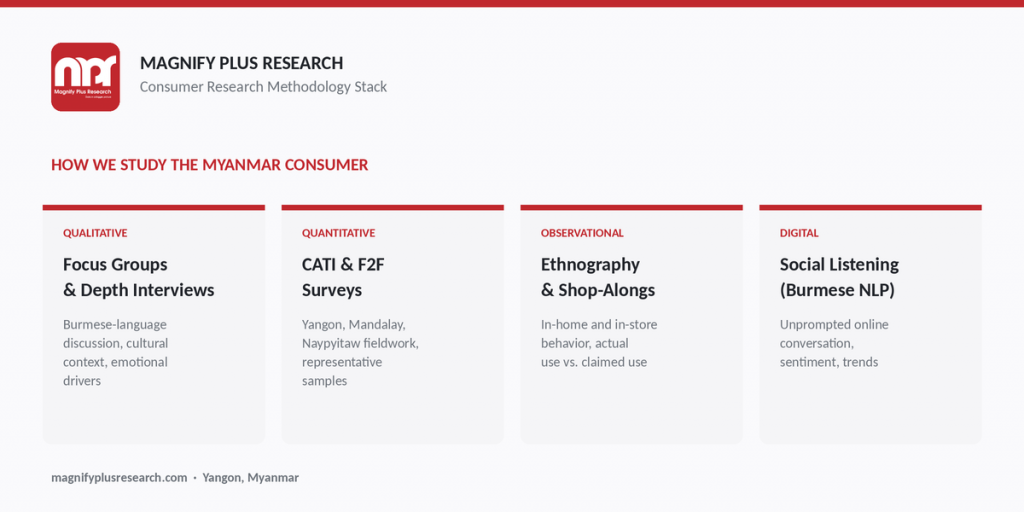
MPR designs each consumer research programme around the commercial question being asked, not around a fixed methodology. Our standard toolkit for the Myanmar market includes four complementary layers.

Qualitative depth. Focus groups and in depth interviews conducted in Burmese, designed to uncover motivations, category emotions, decision triggers, and the language consumers actually use about your brand. This is where the “why” lives.

Quantitative scale. CATI and face to face surveys across Yangon, Mandalay, and Naypyitaw, with representative sampling by age, gender, and income, and extended coverage available for secondary urban and rural areas. This is where the “how big and how often” lives.

Observational research. Ethnography, shop alongs, and in home visits that capture what people actually do, which is often different from what they say they do, especially in categories like personal care, beverages, and household goods.

Digital and social listening. AI assisted monitoring of Facebook, TikTok, YouTube, and forums using Burmese language natural language processing, capturing the unprompted consumer conversation about categories, brands, and campaigns in real time.

Programmes typically combine two or more of these layers so that qualitative depth explains the patterns the quantitative work measures, and the digital signal validates both against what is happening in the live market.

Specialized Consumer Research for Your Brand

Consumer research delivers the clearest commercial value in four scenarios. Each requires a different design.

Product launches. Concept testing, price elasticity work, and packaging research with the right Myanmar consumer segments before production and inventory commitments are made. The cost of getting this wrong in Myanmar is amplified by import logistics and currency exposure, which makes pre launch consumer validation one of the highest return research investments a brand can make.

Brand strategy and positioning. Qualitative depth that explains not just what Myanmar consumers choose but why, including the cultural and social dynamics shaping that choice. This is the foundation for positioning, messaging, and creative direction that actually resonates locally rather than being translated from a regional template.

Competitive tracking. Brand health tracking studies that measure awareness, consideration, usage, loyalty, and image attributes over time, not at a single point. Tracking is where you see threats from new entrants early, and where you see whether your own activity is moving the dial.

Customer experience and journey work. Mapping the actual Myanmar consumer journey across discovery, purchase, use, and repurchase, including the informal and offline steps that are often invisible in digital analytics. This is particularly important in categories where the path to purchase still runs through traditional trade and word of mouth.

MPR designs each programme from the research question outward, selecting the methodology, sample, and instrument that produces the most reliable answer, not the fastest or cheapest one. Our consumer research covers FMCG, telecommunications, financial services, healthcare, gaming and digital entertainment, consumer durables, and retail categories across urban and select rural Myanmar.

What This Means for Myanmar Brand Owners

If you own or lead a Myanmar brand, consumer research is not a foreign brand luxury, it is your competitive advantage on home ground. A current consumer read tells you where your franchise is strongest, where switching risk is rising, and where a well funded entrant could cut in. Three practical priorities for local brand owners.

  1. Run at least one annual representative read on your category. Awareness, consideration, usage, and key image attributes, by region and income tier.
  2. Pair every major campaign with a pre and post measure. Without it you are guessing whether the spend worked.
  3. Listen to the unprompted conversation. Social listening in Burmese surfaces issues, complaints, and emerging preferences weeks before they show up in sales data.

Frequently Asked Questions

How long does a consumer research study in Myanmar take? A focused qualitative study runs four to six weeks. A representative quantitative study runs six to ten weeks depending on sample size and regional coverage. Tracking programmes run continuously, typically in quarterly or wave based cycles.

Do you research outside Yangon? Yes. Yangon, Mandalay, and Naypyitaw are standard coverage. Secondary urban and rural townships are available depending on study design and timeline.

Can consumer research be run in Burmese? Yes, and it should be. All MPR qualitative fieldwork is conducted in Burmese by local moderators. Quantitative instruments are designed bilingually and fielded in Burmese.

Is secondary data enough for a Myanmar decision? No. Secondary data is useful for framing the question. Primary fieldwork is what answers it reliably in this market.

Get started: Want to understand your Myanmar consumer with the rigor your decisions deserve? Talk to MPR about a consumer research programme. Email to business@magnifyplusresearch.com

Sources, World Bank Myanmar overview, Asian Development Bank Myanmar economy, DataReportal Digital 2026 Myanmar. Refresh all figures at publication.
Market Feasibility Study in Myanmar: The Go or No Go Validation

A feasibility study is the essential filter between ambition and reality. While a market entry strategy defines how you will enter Myanmar, through distribution partnerships, joint ventures, acquisitions, or a direct setup, a feasibility study answers a more fundamental question. Should this project proceed at all?

At Magnify Plus Research (MPR), we provide the objective, tactical validation required to make that decision with confidence. We act as the Go or No Go gate, stress testing your project against the economic, regulatory, and cultural realities of the Myanmar market before you commit significant capital, inventory, or partnership equity.

Too many companies launch in Myanmar on the back of optimistic projections, only to discover late, expensive friction points. Pricing resistance in a high inflation environment. Distribution dependence on a small set of established wholesalers. Concept features that translate poorly to Burmese consumer expectations. Each of these is identifiable in advance. That is what feasibility research is for.

Why Feasibility Studies Matter More in Myanmar

Three market conditions make rigorous feasibility validation especially important in Myanmar.

First, capital is expensive and the kyat is volatile. Currency swings and inflation, which the Asian Development Bank and World Bank both flag in their recent Myanmar updates, mean that a launch built on stale price assumptions can lose its margin before it ships its first batch. Pricing and unit economics need to be tested against current consumer willingness to pay, not against last year’s benchmarks.

Second, the data environment is thin. Official statistics are dated, syndicated panels are limited, and secondary reports often recycle the same handful of headline figures. A feasibility study built only on desk research is a feasibility study built on assumption. Primary fieldwork is the only reliable source of category and segment level numbers in Myanmar.

Third, the country is operationally complex. Distribution is fragmented across modern trade, traditional trade, township wholesalers, and informal channels. Regulation can shift. Logistics costs and lead times need to be modeled honestly. None of this is a reason to avoid Myanmar. It is a reason to validate before you commit.

The Three Pillars of a Myanmar Feasibility Study

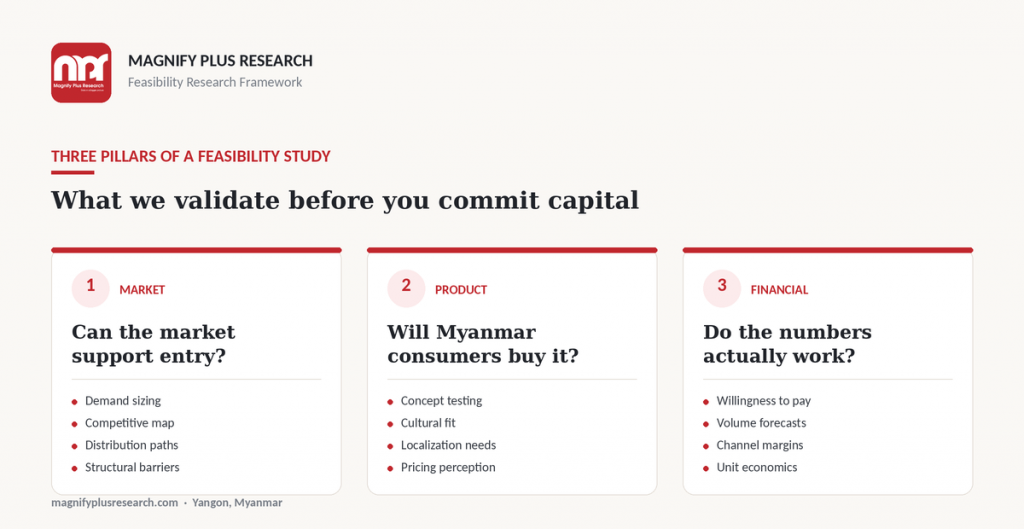
Three pillars of an MPR feasibility study

We focus on commercial viability and remove speculation by replacing it with primary, verified evidence. Every feasibility programme at MPR is built on three pillars.

1. Market and Project Feasibility

We evaluate the structural environment to determine whether the Myanmar market can realistically support a new entrant in your category.

Demand quantification. Calculating actual market appetite through consumer surveys and purchase intent modeling, not just regional analogues or secondary estimates. We size the addressable market, the segments inside it that are realistically reachable, and the share of that opportunity a credible entrant can capture in years one through three.

Competitive landscape. Identifying where the real service gaps lie and which consumer pain points remain unaddressed. The output of this is binary in practice. You are either entering a saturated space or finding genuine white space, and the answer changes everything downstream.

Structural barriers. Evaluating distribution bottlenecks, regulatory complexity, import friction, and the informal rules of access that govern success in Myanmar. Foreign brands often discover these the slow way. Feasibility research surfaces them in weeks, not quarters.

2. Product Feasibility

We validate product market fit inside Myanmar’s cultural and consumer context before you commit to launch volumes.

Concept and experience validation. Testing whether your product’s features and benefits align with how Myanmar consumers actually think about your category. Priorities that look universal from a regional HQ often invert in Yangon and Mandalay. What matters most to a Bangkok or Jakarta consumer may be a tertiary consideration locally, and the reverse.

Localization requirements. Identifying necessary adjustments in packaging size, formulation, language, payment options, or feature set. Burmese consumers respond to specific signals around value, quality cues, and trust. Our product feasibility work pinpoints exactly which adjustments are required and which are over engineering.

Cultural friction points. Uncovering the psychological or behavioral barriers that can quietly suppress adoption. Family approval dynamics in higher consideration purchases. Cash versus mobile money behavior at the point of sale. Habits around brand trial, recommendation, and word of mouth that are stronger here than digital analytics will ever show.

Price and value perception. Testing whether your proposed pricing aligns with perceived value. Premium positioning, mainstream value, and accessible entry tiers each require different validation, and the gap between what consumers say they will pay and what they actually pay narrows considerably with the right instrument design.

3. Financial and Commercial Feasibility

We deliver the market intelligence that drives realistic financial projections. A financial feasibility study built on optimistic inputs creates false confidence and protects no one.

Willingness to pay analysis. Determining optimal price points through conjoint analysis, pricing sensitivity research, and Van Westendorp style modeling. We identify the ceiling at which consumer demand collapses and the floor below which margin disappears.

Revenue modeling inputs. Providing realistic volume forecasts based on intent to buy data, adoption curve assumptions appropriate to your category, and segment level conversion benchmarks. The output is a revenue model your finance team can actually defend, not a hopeful projection.

Customer acquisition economics. Evaluating acquisition costs against projected lifetime value under Myanmar conditions. Distribution costs, retailer margins, and media costs differ meaningfully from regional norms. The same campaign that works in Bangkok will rarely have the same unit economics in Yangon.

The MPR Feasibility Process

MPR feasibility decision process

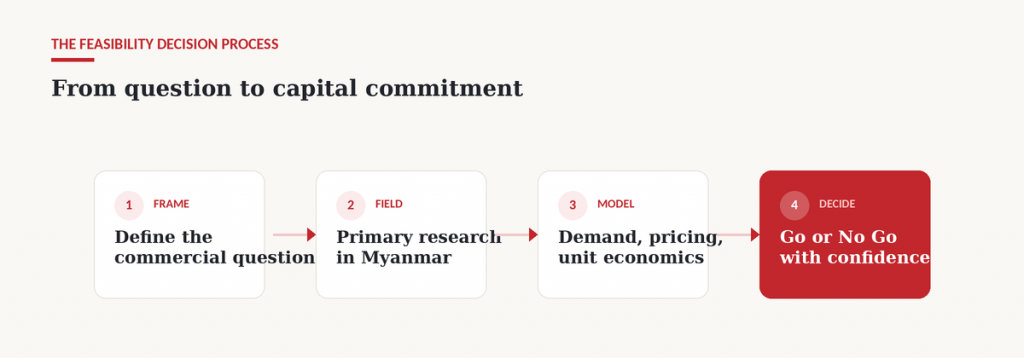
Every MPR feasibility programme runs through the same four stages, scoped to the size and complexity of the decision being made.

Frame. A short scoping phase to define the commercial question precisely. Are we testing whether the market exists, whether the product fits, whether the price holds, or all three? The clearer the question, the cleaner the answer.

Field. Primary research in Myanmar, designed around the question. Typically a mix of qualitative depth in Burmese, a representative quantitative read across Yangon, Mandalay, and Naypyitaw, and, where appropriate, retail and distributor mapping or social listening to validate the demand signal against unprompted conversation.

Model. Translating fieldwork into demand sizing, price elasticity ranges, and the unit economic inputs your finance team needs. We provide the numbers and the reasoning behind them, so the model holds up under scrutiny.

Decide. A clear, written recommendation. Go, No Go, or Go conditional on specific changes, with the evidence behind it and the trigger points that would change the recommendation if the market shifts.

When a Feasibility Study Pays for Itself

Three commercial scenarios where feasibility research is the highest leverage research a brand can buy in Myanmar.

Before a new market launch. The cost of a failed launch, written off inventory, exited distributor relationships, and brand damage, is many times the cost of validating the launch first. This is the classic feasibility use case.

Before a category extension or premium move. Stretching an existing brand into a new segment or price tier is a launch in everything but name. The same validation discipline applies, and skipping it tends to be more costly because internal teams over rely on existing brand equity.

Before a partnership or acquisition. If you are acquiring a local brand or signing an exclusive distribution agreement in Myanmar, independent feasibility research gives you a defensible read on the asset’s actual market position, not the position the seller is presenting.

What This Means for Myanmar Brand Owners

Feasibility research is not only for foreign entrants. If you are a Myanmar brand owner, three uses apply directly.

  1. Validate before you scale. Before you commit production volume to a new SKU, regional expansion, or premium line, run a focused feasibility study. The investment is small relative to the cost of getting it wrong.
  2. Pressure test partnership offers. When a regional player approaches you about distribution or co branding, an independent feasibility read tells you what the deal is actually worth.
  3. Defend pricing. In an inflationary environment, willingness to pay research lets you reprice with evidence rather than hope.

Frequently Asked Questions

How long does a feasibility study in Myanmar take? A focused feasibility programme typically runs six to ten weeks from kickoff to final report, depending on the number of pillars in scope and the geographic coverage required.

Is a feasibility study the same as a market entry strategy? No. A market entry strategy defines how to enter. A feasibility study decides whether to enter. The two are sequential. Feasibility comes first.

Can MPR run feasibility research outside Yangon? Yes. Yangon, Mandalay, and Naypyitaw are standard. Secondary urban and selected rural coverage is available depending on study design.

What does MPR deliver at the end of a feasibility study? A written recommendation, a market sizing model, a pricing and unit economics input pack, a competitive and distribution map, and the underlying fieldwork data. Everything your strategy and finance teams need to act.

Get started: Considering a launch, an expansion, or a partnership in Myanmar? Talk to MPR about a feasibility study before you commit.

Sources, World Bank Myanmar overview, Asian Development Bank Myanmar economy. Refresh all macroeconomic figures at publication.