Myanmar E-Commerce: Market Overview and Competitor Analysis

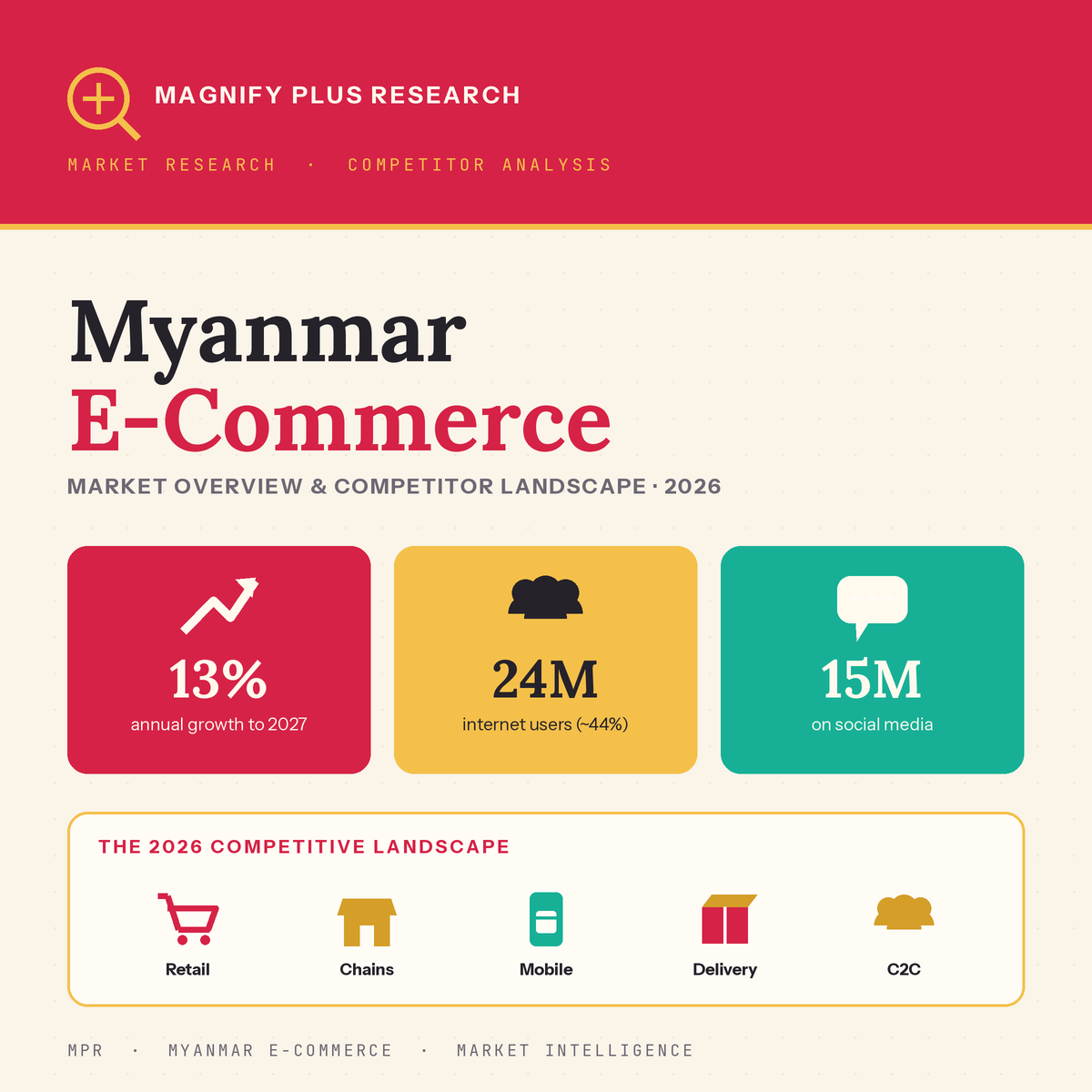
Myanmar’s online retail market is growing rapidly (≈13% CAGR through 2027) as internet penetration (≈44%, ~24 M users) and mobile usage climb. Facebook is the dominant social channel (≈15 M users, 85% of internet traffic), so social listening (monitoring customer sentiment on social media) is crucial for brands. In this market research Myanmar report we survey the surviving platforms in 2026, analyzing each competitor’s offerings, ownership, and channels. We draw on local data sources (company sites, app stores) and industry analyses. (By contrast, Alibaba-backed Shop.com.mm (“SHOP APP MM”) ceased operations in April 2026, leaving space for local players.)

Major Retail Chains Online

  • City Mall Online (City Mart) – City Mart Holding (CMHL) is Myanmar’s largest supermarket operator and was the country’s retail market leader. CMHL launched City Mall Online in 2017 to sell groceries and household goods. The platform spans multi-category products (groceries, baby/maternity, beauty, home care, pet supplies, sports, travel, etc.). CMHL operates ~6300 staff (2023) and multiple store brands (City Mart supermarkets, Ocean hypermarkets, Seasons Bakery, City Express convenience stores). City Express (a CMHL subsidiary) has even offered online snack/ready-food items, for example hot sausages and steamed buns (see image). City Mall Online advertises fast delivery (often 2-hour) and cashless/mobile payments, reflecting the group’s focus on mobile banking.
    City Express (part of City Mart group) sells convenience foods online – here, grilled sausages in a City Express store.
  • Capital Online (Capital Retail) – Capital Retail Ltd (a CDSG subsidiary) runs Myanmar’s first “modern trade” hypermarkets (Yangon, Mandalay). Founded 2008, Capital employs ~1000 people and operates 2 hypermarkets, 3 supermarkets, and 3 convenience (Express) stores. Capital also has an e-commerce site (“Capital Online”) serving a broad inventory of local and imported goods. The Capital site highlights home delivery and card/e-wallet payments, similar to peers.
  • Makro Click (Makro Myanmar) – A B2B wholesale chain 100% owned by Thailand’s Siam Makro. Launched 2020, Makro Myanmar has one 7,000 m² cash-and-carry store (Yangon) and a delivery channel. It targets restaurants, retailers and institutions (Foodservice/HORECA) with bulk groceries, fresh produce, and restaurant supplies. Its “Makro Pro” app/website focuses on trade customers, operating on a membership model (like other Makro brands). Makro’s platform typically offers digital payment, bulk pricing and logistic support.

Electronics & Tech Retailers

  • ICT.com.mm – Branded as “#1 Online Tech Retailer in Myanmar”, ICT.com.mm specializes in electronics (smartphones, laptops, PCs, networking, accessories). It offers branded products at competitive prices, frequent deals (e.g. 60% off sales), and services like “Click & Collect” or “Buy-Now-Pay-Later” to attract tech buyers. ICT is owned by a local ICT Group Co. and has a mobile app with 5-star ratings.
  • Technoland – An established computer/IT chain founded in 2000 (12 stores nationwide). The Technoland site sells a very wide range of devices: PCs, laptops (student, business, gaming), Apple products (iPhone/iPad/MacBook), monitors, printers/scanners, networking gear, gaming peripherals, etc.. It carries major brands (HP, Dell, Apple, Cisco, Samsung, LG, etc.). LinkedIn reports Technoland employs ~310 staff with 12 outlets (5 cities), making it one of the largest tech retailers. They also offer on-site servicing/warranty.
  • UNiQUE.com.mm – A specialty tech retailer focused on “digital lifestyle” gadgets. UNiQUE’s slogan is “The One Stop Partner for Your Digital Lifestyle,” and it sells computers, laptops, mobile phones, cameras and home electronics. It positions itself as a premier seller of authentic, branded electronics (e.g. PCs, Apple products, appliances). UNiQUE (Unique Myanmar Co.) is a local IT company and runs both online sales and physical stores.

Fashion, Beauty and Lifestyle Retailers

  • Sein Gay Har Online – Myanmar’s first department store (est. 1985) and now a leading retail chain. Its online mall offers the same categories as its brick-and-mortar stores: “wide range of products from food and groceries to clothes, electronics, furniture, household goods, etc.”. SeinGayHar.com mirrors in-store promotions and provides in-store pickup options.
  • KhitZay.com.mm – An e-commerce startup targeting fashion and lifestyle goods. Khit Zay sells branded apparel, shoes, bags, and accessories (local/international brands like Adidas, Pedro, etc.). It claims to aim “to become the market leader in offering authentic fashion and lifestyle products”. The platform promises easy returns and authentic inventory. (The site’s design emphasizes apparel categories and featured bags.)
  • Zegobird.com – A broad online marketplace launched in 2017. ZegoBird (run by ZegoBird Co. Ltd) is described as a Myanmar shopping and selling destination with offices in Hong Kong/Singapore. It offers multiple categories (fashion, electronics, home goods, etc.) under one roof, similar to a mini Amazon or Shop.com. Zegobird’s mobile app has regional reach and promotes promotions and user reviews.
  • iMyanmarMarket.com – Myanmar’s largest C2C classifieds/marketplace app. It connects individual buyers and sellers of used/new items. iMyanmarMarket is run by IMYANMAR PTE LTD (Singapore), with an app that claims “Myanmar’s No. 1 trusted online market” and over 10K Android installs. Listings span phones, furniture, cars, fashion, etc. The user-driven platform allows easy selling/publishing of products; it’s a popular “online bazaar” especially for secondhand goods.
  • Remax Online Shop – The official Myanmar store for Remax (a global mobile-accessories brand). Operated by Remax Myanmar, it offers power banks, chargers, earbuds, speakers, and other mobile accessories. The app description emphasizes “High Quality Mobile Accessories & Creative Lifestyle Products” from brands like Remax, Amazfit, Baseus, Ugreen, Lenovo, etc. Remax is distributed by MZ Myanmar Co., Ltd (Remax’s sole distributor). The site runs frequent promotions and loyalty programs for gadget accessories.
  • 365myanmar.com – A general online shopping portal offering electronics, home goods, apparel, and more. It resembles a department-store website (menus include electronics, fashion, books, household, etc.). 365Myanmar features both its own products and a “Sell on 365myanmar” marketplace option, letting third-party sellers list items (like Lazada’s marketplace). (No external citation available, but the site is active with cart/track-order features.) It caters to mid-range shoppers with a local-touch e-marketplace.
  • Medicare (medicarehb.com.mm) – A health & beauty retailer (originated in Vietnam) with stores in Yangon and beyond. Medicare sells cosmetics, personal care, and wellness products. The chain dates to 2001 (Vietnam) and has built ~150 stores across Vietnam and Myanmar. Its Myanmar site offers typical categories: skin care, makeup, supplements, baby care, household, etc., along with frequent promotions. Medicare emphasizes affordable, quality personal-care items and has both app and in-store shopping.

According to a July 2024 DHL analysis, Myanmar’s e-commerce sector powered ~9.6% of global growth in 2023 and is forecast to expand ~13.2% annually through 2027. With Internet penetration ~44% (23.9 M users) and 67% of web traffic on mobile devices, mobile commerce dominates. Most shoppers use Facebook heavily (14.5 M Facebook users in 2023), making social media the primary marketing and sales channel. This means local e-tailers rely on Facebook pages, Messenger chat and ads to reach customers – a key point for social listening Myanmar. Retailers monitor online reviews and social feeds to track brand sentiment and competitors on social platforms.

Cash-on-delivery and mobile wallets (Wave Money, KBZPay) remain widely used payment methods, given relatively low card penetration. Many sites promote free or fast delivery for urban orders. For example, City Mall Online advertises 2-hour delivery in Yangon. Credit card and e-wallet payments (KBZPay, Wave) are increasingly accepted, especially by tech and grocery sites.

Competition is intense. Aside from local chains (City Mart, Capital, Makro) and specialists (ICT, Technoland, Unique, Khit Zay, etc.), there are general marketplaces (Zegobird, 365Myanmar) and C2C apps (iMyanmarMarket). New entrants and pivots also emerge: e.g. mmShop (also known as Shop App) was Alibaba’s platform in Myanmar (selling all categories), but it closed in 2026. Another early marketplace, rgo47 (fashion site), focused on clothes/shoes but has since shut down. Thus the field is dominated by these local players and a few global brands (e.g. Remax). Ongoing competitor analysis Myanmar requires tracking each platform’s niche, promotions, and social buzz.

Key Takeaways and Competitor Insights

  • City Mart Group is the incumbent retail leader. Its online arm (City Mall Online) covers groceries and household goods, with strong brand trust. It also uses its convenience arm (City Express) to sell quick-serve foods online. Newer competitors must match CMHL’s logistics and trust.
  • Capital Retail (CDSG) competes in groceries and general merchandise, using its Capital hypermarkets to support online sales (Capital Online). Its backing by a conglomerate gives stability.
  • Makro Click occupies the wholesale B2B niche; not retail-oriented. Regular consumers can’t shop there unless through a business account.
  • In electronics, the clear leaders are ICT.com.mm and Technoland. They must compete with each other and with direct imports. (ICT advertises exclusive deals and same-day delivery).
  • In fashion & lifestyle, Sein Gay Har and Khit Zay are prominent. Sein Gay Har leverages its department-store legacy, while Khit Zay focuses on trendy brands and easy returns. New competitors will find it hard to convince customers of authenticity and refund policies.
  • Marketplaces/C2C: iMyanmarMarket dominates peer-to-peer classified sales. Zegobird and 365Myanmar provide open platforms for merchants, which is appealing to smaller retailers. Competition here depends on app usability, seller base, and trust.
  • Payments & Delivery: Nearly all remaining players offer cash-on-delivery and mobile wallet payments. E-commerce in Myanmar still relies on these. Advance-payment (card online) is growing but not dominant. Fast delivery and app-based order tracking (e.g. Track your order) are becoming standard features.

Sources: Company websites and app stores (CityMall, CityMart, Capital, Makro, Unique, Khit Zay, Medicare, Remax, ZegoBird, etc.), business profiles (LinkedIn, Tracxn), and market reports (e.g. DHL e-commerce trends for Myanmar; news on Shop.com.mm’s exit; Myanmar Business Guide listings for Sein Gay Har, Khit Zay). All information is drawn from these connected sources, ensuring up-to-date market research and competitor analysis.
Myanmar E-Commerce in 2026: Who Is Winning the Race (and Who Just Left the Field)

In April 2026, one of the biggest names in Myanmar online shopping quietly switched off the lights. Shop.com.mm, the Alibaba-backed platform once expected to dominate, closed its doors. When a giant leaves, everyone else inherits its customers, and the scramble to win them is exactly the kind of moment where market research earns its keep.

So who is actually left standing? And more importantly, who is winning? We went through the surviving players, category by category, to map Myanmar’s e-commerce landscape as it looks in 2026. Consider this your field guide to the competition: the incumbents, the specialists, the marketplaces, and the quiet operators most rankings miss.

The state of play: Myanmar e-commerce in 2026

Before we meet the contenders, a quick lay of the land, because the rules of this game are unusually local.

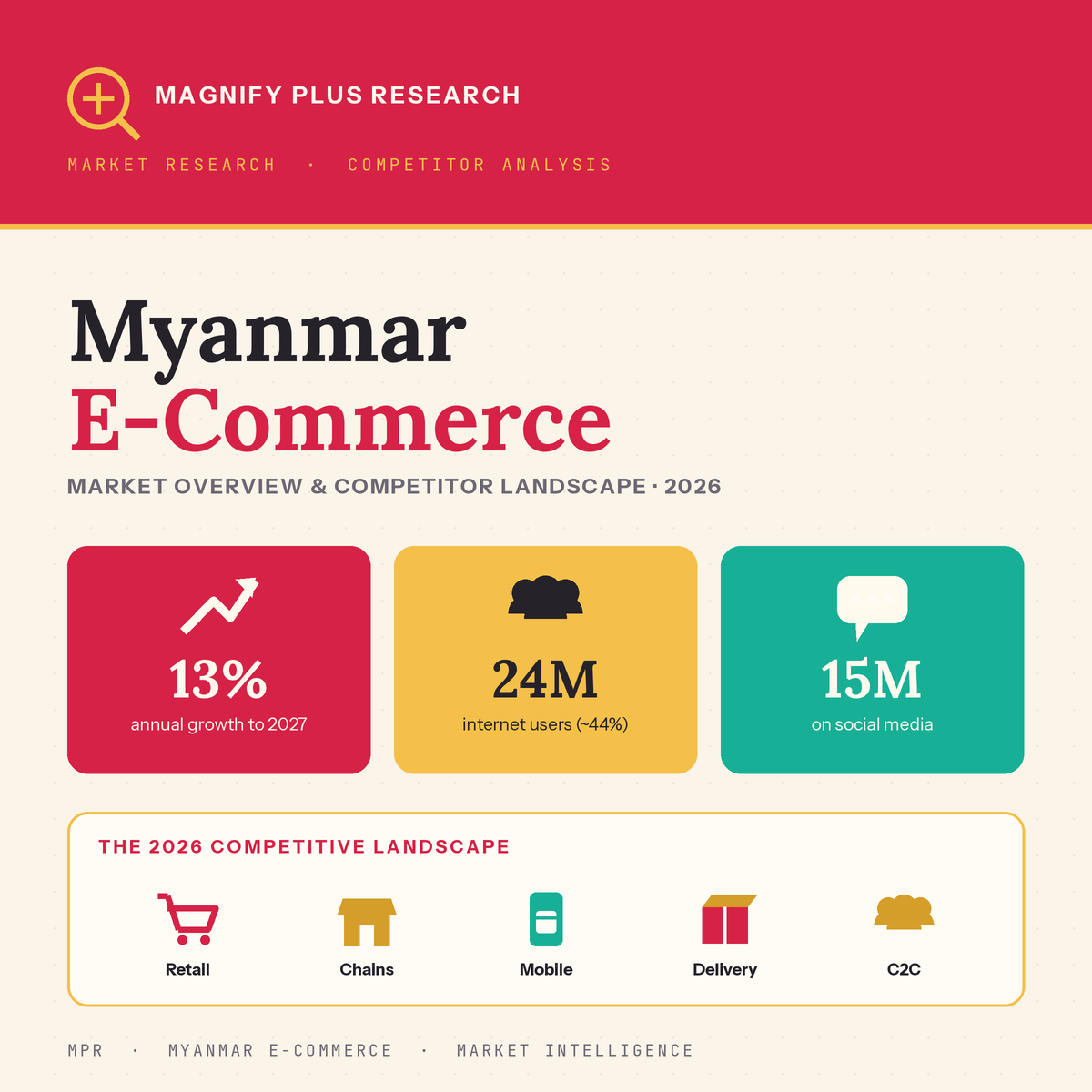
Myanmar’s online retail market is growing fast, expanding at roughly 13% a year through 2027 by DHL’s estimates. Tens of millions of people are now online, the overwhelming majority reaching the internet through a smartphone rather than a laptop. That single fact shapes everything: this is a mobile-first market, and any platform that is clunky on a phone is already losing.

Then there is the Facebook factor. In Myanmar, Facebook and Messenger are not just social networks; for a huge share of businesses they are the storefront, the catalogue, and the checkout counter all at once. Customers discover products in their feed, ask questions over Messenger, and place orders in a chat thread. This is why social listening, which means tracking what people say about brands on social media, is not a nice-to-have in Myanmar. It is often the clearest window you have into who is winning and why.

Finally, follow the money and the parcels. Cash-on-delivery is still king, closely followed by mobile wallets like KBZPay and Wave Money, because card penetration remains low. And delivery speed has become a bragging right, with the sharpest players promising same-day or even two-hour delivery in Yangon. Keep those three battlegrounds in mind, payments, delivery, and social, because they decide most of the fights below.

A note on the numbers: figures like market growth, internet penetration, and Facebook usage move quickly and vary by source. Treat the headline stats here as directional, and refresh them against a single current source before you rely on them for a decision.

Why one big exit changes the whole game

Shop.com.mm was not the only casualty. The fashion marketplace rgo47 also shut down, and it was not the first pivot the market has seen. Every closure does two things at once: it removes a competitor, and it releases a pool of customers and sellers who now need a new home.

For the survivors, this is opportunity and pressure in equal measure. Opportunity, because there is suddenly demand to capture. Pressure, because those newly homeless customers are shopping around, comparing, and perfectly willing to switch. In a shakeout, the brands that understand shifting sentiment fastest are the ones that convert a rival’s collapse into their own growth. Which brings us to the survivors.

The contenders, by category

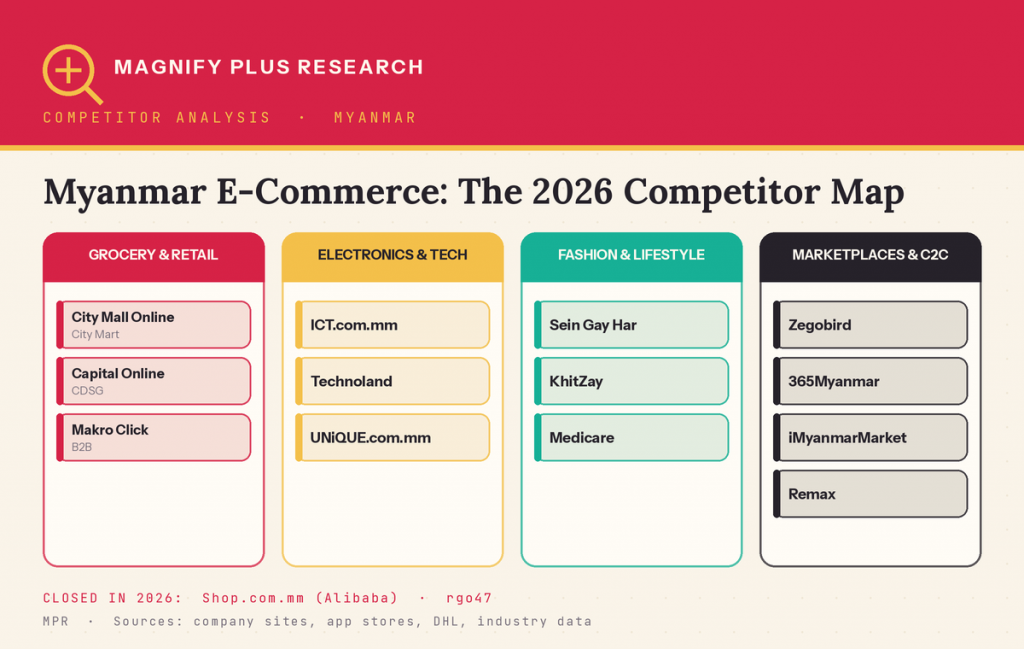
Here is the full field, grouped by where each player actually competes.

Grocery and retail chains: the heavyweights

City Mall Online (City Mart). If Myanmar e-commerce has an incumbent champion, this is it. City Mart Holdings is the country’s largest supermarket group, and its online arm sells everything from groceries and baby care to beauty, home, and pet supplies. Its advantages are the boring, decisive ones: trust, scale, and logistics. It even uses its convenience-store brand, City Express, to sell quick-serve foods online, and it leans hard into fast delivery and cashless payments. Any challenger has to match a machine that has spent years earning shoppers’ confidence.

Capital Online (Capital Retail). Backed by the CDSG conglomerate, Capital runs Myanmar’s first modern-trade hypermarkets and brings that stability online, offering a broad mix of local and imported goods with home delivery and e-wallet payments. It is the credible number two in general merchandise: not the biggest, but well-funded and hard to dislodge.

Makro Click (Makro Myanmar). The odd one out, in a good way. Wholly owned by Thailand’s Siam Makro, Makro plays the business-to-business game, supplying restaurants, retailers, and institutions with bulk groceries through a membership model. Ordinary shoppers cannot really use it, and that is the point. Makro is not fighting for your weekly groceries; it is quietly owning the HORECA and trade-supply niche while everyone else scraps over consumers.

Electronics and tech: the two-horse race

ICT.com.mm. Branding itself the number-one online tech retailer in Myanmar, ICT sells smartphones, laptops, PCs, and accessories with the tactics tech buyers respond to: aggressive deals, click-and-collect, and buy-now-pay-later. Its app is well rated, and it competes on price and urgency.

Technoland. The seasoned veteran, founded in 2000, with a dozen stores across several cities and a deep catalogue spanning everything from student laptops to Apple gear to networking equipment. Its edge is physical presence and after-sales service, warranty, and on-site support, which matters enormously when someone is spending real money on a device.

UNiQUE.com.mm. The lifestyle-tech specialist, positioning itself around authentic, branded gadgets, from computers and phones to cameras and appliances. In a market where fakes are a genuine worry, UNiQUE’s whole pitch is trust in what you are buying.

The story here is a genuine rivalry: ICT competes on deals and speed, Technoland on service and range, UNiQUE on authenticity. Whoever a shopper believes on price and legitimacy wins the sale.

Fashion, beauty, and lifestyle: authenticity is everything

Sein Gay Har. Myanmar’s first department store, dating to 1985, now selling online across the same sprawling range as its shops, from groceries and clothes to electronics and furniture. Its weapon is legacy. Decades of high-street trust translate into online credibility that a startup simply cannot buy.

KhitZay. The challenger, chasing the fashion-and-lifestyle crowd with branded apparel, shoes, bags, and accessories, and staking its reputation on authenticity and easy returns. In a category where counterfeits and refund horror stories scare buyers off, “genuine products, easy returns” is a sharp positioning.

Medicare. A health-and-beauty specialist with roots in Vietnam and a growing Myanmar footprint, selling cosmetics, personal care, and wellness products both online and in-store. It competes on affordable, dependable everyday essentials.

Marketplaces and C2C: platforms, not shops

Zegobird. A broad online marketplace launched in 2017, bringing fashion, electronics, and home goods under one roof, a little like a compact local Amazon, with a mobile app and a promotions-and-reviews model.

365Myanmar. A general shopping portal that also lets third-party sellers list their own products, giving it a marketplace flavour and appeal to smaller retailers who want a ready-made shopfront.

iMyanmarMarket. The peer-to-peer heavyweight, effectively Myanmar’s online bazaar, where individuals buy and sell new and secondhand items, from phones to furniture to cars. Its strength is the sheer breadth of listings and its popularity for secondhand goods.

Remax. A focused single-brand store for mobile accessories, power banks, chargers, earbuds, and the like, run by the brand’s local distributor and leaning on frequent promotions and loyalty perks. Narrow, but well-defended within its niche.

How they actually compete

Strip away the category labels and almost every one of these players is fighting on the same three fronts.

Payments. Nearly all of them offer cash-on-delivery plus mobile wallets, because that is what customers trust. Card-on-checkout is growing but still not the default. If your payment flow does not include COD and wallets, you are excluding most of the market.

Delivery. Speed and reliability have become genuine differentiators, and app-based order tracking is fast becoming table stakes. City Mall Online’s two-hour Yangon delivery is the kind of promise that quietly wins repeat customers.

Social. This is the real arena. Because discovery, questions, and even sales happen on Facebook and Messenger, the brands that monitor social sentiment closely, catching complaints early, spotting what is resonating, and watching competitors’ buzz, get an information edge the others do not. This is precisely why serious competitor analysis in Myanmar has to include social listening, not just a look at each rival’s website.

What it all means: the competitor takeaways

Pulling the threads together:

  • The incumbents are hard to beat on trust. City Mart and Sein Gay Har convert decades of high-street credibility into online confidence. Challengers cannot out-trust them; they have to out-specialise them.
  • Niches are safer than open war. Makro (B2B) and Remax (accessories) thrive precisely because they are not fighting everyone at once. A well-defended niche beats a weak claim to the whole market.
  • In electronics, it is a real duel. ICT versus Technoland versus UNiQUE is decided on price, service, and authenticity. There is room for more than one winner, but not for a fourth generic clone.
  • In fashion, authenticity and returns are the whole ballgame. KhitZay’s bet on genuine products and easy returns is the right bet, because it targets buyers’ single biggest fear.
  • Marketplaces live or die on trust and usability. For Zegobird, 365Myanmar, and iMyanmarMarket, the battle is app experience, seller quality, and buyer confidence.

Across all of it, one thing is constant: the winners are the ones who understand their customers and their rivals better than the competition does. In a market with little reliable public data and a shakeout in progress, that understanding does not come from guessing. It comes from research.

Where this leaves you (and where MPR fits)

If you sell online in Myanmar, or you are thinking about entering, the exit of a major player is the moment to move, and the moment to make sure you are moving in the right direction. That means knowing where the freed-up customers are going, how sentiment is shifting on social, and where each competitor is strong and exposed.

That is the work we do. Magnify Plus Research runs market research, competitor analysis, and Burmese-language social listening across Myanmar and Asia, turning the noisy, fast-changing e-commerce landscape into a clear picture you can actually act on. If you want to know who is really winning your category, and why, that is a question we can answer with data rather than hunches.

Frequently asked questions

Who are the biggest e-commerce players in Myanmar in 2026? The leaders span several categories: City Mall Online (City Mart) and Capital Online in grocery and general retail, ICT.com.mm and Technoland in electronics, Sein Gay Har and KhitZay in fashion and lifestyle, and marketplaces like Zegobird, 365Myanmar, and iMyanmarMarket. Makro serves the B2B wholesale niche.

Why did Shop.com.mm close? The Alibaba-backed platform ceased operations in Myanmar in April 2026. Its exit, alongside the closure of the fashion site rgo47, has opened space for local players to capture displaced customers and sellers.

How do Myanmar shoppers pay and receive orders? Cash-on-delivery remains the most trusted method, followed by mobile wallets such as KBZPay and Wave Money. Card payments are growing but not dominant. Fast delivery and app-based order tracking are increasingly expected.

Why is social listening so important for e-commerce in Myanmar? Because Facebook and Messenger are where discovery, customer questions, and even sales happen. Monitoring social sentiment is often the clearest, fastest way to track brand health and competitor performance in this market.


Want to know who is winning your category? MPR runs competitor analysis, market research, and social listening across Myanmar and Asia.

Meta keywords

Sources: company websites and app stores (City Mall Online, Capital, Makro, ICT.com.mm, Technoland, UNiQUE, Sein Gay Har, KhitZay, Medicare, Zegobird, 365Myanmar, iMyanmarMarket, Remax), business profiles, and market reports including DHL e-commerce trends for Myanmar. Figures are directional and should be verified against a single current source before publication.