

Your competitors in Myanmar aren’t standing still, and in a market this fast and this hard to read, the businesses that win are usually the ones that understand their own position most honestly. A SWOT analysis is the simplest, most durable tool for doing exactly that. It forces four uncomfortable, useful questions: what are we good at, where are we weak, what could we seize, and what could hurt us?
This guide shows you how to run a SWOT analysis and turn it into real competitor analysis in Myanmar, with a free template, worked examples relevant to Myanmar and the wider Asia market, and the one thing most SWOT guides skip: how to fill it with real data instead of guesswork.
What is a SWOT analysis?
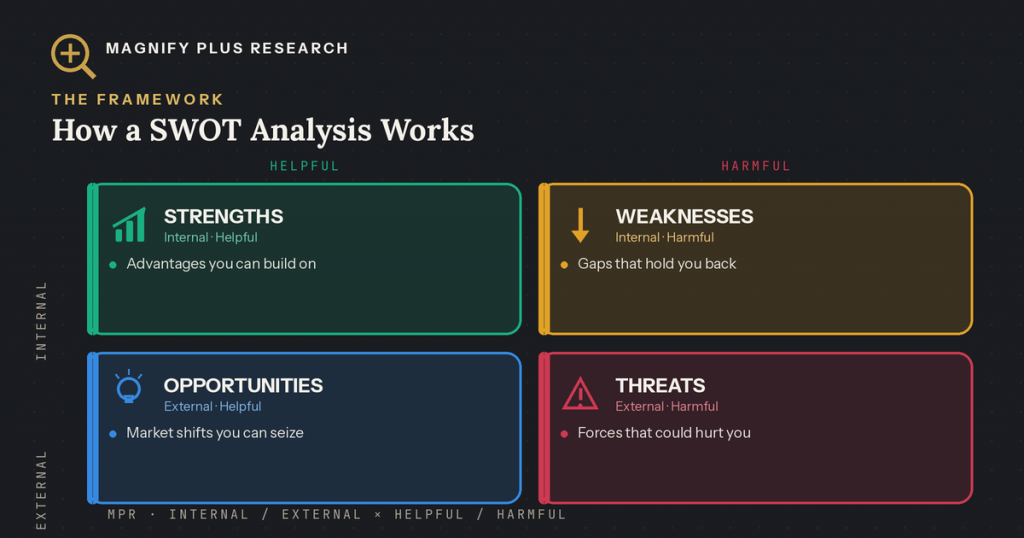
A SWOT analysis is a simple framework that maps your business across four categories: Strengths, Weaknesses, Opportunities, and Threats. These are usually laid out as a two-by-two grid, and the magic is in how those four boxes are split along two axes:
- Internal vs. external. Strengths and weaknesses are internal, things inside your control (your team, your product, your pricing). Opportunities and threats are external, forces in the market you don’t control (competitors, regulation, consumer shifts).
- Helpful vs. harmful. Strengths and opportunities help you; weaknesses and threats harm you.
Put those together and you get the classic matrix: internal-helpful (Strengths), internal-harmful (Weaknesses), external-helpful (Opportunities), external-harmful (Threats).
Why SWOT matters for businesses in Myanmar and Asia
SWOT is useful everywhere, but it earns its keep in Myanmar and across Asia for specific reasons:
The market moves fast. Inflation, shifting consumer behaviour, new digital platforms, and a volatile operating context mean a position that was strong last year may be exposed today. SWOT gives you a regular, structured checkpoint.
Reliable data is scarce. In many Asian markets, and Myanmar especially, you can’t just download a competitive report and call it insight. A SWOT forces you to ask what you actually know versus what you’re assuming, which is exactly the discipline a low-data market demands.
Competition is intense and local. The players who win in Myanmar are often strong local and regional brands, not the international names you’d expect. A SWOT anchored in real market research in Myanmar keeps you honest about who you’re really up against.
Done well, a SWOT helps you play to your strengths, fix your weaknesses before they cost you, move on opportunities before rivals do, and see threats coming while you can still respond.
The four components, with Myanmar examples
Strengths (internal · helpful)
Strengths are the internal advantages you can build on, the things you do better than rivals. In a Myanmar context, real strengths might include a trusted local brand name, a strong distribution network into secondary cities, a genuine understanding of Burmese-language consumers, or an established presence on Facebook and Messenger where commerce actually happens.
Weaknesses (internal · harmful)
Weaknesses are the internal gaps that hold you back. Common ones here: over-reliance on a single city (usually Yangon), thin data on rural consumers, a cash-only payment flow in a market moving to mobile wallets, or a product priced for a pre-inflation consumer.
Opportunities (external · helpful)
Opportunities are external shifts you can ride. Think: the rapid growth of mobile money, the rise of social commerce, a young and phone-native population, or a competitor stumbling in a category you could own. (Our Myanmar consumer trends overview is a good source of these.)
Threats (external · harmful)
Threats are external forces that could damage you: aggressive local competitors, regulatory or currency shifts, supply-chain and power disruptions, or changing consumer priorities under economic pressure. Naming them doesn’t make them go away, but it lets you plan.
From SWOT to competitor analysis in Myanmar
A SWOT of your own business is step one. Competitor analysis is where it gets powerful: you run a SWOT on each major rival too, then compare. That comparison reveals the gaps: the opportunities they’re ignoring, the weaknesses you can exploit, the strengths you need to neutralise.
In Myanmar, the hard part isn’t the framework; it’s the inputs. Competitor analysis is only as good as the intelligence behind it, and in a market with little public data, that intelligence has to be gathered deliberately: through consumer research, social listening, retail and channel checks, pricing audits, and on-the-ground fieldwork. A SWOT grid filled with assumptions is just a tidy-looking guess. A SWOT grid filled with real data is a strategy.
SWOT analysis examples (illustrative, Myanmar & Asia)
The examples below are illustrative archetypes, not profiles of specific companies. They show what a realistic SWOT looks like in this region.
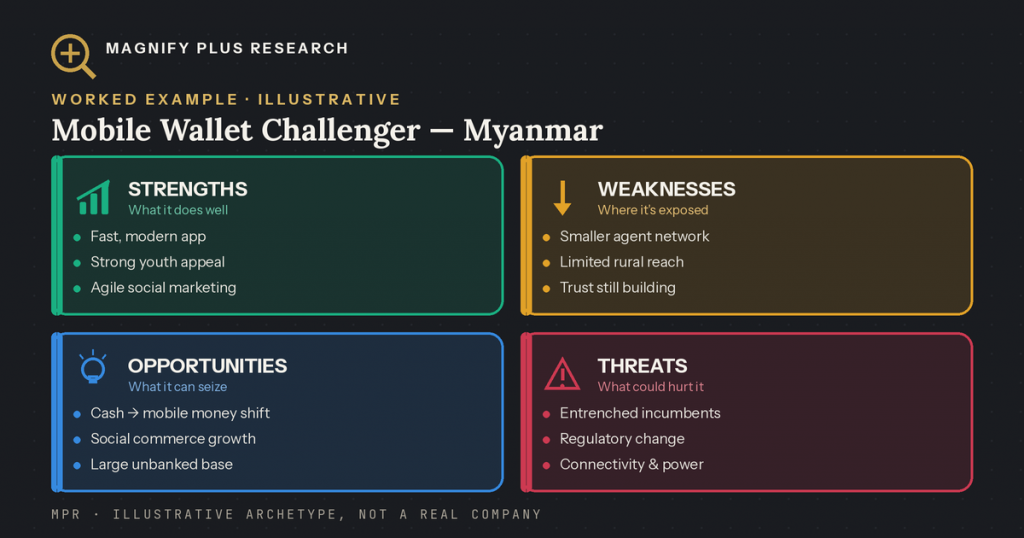
Example 1: A mobile wallet challenger (Myanmar)
- Strengths: fast, modern app; strong appeal to young urban users; agile marketing on social platforms.
- Weaknesses: smaller agent network than incumbents; limited reach in rural areas; brand still building trust for a financial product.
- Opportunities: rapid shift from cash to mobile money; growth of social commerce needing embedded payments; a large unbanked population.
- Threats: entrenched incumbents with bigger networks; regulatory change; connectivity and power reliability; consumer caution about digital finance.
Example 2: An FMCG brand entering Myanmar
- Strengths: established regional supply chain; strong product quality; capital to invest.
- Weaknesses: no local brand recognition; distribution built for other markets; limited grasp of Burmese consumer nuance.
- Opportunities: “premium-affordable” positioning as consumers seek value; under-served categories; social-first route to market.
- Threats: strong incumbent local brands; price sensitivity under inflation; the cost and difficulty of national distribution.
Example 3: A regional e-commerce player expanding across Asia
- Strengths: proven platform and logistics tech; scale and brand across multiple markets.
- Weaknesses: one-size-fits-all playbook that ignores local behaviour; thin last-mile coverage in newer markets.
- Opportunities: rising smartphone penetration across Asian markets; demand for reliable online retail; partnerships with local sellers.
- Threats: hyper-local competitors; varied regulation across borders; logistics and payment fragmentation.
How to do a SWOT and competitor analysis in Myanmar, step by step
- Define the objective and the competitive set. What decision is this for? Who are the two or three rivals that actually matter? A vague SWOT of “the market” helps no one.
- Gather real data. This is the crux. In a low-data market, decide what you’ll base each quadrant on: consumer surveys, social listening, pricing and shelf checks, expert interviews, distribution mapping. Note where you’re guessing so you can fill the gap later.
- Sort findings into the four quadrants. Be ruthless about internal vs. external; a common error is filing an external threat as an internal weakness.
- Prioritise. Not every point matters equally. Flag the two or three items in each box that would most change your decisions.
- Turn it into action. The output isn’t the grid; it’s a short list of moves: strengths to press, weaknesses to fix, opportunities to chase, threats to defend against.
Common mistakes to avoid
- Filling it with opinion, not evidence: the fastest way to a confident, wrong strategy.
- Being vague: “good marketing” tells you nothing; “strong Messenger response time vs. competitors” is actionable.
- Confusing internal and external: strengths/weaknesses are yours; opportunities/threats are the market’s.
- Doing it once: in a market as fast as Myanmar, a SWOT is a living document, not a one-off.
- Stopping at the grid: analysis without action is just decoration.
Free SWOT analysis template
Use the template below to run your own. Copy the four-quadrant grid, drop your findings (or a competitor’s) into each box, and mark which points are evidence-based versus assumptions to verify.
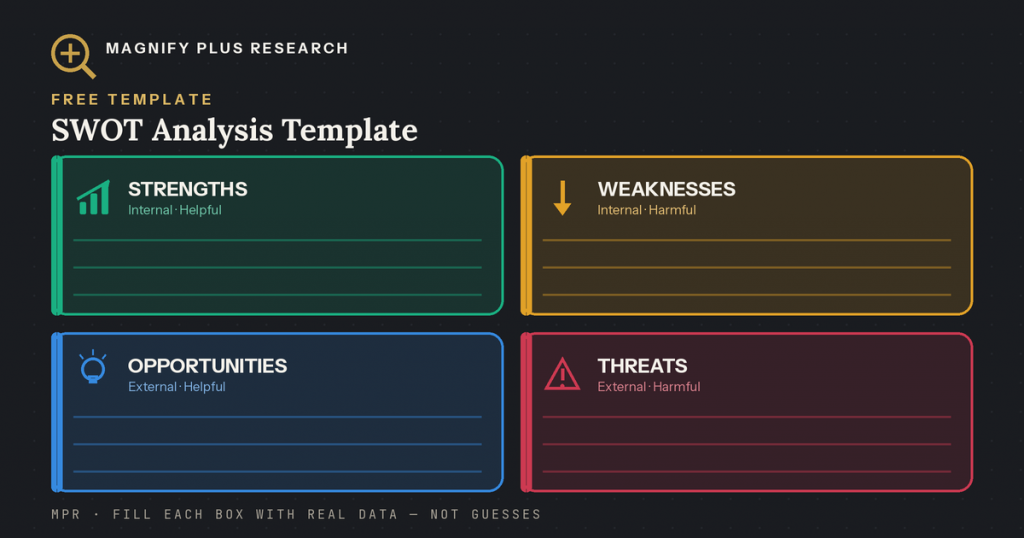
For the analysis to be worth anything, those boxes need real inputs. That’s where market research comes in, and where a low-data market like Myanmar rewards teams who invest in genuine, local intelligence over borrowed assumptions.
Frequently asked questions
What is a SWOT analysis used for? To evaluate a business across four dimensions (strengths, weaknesses, opportunities, and threats) so you can make better strategic decisions. It’s widely used for planning, competitor analysis, and market-entry assessment.
How is SWOT used in competitor analysis? You run a SWOT on each major competitor as well as your own business, then compare. The comparison reveals gaps to exploit, rival weaknesses to target, and threats to prepare for.
Why is competitor analysis harder in Myanmar? Because public and secondary data is scarce, so reliable competitive intelligence must be gathered through primary research (consumer studies, social listening, pricing and channel checks) rather than downloaded from a report.
How often should I update a SWOT analysis? In a fast-moving market like Myanmar or much of Asia, at least once or twice a year, and whenever a major shift occurs: a new competitor, a regulatory change, or a clear move in consumer behaviour.
One thought on “SWOT Analysis in Myanmar: Examples, Free Template, and How to Run Competitor Analysis”
Comments are closed.