

A Magnify Plus Research (MPR) Market Brief Based on Secondary Research
Executive Summary
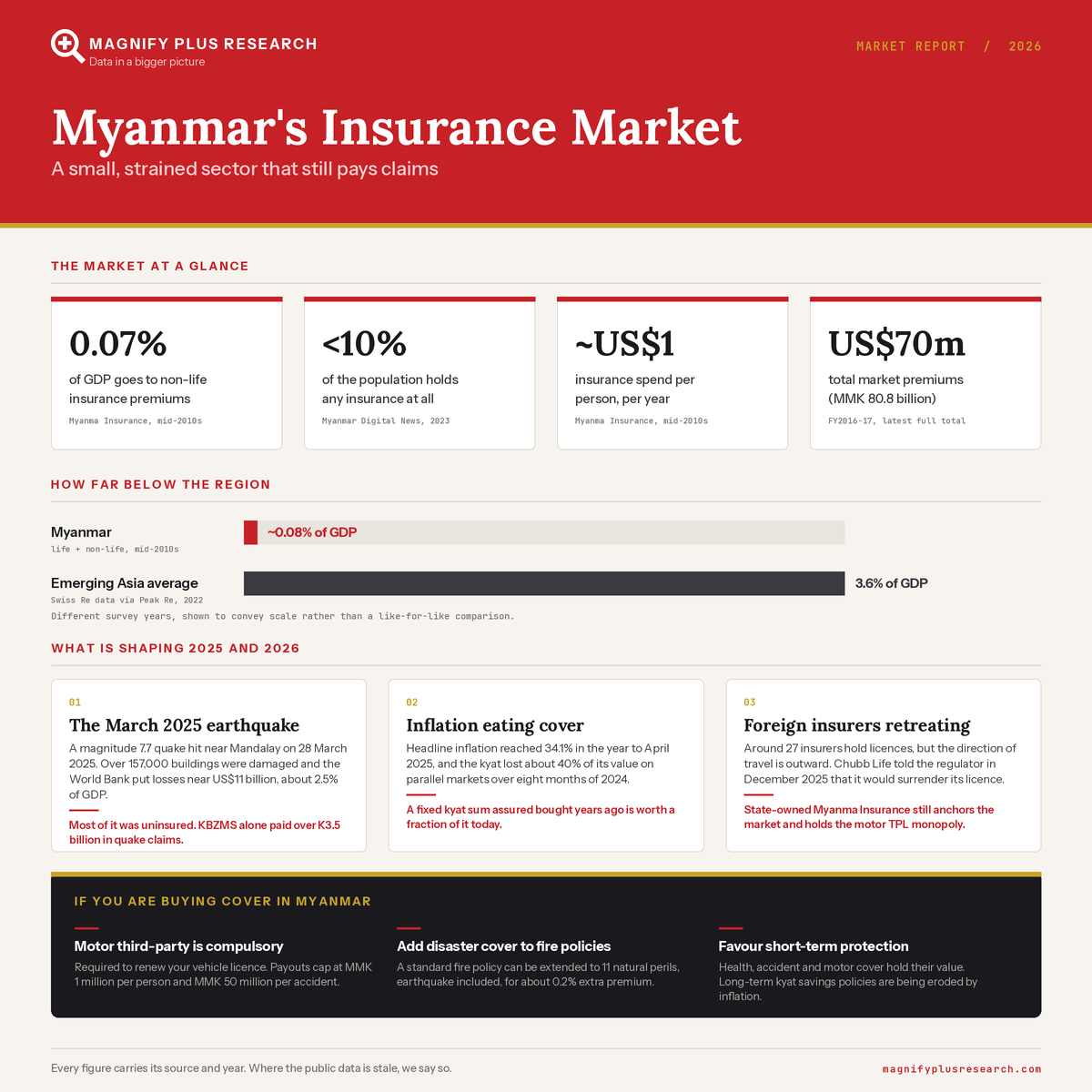
- Myanmar’s insurance market remains one of the smallest and least-penetrated formal insurance markets in the region. Historical figures indicate insurance penetration of roughly 0.07% of GDP for non-life insurance and 0.01% for life insurance. These figures date from earlier industry sources and should be treated as historical indicators rather than precise 2026 estimates.
- The formal insurance sector continues to operate in 2026 despite severe economic and operating pressures, including currency depreciation, high inflation, conflict, sanctions-related constraints, and the aftermath of the devastating 28 March 2025 earthquake.
- Myanma Insurance remains a structurally important institution in the market, particularly in compulsory insurance and reinsurance arrangements. Private insurers continue to operate across life and non-life segments, although competition remains constrained by regulatory and economic conditions.
- Foreign-linked insurers have also faced increasing operating challenges. Chubb Life’s announced exit from Myanmar in December 2025 illustrates the difficult environment for international insurance businesses.
- The March 2025 earthquake highlighted both the value of insurance and Myanmar’s significant protection gap. Insurers processed earthquake-related claims, but a large share of economic losses remained uninsured.
- For consumers, short-term protection such as health, personal accident, motor, fire, and natural-disaster coverage may provide particularly tangible value in the current environment. Long-term kyat-denominated life and endowment products require careful consideration because high inflation can substantially reduce the real value of future benefits.
- Current industry-wide market-size data remains limited. The most defensible publicly available total-market gross written premium (GWP) figure identified in this review is approximately MMK 80.8 billion for FY2016–17. This should be treated as a historical benchmark, not as an estimate of the 2026 market size.
Key Findings
1. The market is small, data-constrained, and difficult to measure. The most defensible publicly available industry-wide gross written premium (GWP) figure identified in this review is approximately MMK 80.8 billion (about US$70 million) for FY2016–17. Comprehensive, recent industry-wide GWP figures for 2022–2024 are difficult to verify through freely available public sources, while some commercial insurance databases remain behind paywalls. As a result, historical market figures should not be presented as current 2026 market-size estimates.
2. Myanma Insurance (MI) remains structurally important. MI is state-owned and has a central role in Myanmar’s insurance system. It holds an important position in compulsory motor third-party liability insurance, participates in reinsurance arrangements, and offers a broad range of insurance products. Its institutional position differs from that of private insurers, making it an important anchor of the market.
3. Private competition exists but is constrained. Twelve local private insurers were licensed from 2013; roughly 11 remained active. Because the regulator historically set standardised premiums and terms, private insurers competed mainly on service, not price. Key local names: IKBZ (KBZ Group, now KBZMS after its Mitsui Sumitomo JV), Grand Guardian (GGI), AYA Myanmar (AMI), Capital Life, Citizen Business Insurance (CB Insurance), First National Insurance (FNI), Aung Myint Moh Min, Aung Thitsar Oo, Excellent Fortune (EFI), Global World, Young Insurance, Pillar of Truth, and Ayeyar Myanmar.
4. Foreign insurers are pulling back. Five wholly foreign-owned life insurers were licensed in 2019 (AIA, Chubb, Dai-ichi, Manulife, Prudential) plus six JVs. In December 2025, Chubb Life announced it would surrender its licence and exit: per Myanmar Now (22 December 2025), Zurich-headquartered Chubb “informed the country’s military regime that it could no longer operate under the current economic and political conditions”; per Eleven Media, Chubb submitted a letter to the IBRB “requesting the company to surrender its insurance license and close its representative offices,” agent systems went down on 12 December, and it said it “would suspend and cancel all insurance policies sold from December 15,” with 100% premium refunds. This is a bellwether of deteriorating conditions.
5. The March 2025 earthquake is the defining recent event. Per USGS and Britannica, a magnitude 7.7 quake struck near Mandalay at 12:50pm local time on 28 March 2025 at 10km depth, followed 12 minutes later by a Mw 6.7 aftershock, the most powerful to strike Myanmar since 1912. Per the UNU-INWEH “Building Damage Assessment of the March 2025 Myanmar Earthquake” (Shirzaei et al., 16 June 2025): “over 157,000 buildings identified as likely damaged… the earthquake resulted in 3,600 to 5,350 deaths and left approximately 200,000 people without homes,” with the town of Woundwin worst-hit (73% of buildings affected). The World Bank estimated total damage at about US$11 billion (around 2.5% of GDP). Most losses were uninsured (a large protection gap), but insurers with exposure did pay, and awareness of catastrophe cover has since jumped.
6. Consumer awareness, trust, and perceived value remain important barriers. Available secondary research and industry commentary indicate that limited insurance knowledge, low trust in financial institutions, and confusion between insurance and investment can affect consumer adoption. At the same time, the absence of recent nationally representative consumer research makes it difficult to quantify current awareness, willingness to pay, or insurance attitudes across Myanmar.
Details
Market fundamentals and how to read the numbers
How to read the data: Myanmar’s insurance statistics are uneven in availability and recency. Throughout this report, historical figures are identified by their reference year and should not automatically be interpreted as current 2026 market estimates. Where current industry-wide data could not be reliably established, this report does not produce an unsupported estimate.
Myanmar’s insurance market is a genuine “last frontier” in Southeast Asia. The most-cited penetration figures, attributed to Myanma Insurance managing director Daw Sandar Oo (via Lexology, “Myanmar Insurance Market: The Last Frontier of Insurance in South East Asia”), are 0.07% of GDP for non-life and 0.01% for life, with insurance density of about US$1 per capita and roughly 500,000 life policies for a population over 53 million. These date to the mid-2010s and should be treated as illustrative of scale rather than current precision.
For comparison, the same source noted Myanmar’s penetration was around 60 times smaller than Vietnam’s and 100 times smaller than the Philippines’. Across emerging Asia, penetration averaged about 3.6% of GDP in 2022 with density of US$229 (Peak Re, citing Swiss Re data), which underlines just how far below the regional norm Myanmar sits. The World Bank/Swiss Re series shows Myanmar life premium at about 0.047% of GDP in 2020, the most recent official-style datapoint.
The most defensible total-market figure identified in available secondary sources remains approximately MMK 80.8 billion / US$70 million in GWP for FY2016–17, with non-life insurance contributing more than 70% of the market at that time. Historical estimates of population insurance take-up have also indicated coverage of less than 10%. These figures should be treated as historical indicators rather than current 2026 estimates.
Company-level snapshots survive from Statista/MMSIS government data: in fiscal 2021, Aung Myintmo Minn led life premiums at about MMK 32.5 billion, followed by CB Insurance at about MMK 9.4 billion; in fiscal 2022, GGI Tokio Marine led non-life premiums, followed by IKBZ MS. These are fragments, not a full market map.
The competitive landscape
Myanma Insurance (state-owned). The anchor of the market since 1993, operating around 38-39 branches nationwide. It holds the compulsory motor third-party liability monopoly (required for annual vehicle licence renewal), a monopoly-like role in reinsurance placement, and a captive base from public-sector employees who must buy life cover from MI. It reported substantial reserve funds (Life Fund about MMK 18 billion, General Fund about MMK 132.6 billion). It is exempt from the regulator’s oversight (Article 35 of the 1996 law) and sets its own tariffs.
Local private insurers (licensed from 2013). IKBZ/KBZMS (KBZ Group) was the first licensed private insurer (registration 001, May 2013) and historically the largest private non-life player (about 52% of private non-life GWP in 2017, per Oxford Business Group). Others: Grand Guardian (GGI), AYA Myanmar Insurance (AMI), First National Insurance (FNI), Capital Life, Citizen Business Insurance/CB Insurance, Aung Myint Moh Min, Aung Thitsar Oo, Excellent Fortune (EFI), Global World Insurance, Young Insurance, Pillar of Truth, and Ayeyar Myanmar. Many are affiliated with banks and conglomerates (IKBZ-KBZ, AYA-AYA Bank, CB-CB Bank), which double as distribution channels.
Foreign insurers and JVs. Wholly foreign-owned life licences (2019): AIA (Hong Kong), Chubb (US), Dai-ichi Life (Japan), Manulife (Canada), Prudential (UK/Hong Kong). Life JVs: Grand Guardian Life-Nippon Life; Capital Life-Taiyo Life; Citizen Business Insurance-Thai Life. Non-life JVs: AYA Myanmar-Sompo (AYA SOMPO); Grand Guardian General-Tokio Marine (GGI Tokio Marine); IKBZ-Mitsui Sumitomo (KBZMS). Foreign partners could hold up to 35% of a life JV; for non-life, foreign majority up to 65% was permitted under the 2019 framework. A further life and non-life JV was licensed in January 2023, bringing the total to around 27 licensed insurers as of early 2023.
The retreat. Post-2021, the operating environment turned hostile: sanctions exposure, FATF blacklisting, reputational risk, currency and repatriation problems, and physical danger. Chubb Life announced its exit in December 2025 (details above); policyholders publicly demanded refunds. This follows the broader pattern of foreign disengagement and, in the words of one Yangon underwriter quoted by Axco, a market operating with “crossed fingers.”
Regulation and policy
The regulator is the Insurance Business Regulatory Board (IBRB), reconstituted on 9 March 2021, operating under the Ministry of Planning and Finance through the Financial Regulatory Department (FRD). The governing laws remain the Myanmar Insurance Law (1993), Insurance Business Law (1996), and Insurance Business Rules (1997). A new Insurance Business Law has been drafted and under discussion for years but has not been enacted as a modernised replacement; private insurers still effectively operate under the 1990s framework.
Capital requirements (MMK): life MMK 6 billion; non-life MMK 40 billion; composite MMK 46 billion. Of paid-up capital, 10% must be deposited at Myanmar Economic Bank and 30% invested in government treasury bonds; capital is solvency-margin based, not risk-based. Product approval runs through the IBRB (Directive 1/2020), with a 90-day approval window. The market is nominally “free-rated” but private insurers in the same line historically had to offer the same premiums, limiting price competition.
Compulsory insurance consumers must know about:
- Motor third-party liability (TPL): required for annual vehicle licence renewal, purchased from Myanma Insurance. Maximum compensation for death/bodily injury to a third party is MMK 1,000,000, with a MMK 50,000,000 cap per single occurrence.
- Inbound cross-border vehicles pay TPL at checkpoints (Myawaddy, Muse, Tachilek, Tamu) under the ASEAN Compulsory Motor Insurance (ACMI) scheme.
- A 2014 rule introduced compulsory accident insurance for anyone travelling 100 miles or more on local roads.
- Public-sector employees must insure their lives with Myanma Insurance.
- Foreign-investment enterprises face compulsory property, marine, personal accident, and general liability requirements.
Reinsurance rules: All insurers must offer up to 10% of each risk to Myanma Insurance first; the remainder can go to cross-border reinsurers rated BBB or above (with cession caps by rating). A minimum 20% retention applies to life portfolios.
Macro and operating context
Currency and inflation. Per the World Bank Myanmar Economic Monitor (December 2024), “the kyat lost 40 percent of its value against the US dollar on parallel markets over the first eight months of 2024,” stabilising since October 2024; parallel rates reached around 5,000 kyat per dollar in early 2024 versus an official peg near 2,100. Bank of Ayudhya (Krungsri) projected inflation would average 26% for fiscal 2024-25, and the World Bank Myanmar Economic Monitor (12 June 2025) reported that “headline inflation rose to 34.1 percent over the year to April 2025, up from 24.7 percent over the previous year,” with food inflation at 29.5% and non-food inflation rising from 21.6% to 36.4%. This is corrosive for long-term life insurance: a fixed kyat sum assured taken out years ago is worth a fraction of its original real value today. This creates an important consumer consideration for endowment and whole-life products.
Reinsurance and sanctions. International reinsurers and brokers have withdrawn or curtailed Myanmar business; local insurers sought reinsurance mainly in Singapore and other ASEAN markets, complicated by sanctions on some banks and FX constraints (Axco, April 2025). This pushes insurers to retain more risk and leaves catastrophe risk under-covered. One practical fix flagged by market observers: allowing private insurers to collect premium and pay claims in foreign currency, so they can buy reinsurance without currency risk.
The March 2025 earthquake. Beyond the human toll (above), insurance did respond even as most losses went uninsured. KBZMS paid out over K3.5 billion in earthquake-related benefits as of 19 June 2025 (Global New Light of Myanmar, 23 June 2025), up from K1.238 billion as of 22 May. Myanma Insurance opened fire-and-earthquake claims: a standard fire policy can be extended to cover 11 natural-disaster perils including earthquake, at roughly 0.2% extra premium. Many construction workers killed or injured reportedly lacked accident insurance because employers had not bought voluntary cover. Demand for natural-disaster cover, especially among Yangon high-rise residents, has since risen sharply. (For scale, insured losses on the Thai side of the same quake were far larger and better-covered: the Thai General Insurance Association estimated claims there could reach around 50 billion baht / about US$1.53 billion, absorbed mostly by reinsurers, a stark illustration of Myanmar’s protection gap.)
Segments in plain language
Life insurance. Individual life, endowment, term, and group life are offered by MI and private/foreign insurers. Endowments are marketed partly as savings, but inflation and kyat depreciation have gutted their real returns. Government personnel life assurance is a captive MI line.
General/non-life. Motor (compulsory TPL plus voluntary comprehensive), fire and allied perils (extendable to natural disasters), marine cargo and hull, travel, health/medical, personal accident, engineering (contractors’ all risks, erection all risks), liability, and nascent agriculture/crop cover. Comprehensive motor is voluntary, term up to one year.
Health and accident (consumer-relevant detail). Myanma Insurance basic health units run around MMK 11,000/year with modest daily hospitalisation payouts (around MMK 10,000/day, up to 60 days). Mid-tier private plans (AYA SOMPO tiers, Prudential PRUHealth, AIA) offer higher ceilings (up to about MMK 25 million) and cashless hospital networks, at tens of thousands of kyat per year. Personal accident cover ranges from micro products (from about MMK 1,250 premium for MMK 500,000 cover via MPT’s mobile product) up to MMK 20 million sums assured. Common exclusions: pre-existing conditions, maternity (unless a rider), dental/optical, intoxication, illegal acts.
Microinsurance. Historically thin. Myanmar has had “microinsurance-like” products such as snakebite insurance (premium MMK 5,000, paying up to MMK 500,000 on death or up to MMK 400,000 medical), highway travel accident cover, and property. Weather-index insurance for rice farmers has been piloted (e.g. Labutta, Ayeyarwady) with GIZ and academic support, and climate-advisory programmes reached tens of thousands of farmers (26,064 crop and fish farmers in 2024 via Village Link’s Htwet Toe app). Rural awareness is very low; most rural policyholders only hold cover because a loan required it.
Distribution and digital
Agents may represent up to three insurers (including MI). Bancassurance via KBZ, AYA, and CB banks is growing. Brokers remain underdeveloped: only one major international broker runs a representative office and, as of 2025, no local broker held a full licence. Mobile wallets are a real channel: WavePay (Wave Money, roughly 60,000 agents and 200,000+ merchants) lets users pay premiums for Prudential, Manulife, Capital Taiyo, Young Insurance, and KBZMS, and KBZPay offers similar reach. Mobile microinsurance (e.g. MPT’s Thet Taw Saunt) and telemedicine-linked products are early but promising.
Outlook for 2026 and beyond
The near-term outlook is survival, not expansion. Independent analysis (myanmarinsurance.com, August 2025) frames post-election 2026 scenarios as a “Façade of Stability” or “Protracted Stalemate,” both implying continued crisis with no meaningful recovery, and a lower-probability “Escalation and Fragmentation” that would collapse the formal market. Structural barriers to growth: hyperinflation eroding capital and long-term product value, FX and repatriation constraints, withdrawn reinsurance capacity, sanctions and reputational risk, low trust, and stale regulation. What would change the trajectory: currency stabilisation and single-digit inflation, enactment of the modernised Insurance Business Law with genuine product and price freedom plus stronger consumer protection, permission to transact in foreign currency, and the return of international reinsurers. Digital distribution and short-term, disaster-focused microinsurance are the most plausible growth areas.
Recommendations
For consumers (staged, practical):
- Buy compulsory cover correctly. Renew motor TPL through Myanma Insurance at licence renewal; keep the certificate. Know the payout caps (MMK 1 million per person, MMK 50 million per event) so you are not surprised.
- Prioritise short-term, tangible protection over long-term kyat savings products. In a high-inflation environment, consumers may find health, personal accident, and annual fire/natural-disaster cover easier to evaluate in terms of immediate protection than multi-year endowment products.
- Add natural-disaster cover to fire policies if you own property, especially in Mandalay, Sagaing, and along the Sagaing Fault; the extra premium is small (around 0.2%).
- Do due diligence on the insurer. Confirm it is IBRB-licensed, ask for the claims-settlement record, read exclusions and waiting periods, and prefer insurers with strong local backing and cashless hospital networks. Treat foreign-brand presence as no longer a guarantee of permanence, given Chubb’s exit.
- Keep evidence. Photograph assets, keep policy documents and payment receipts (mobile-wallet records help), and contact the insurer promptly after any loss.
Benchmarks that would change this advice: a stabilised kyat and single-digit inflation would restore the case for long-term life/endowment products; enactment of the new Insurance Business Law with genuine product/price freedom and stronger consumer-protection and guarantee mechanisms would raise trust; and a return of international reinsurers would improve catastrophe capacity and claims security.
Caveats
- Data Limitations. This publication is based on secondary research and publicly available information. It does not present findings from an MPR primary consumer survey or proprietary industry-wide insurance dataset.
- Data is old and patchy. The strongest total-market figures are from 2016-17; penetration and density figures are mid-2010s vintage. Publish these as historical/illustrative, not current.
- Company-level premium data is fragmentary (fiscal 2021-2022 fragments) and partly paywalled.
- The new Insurance Business Law’s enactment status is unconfirmed; treat “new law” claims cautiously.
- Death-toll and damage ranges vary by source (official counts near 3,600; UNU-INWEH cites a 3,600-5,350 range). We report the range rather than a single figure.
- Political framing: this report documents facts (sanctions, FX rules, conflict, foreign exits) without political advocacy.
- Claims-ratio and complaint data for Myanmar are not publicly quantified in reliable aggregate; the Chubb refund complaints and uninsured-worker reports are documented instances, not a measured complaint rate.
Consumer FAQs (People Also Ask)
Is insurance compulsory in Myanmar? Only some types. Motor third-party liability is compulsory to renew your vehicle licence and must be bought from Myanma Insurance. Public-sector staff must hold life cover with Myanma Insurance. Most other insurance is voluntary.
How much is motor third-party insurance in Myanmar? Premiums depend on vehicle type and size. The compulsory TPL pays up to MMK 1,000,000 for death or injury to another person, capped at MMK 50,000,000 per accident. Comprehensive motor cover is separate and voluntary.
Does home or fire insurance cover earthquakes? Not automatically, but a fire policy can be extended to cover natural disasters including earthquakes for a small extra premium (around 0.2%). After the March 2025 quake, many people added this cover.
Will I actually get paid if I claim? Yes, insurers do pay valid claims. After the 2025 earthquake, KBZMS paid over K3.5 billion and Myanma Insurance processed fire-and-earthquake claims. But you must have the right cover, follow the claims process, and watch for exclusions.
Is life insurance a good investment in Myanmar right now? Be careful. With high inflation and a falling kyat, the real value of long-term, fixed-sum life and endowment policies has fallen sharply. Short-term protection (health, accident, term) often gives clearer value today.
Which insurers operate in Myanmar? The state-owned Myanma Insurance plus private firms including IKBZ/KBZMS, Grand Guardian, AYA Myanmar, First National, Capital Life, CB Insurance, and others, plus foreign-linked life insurers such as AIA, Dai-ichi, Manulife, and Prudential. Note that Chubb Life announced its exit in December 2025.
Can I buy insurance on my phone? Yes. Mobile wallets like WavePay and KBZPay let you pay premiums for several insurers, and some micro-cover products are sold directly through mobile channels.
How do I complain if my claim is denied? Keep all documents and communications, contact the insurer’s claims office, and escalate to the Insurance Business Regulatory Board (IBRB) under the Ministry of Planning and Finance. Formal consumer-recourse mechanisms are still developing, so documentation is your best protection.
Source list (key references)
- Axco Insurance Information: “Myanmar’s Insurance Market Faces the Earthquake Challenge” (April 2025); Myanmar country market data.
- HLAP broker country profile (Myanmar): legislation, compulsory classes, reinsurance rules, distribution.
- Tilleke & Gibbins: Myanmar market snapshot and reinsurance directives; Lexology and DFDL legal updates; VDB Loi (capital and ownership rules).
- Financial Regulatory Department (frd.gov.mm); Ministry of Planning and Finance (mopf.gov.mm); Myanma Insurance (mminsurance.gov.mm).
- Global New Light of Myanmar: 27 insurers operating; KBZMS earthquake payouts (23 June 2025); Myanma Insurance third-party claims; disaster-cover demand.
- Myanmar Now and Eleven Media: Chubb Life exit (December 2025).
- Frontier Myanmar Financial Services Monitor: Chubb Life closure (30 December 2025).
- World Bank Myanmar Economic Monitor (December 2024; June 2025): currency, inflation.
- Bank of Ayudhya (Krungsri) Regional Outlook 2025: inflation projection.
- UNU-INWEH Building Damage Assessment (Shirzaei et al., 16 June 2025); USGS; Britannica; World Economic Forum; Guy Carpenter earthquake reports.
- Peak Re; Swiss Re/World Bank penetration data; Lexology “Last Frontier” (Myanma Insurance MD); Oxford Business Group; Statista/MMSIS company-level data.
- The Professional Consortium (microinsurance in Myanmar); GIZ/ASEAN agricultural insurance; Springer (weather-index insurance); FAO/Village Link (Htwet Toe climate advisory).
- Wave Money/WavePay and KBZPay app listings (mobile premium payment channels).
Note: Several key statistics on total GWP, penetration, insurance density, and life-policy counts originate from historical sources. These figures are presented with their original reference periods and should not be interpreted as precise estimates of the 2026 market size.