

A brand is not just a product. It is the symbol customers attach their trust to, and in a competitive market that trust is one of the most valuable assets a business owns. So when a company decides to change its name, reposition, or rebrand, it is not simply swapping out a logo. It is moving the thing customers have quietly decided to rely on.
Get it right, and a rebrand refreshes the business and opens the door to new audiences. Get it wrong, and years of hard-won loyalty can walk out with the old name. The difference between those two outcomes usually comes down to a single question that too many businesses skip: how will our customers actually feel about this change?
That is a question you can answer before you commit, not after. This is exactly what consumer perception research is built to do, and it is one of the most valuable applications of market research in Myanmar today.
Why rebranding is riskier than it looks
Aggressive marketing has turned brands into genuine assets. A name carries associations built over years: reliability, familiarity, a sense of who the company is and who it is for. When that name changes, all of those associations are suddenly up for renegotiation in the customer’s mind.
The risk is that customers do not experience a rebrand the way the business does. Inside the company, a name change is the end of a long strategic process. To the customer, it can feel abrupt, even suspicious. People wonder what else is changing. They ask whether ownership has changed, whether service quality will slip, whether the thing they trusted still exists under the new name. Left unanswered, those questions turn into hesitation, and hesitation is how loyal customers become switchers.
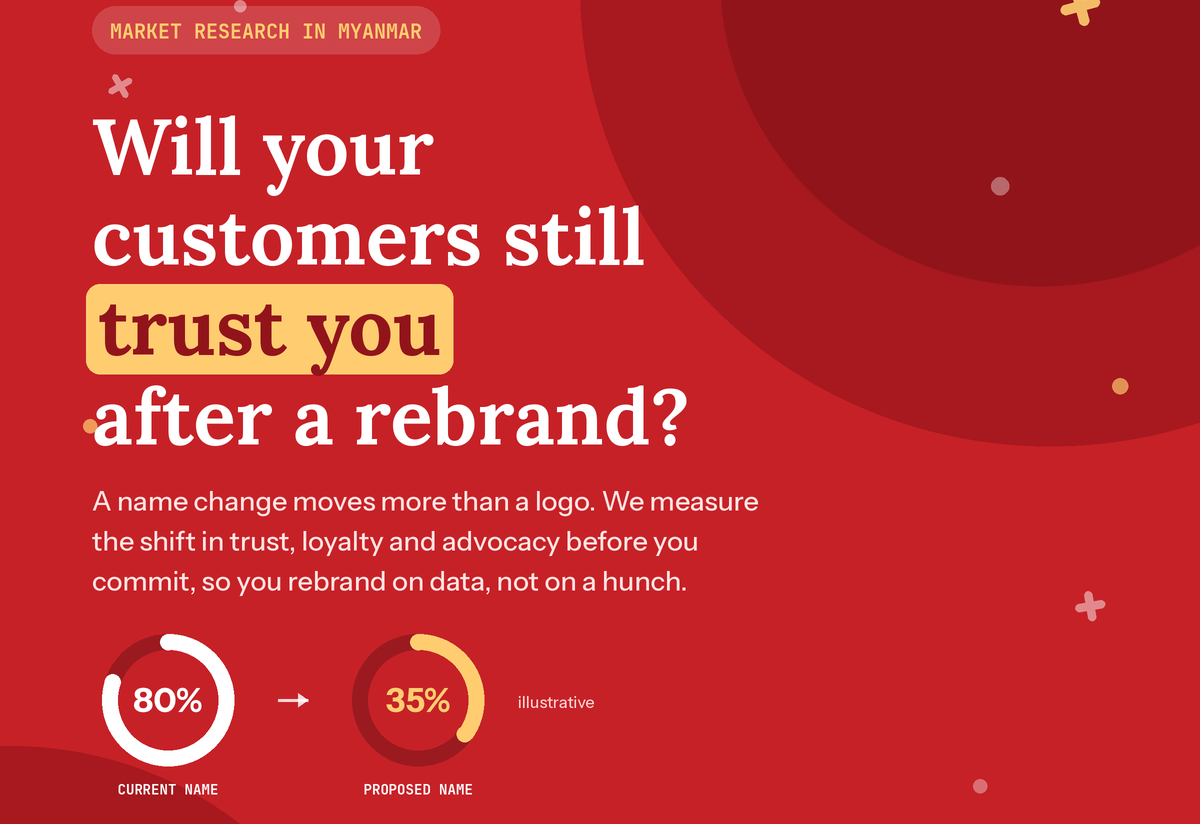
The uncomfortable reality is that a name change can move brand trust sharply. In illustrative perception studies, the share of customers who describe a brand as trustworthy can fall significantly between the current name and a proposed new one, even when the product, the people, and the service behind it are completely unchanged. Same company, different name, very different level of confidence.
That gap is not a reason to avoid rebranding. It is a reason to measure it first.
What consumer perception research actually measures
Understanding how customers will respond to a rebrand means looking at the complete customer journey, not just a single reaction to a new logo. A thorough study traces every meaningful interaction, from the first moment someone browses or considers the brand, through purchase, activation, and everyday use, all the way to the decisions where a customer chooses to stay or switch.
It also covers the places where those interactions happen. Customers form impressions across retail outlets and online platforms alike, and a perception study that only looks at one channel gives you half the picture. Mapping both ensures the findings reflect how people really experience the brand.
To make sense of all this, our research uses the Pillars of Customer Experience Framework, which isolates the factors that shape how customers perceive a brand. Three of those pillars consistently emerge as the strongest drivers of loyalty and advocacy:
- Personalization. Whether customers feel the brand understands and speaks to them specifically.
- Integrity. Whether the brand is seen as honest and dependable, which is the pillar most directly threatened by a name change.
- Time and effort. Whether dealing with the brand feels easy, or whether every interaction costs the customer something.
By measuring perception against these pillars, a study does more than tell you whether customers like a new name. It tells you why they feel the way they do, and which levers you can pull to protect loyalty through the transition.
The questions a rebranding study should answer
A perception study earns its place by answering the specific questions that determine whether a rebrand succeeds. A well-designed research programme sets out to do the following.
Evaluate customer experience. Apply the Pillars of Customer Experience Framework to assess how personalization, integrity, and time and effort influence customer loyalty and advocacy for your brand.
Analyse market trends. Provide insight into the wider market landscape, including major players and their competitive positioning, so a rebrand is read in context rather than in isolation.
Understand the impact on brand loyalty. Surface the specific concerns and expectations customers hold about a name change, and how those feelings are likely to shift perception once the change goes live.
Identify concerns and expectations. Get to the heart of what customers actually worry about when they hear a brand is changing its name, from fears about service quality to questions about ownership.
Develop consumer personas. Break perception down by demographic so strategy can be tailored to the segments that matter, rather than built on a single average customer who does not exist.
Evaluate communication strategies. Test the most effective ways to announce and explain the change so the business can minimise negative perception and carry existing loyalty into the new identity.
Answer those six questions and a rebrand stops being a leap of faith. It becomes a managed decision with the risks understood and the messaging planned.
Why this matters most in a tough economy
Brand health is easy to take for granted when times are good. It becomes critical when they are not. In a challenging economic climate, customers are more cautious, more price-sensitive, and quicker to reconsider the brands they use. A rebrand introduced without understanding perception can tip already-hesitant customers toward a competitor at exactly the moment a business can least afford to lose them.
This is where research pays for itself. A perception study replaces assumption with evidence, giving decision-makers a clear read on the risk before any money is spent on the rebrand itself. It supports the kind of strategic decision-making that drives growth and builds resilience, rather than gambling equity on a name that looks good in a boardroom but has never been tested with the people who actually pay for it.
At Magnify Plus Research, this is core to how we think about market research in Myanmar. Alongside competitor and SWOT analysis, consumer trend research, and AI-powered social listening with Burmese-language capability, consumer perception research gives businesses the full picture before they make a move that is very hard to reverse.
The bottom line
If you are considering a rebrand, a repositioning, or a name change of any kind, the single most valuable thing you can do is find out how your customers will react before you act. Perception can be measured. Loyalty can be protected. And the risk of a name change can be turned into a number you can plan around.
Know the number before you make the call.
Frequently Asked Questions
What is consumer perception research?
Consumer perception research measures how customers think and feel about a brand: how much they trust it, how satisfied they are, and how likely they are to stay loyal or recommend it. In a rebranding context, it compares perception of the current brand with perception of a proposed new name, so a business can see the likely impact of a change before committing to it.
How does rebranding affect customer trust?
A name change can significantly reduce customer trust, even when the product and service stay the same, because customers associate the existing name with reliability and familiarity. A new name raises questions about whether ownership, quality, or the brand itself has changed. Research measures the size of that trust shift so businesses can address concerns before they cost them loyalty.
Why should a company do market research before rebranding?
Rebranding puts years of accumulated brand equity at risk. Market research before a rebrand replaces guesswork with evidence, revealing how customers will react, what concerns they hold, and how best to communicate the change. This lets a business make the decision on data rather than on a hunch, and plan messaging that protects existing loyalty.
What is the Pillars of Customer Experience Framework?
It is a framework that identifies the key factors shaping how customers perceive a brand. In perception studies, personalization, integrity, and time and effort consistently emerge as the strongest drivers of customer loyalty and advocacy. Measuring perception against these pillars shows not just whether customers respond well to a change, but why, and which levers protect loyalty.
Does Magnify Plus Research offer rebranding perception studies in Myanmar?
Yes. Magnify Plus Research provides brand and rebranding perception research as part of its market research services in Myanmar, covering the full customer journey across retail and online channels, with consumer personas broken down by demographic and guidance on communicating a change effectively.