

Pull up a low wooden stool. Order tea by making a kiss-kiss noise to the waiter. You are now doing market research in Myanmar the right way.
Myanmar’s beverage culture is one of the most underrated in Southeast Asia. It is also one of the most useful windows into the country’s consumer behavior, because in Myanmar, what you drink and where you drink it tells you almost everything about who you are, who you are with, and what time of day it is. This is a short, illustrated field note from MPR on what Myanmar actually drinks in 2026, and why brands should care.
A note before we begin. Every price in this piece is a 2026 price, and 2026 prices in Myanmar look nothing like 2020 prices. Hyper-inflation has reshaped the menu. We will flag it as we go.
1. Laphet Yay: Tea That Built a Country
If Myanmar had a national social network before Facebook arrived, it was the teashop. And the drink that runs through it is laphet yay, the unmistakable Burmese milk tea, a mix of strong black tea, evaporated milk, and sweetened condensed milk, served in small porcelain cups with a steaming frothy top.
Tea shops in Myanmar are not coffee shops. They are neighborhood nuclei. They open at dawn and stay open through the day, and across the country, from downtown Yangon to villages in Kachin State, they are where deals are brokered, gossip travels, newspapers are read, and political conversations happen quietly across short square tables. The classic picture is unchanged for decades: men in longyis, samosas on the table, free flowing yay nway gyan (Chinese green tea) topped up endlessly, and a waiter wandering by with a giant kettle pouring tea from a dramatic height to oxidize the brew and make the foam.
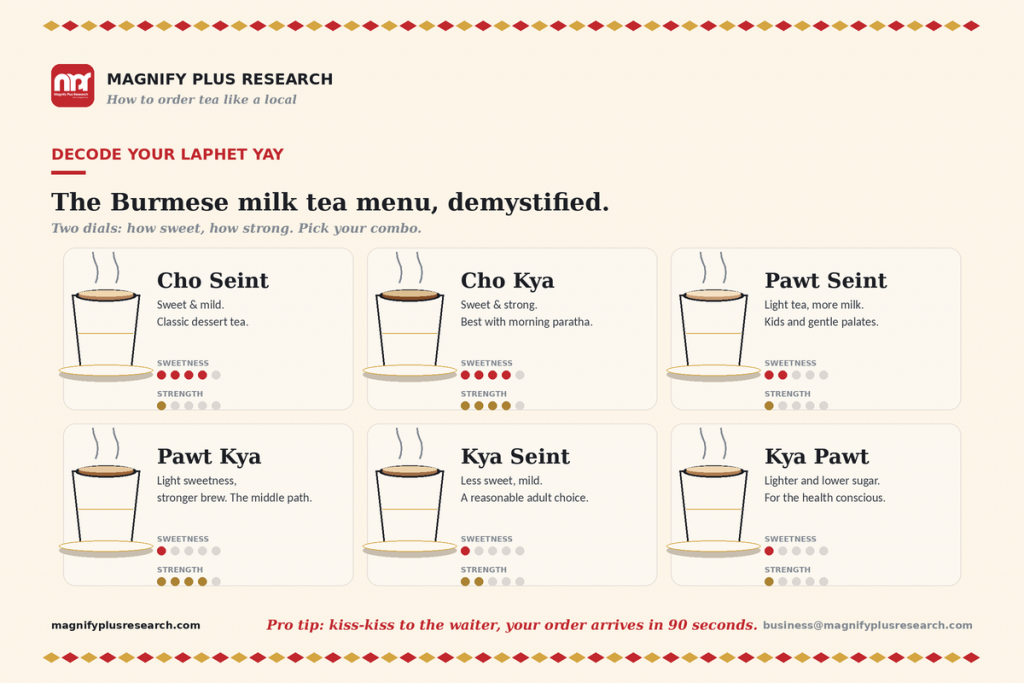
The drink itself has at least twenty variations. They orbit two dimensions: how sweet (cho is sweet, kya is less sweet) and how strong (pawt is light, seint is mild). Order cho seint and you are getting a sweet dessert-grade brew. Order pawt kya and you are getting something a long-haul reader of the morning paper would respect. Modern operators like Rangoon Tea House serve sixteen variations of laphet yay on a color-coded chart.
The price shock. A cup of laphet yay at a normal neighborhood tea shop cost 300 to 500 kyat just a few years ago. In 2026, the same cup is around 1,500 kyat. At premium tea houses like Rangoon Tea House, a single laphet yay can run up to 12,000 kyat. That is a three-to-twenty-four-times jump for the same drink in less than five years, depending where you sit. Inflation has not killed the ritual. It has reshaped who can afford it daily and who treats it as a small luxury.
The brand insight: in Myanmar, tea is identity, and the identity now comes in multiple price tiers. Brand teams that try to ladder hot beverage categories on global benchmarks should understand that laphet yay is not just tea. It is the social default. Beverage brands competing for share of throat in Myanmar are competing with this entire ecosystem first.
2. The Bubble Tea Plot Twist (and the Price Twist)
Then bubble tea arrived. And Myanmar absolutely did not see it coming.
Chatime opened in Myanmar back in 2003, and Gong Cha followed into Yangon malls. The boba boom matured as Taiwanese chains and local players opened side by side. Today the bubble tea landscape includes Gong Cha and Chatime at the international tier, Serenitea and Magic Bubble Tea among the homegrown chains, and a wave of local players running brown sugar pearls, taro milk tea, lychee yoghurt, and matcha red bean to a young, mobile, Facebook-driven audience.
Here is the price reality nobody outside Myanmar is tracking properly. In 2020, a small bubble tea was around 2,000 kyat. In 2026, the same cup runs 9,000 to 12,000 kyat. That is a four-to-six-times increase in under six years. And bubble tea is still flying off the counter, because in Myanmar, bubble tea is not a beverage decision. It is an outing. A Gong Cha cup in hand is a small statement, photographed for a Facebook story. The price floor has lifted but the cultural ritual has not budged.
A few other things about how Myanmar took to bubble tea worth knowing.
The discovery channel is, of course, Facebook. New flavors and seasonal drops get launched on Facebook pages with live demos, and the actual sale closing for smaller boba shops often happens in Messenger DM. We have written about this elsewhere. The same playbook applies in beverage as it does across the rest of Myanmar e-commerce.
Bubble tea is also not displacing laphet yay. It is sitting next to it. The Gen Z customer who buys a brown sugar boba at 2 PM will still meet her grandfather at the tea shop in the morning for laphet yay. Beverages here stack rather than substitute.
3. Coffee: From Filter Sock to 15,000 Kyat Cappuccino
Coffee in Myanmar has two faces.
There is khafe saing, the traditional roadside coffee experience, where dark-roasted Robusta gets brewed through a fabric sock filter and served with sugar. Khafe oh is the basic order, strong and black. This style is the cousin of the laphet yay tea shop, and you can find it across the country at a price that still tracks roughly with tea.
Then there is the modern face. Yangon and Mandalay are now full of espresso-based cafes that look indistinguishable from a Bangkok or Hanoi independent coffee shop. Flat whites, lattes, cold brews. Many of them brew Myanmar Arabica from the Shan and Mandalay highlands, which has quietly become a category to watch. The Mandalay Coffee Group, founded in 2014, was central to building Myanmar’s specialty coffee scene, with the first US specialty exports in 2016. Producers like Sithar Coffee, Amayar, Shwe Taung Thu, The Lady Specialty Coffee (women-run), and Ruby Hills Estate are putting Myanmar on the international coffee map.
The pricing reset here is just as dramatic. A cappuccino in a modern Yangon cafe was around 2,000 kyat a few years back. In 2026, a normal coffee shop will charge 12,000 to 15,000 kyat for the same drink. Specialty cafes price higher still. The Yangon and Mandalay specialty coffee scene has effectively become a premium category by default, not by design.
For brands, the takeaway is that Myanmar coffee is now bifurcated by both age and income. Roadside khafe oh is still a daily habit for older urban men because it has held its price relative to other dailies. Specialty cafe coffee is a Gen Z and millennial weekend ritual that consumers stretch their budgets to afford. Both grow. Neither is the other.
4. Juices, Palm Wine, and Everything Else
Myanmar’s tropical fruit basket runs through the day in glasses, plastic bags, and coconut shells, and it is the one category where prices have held up best for consumers.
The headliner is kyan ye, sugarcane juice. Street vendors press fresh cane through metal rollers and serve it ice-cold. It is everywhere, and during Thingyan (the water festival) it becomes the unofficial drink of the season. Fresh fruit juices, especially mango, watermelon, pineapple, and lime, get blended on the spot from corner stalls. Sometimes salt goes in. Sometimes the whole thing is served in a plastic bag with a straw. Of all the categories in this article, juice has stayed the most affordable for everyday consumers, which has quietly made it the cheapest ritual standing.
Two beloved categories deserve their own line. Falooda, the Indian-influenced dessert drink of milk, rose syrup, jelly, basil seeds, and noodles, is a cherished afternoon indulgence. Shwe yin aye, literally “cool heart,” is the Burmese answer: coconut milk, sago, bread, and jelly served over crushed ice. Both are nostalgic, comforting, and woven through childhood memories for most Burmese consumers.
And then there is htan ye, palm juice, drawn from toddy palms in central Myanmar. Fresh it is sweet and lightly fizzy. Fermented it is the local toddy, a drink of villages and palm-climbing tradition far older than any bottled beverage on the shelf.
5. The Evening Belongs to Beer
A correction to a stereotype: Myanmar does not extend the tea shop ritual late into the night. The tea shop morning and afternoon are sacred. The evening is something else.
By 9 PM, if Myanmar is drinking, Myanmar is mostly drinking alcohol. Beer stations and casual bars serve Myanmar Beer (the iconic local lager) on draft, alongside Carlsberg and other regional labels. Local rum and whisky are widely available and often cheaper than imported equivalents. In central Myanmar and rural areas, htan ye in its fermented form continues a tradition older than the colonial era. Cocktails matter less than the social setting. The evening drink in Myanmar is a group activity, almost always shared, almost always with food.
This is not a small footnote for beverage brands. The hot beverage category genuinely tapers as the day ends, and any go-to-market plan that assumes evening tea consumption will quietly underperform.
A Day in Drinks
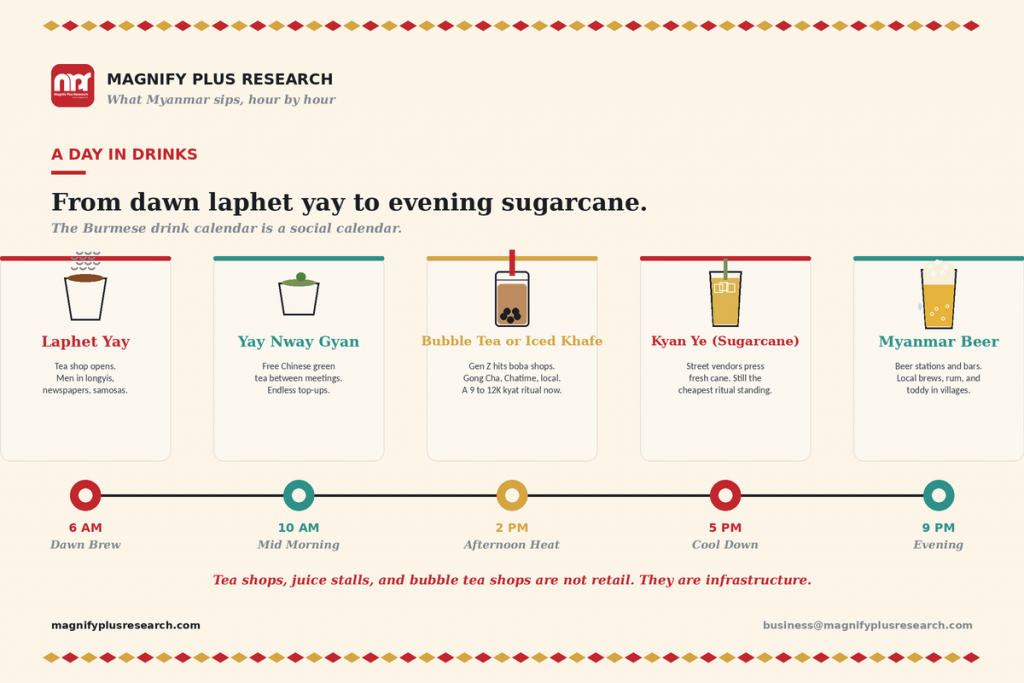
This is the rhythm for an average urban Myanmar consumer in 2026. The pattern matters because beverages here are not isolated SKUs. They are appointments.
What This Means for Brands
A few quick takeaways for anyone trying to win share of throat in Myanmar in 2026.
Place is the product. Tea shops, juice stalls, bubble tea shops, and beer stations are not retail. They are infrastructure. A beverage brand without a presence in those environments is invisible to the consumer it claims to serve.
Stack, do not substitute. Myanmar consumers do not pick laphet yay over coffee or bubble tea over juice. They drink all of them, on different occasions, with different people, for different prices. Position your brand in the day, not against the category.
Inflation has reset the value perception. A bubble tea at 12,000 kyat in 2026 is not the same psychological transaction as a bubble tea at 2,000 kyat in 2020. Consumers are more deliberate, more comparative, and more value-aware than five years ago, even on indulgences. Pricing studies done before 2022 should not be carried forward without re-fielding.
Local sources have local stories. Myanmar grown coffee, Shan tea, palm sugar, and tropical fruit are origin stories the average Myanmar consumer is increasingly proud of. Brands that lean into local provenance, in Burmese, with credible sourcing, build trust faster than imported equivalents.
Price by ritual, not by cost. A 12,000 kyat bubble tea is not expensive when it is a Gen Z weekend ritual. A 1,500 kyat tea shop laphet yay can feel costly at 7 AM for a worker who used to pay 500. Match the price band to the moment and the segment, not to a regional benchmark.
The biggest beverage research question we get asked at MPR is some version of “how do we read this market.” The honest answer is: spend an afternoon in a Yangon tea shop. Then commission proper fieldwork to put structure around what you noticed.
Want the Full Picture?
We are Magnify Plus Research. We run consumer research, brand health tracking, and social listening (in Burmese) across Myanmar’s beverage, food, and FMCG categories. If you are launching a beverage in Myanmar, refreshing one, or just trying to size the opportunity, we should talk.
Email: business@magnifyplusresearch.com
FAQ
What is the most popular drink in Myanmar? Laphet yay, the Burmese milk tea served at neighborhood tea shops, remains the most culturally and commercially dominant hot beverage. Yay nway gyan (free Chinese green tea) accompanies it.
How much does tea actually cost in Myanmar in 2026? A standard cup of laphet yay at a neighborhood tea shop is around 1,500 kyat. At premium tea houses it can run up to 12,000 kyat. Hyper-inflation has pushed prices roughly three to twenty-four times higher than the 300 to 500 kyat range that was normal a few years ago.
How much does bubble tea cost in Myanmar? A medium bubble tea at a Yangon chain in 2026 runs 9,000 to 12,000 kyat, up from around 2,000 kyat in 2020. The category has not lost cultural energy despite the price increase.
Is bubble tea popular in Myanmar? Yes. Chatime arrived in 2003, Gong Cha followed, and a wave of local chains like Serenitea joined them. Bubble tea is now a routine ritual for younger urban consumers, priced as an outing rather than an everyday drink.
How expensive is coffee in Myanmar in 2026? A cappuccino in a normal Yangon coffee shop now runs 12,000 to 15,000 kyat, up from roughly 2,000 kyat a few years ago. Specialty cafes price higher. Roadside khafe oh remains the most affordable coffee option.
Does Myanmar produce its own coffee? Yes. Myanmar grows specialty Arabica in the Shan and Mandalay highlands. The Mandalay Coffee Group and producers like Sithar, Amayar, The Lady Specialty Coffee, Shwe Taung Thu, and Ruby Hills Estate have built a small but quality-focused export scene since 2016.
What do Myanmar people drink in the evening? Not tea. By 9 PM, the social drink shifts to alcohol: Myanmar Beer on draft, imported lagers, local rum and whisky, and in central Myanmar villages, fermented palm toddy.
What is kyan ye? Kyan ye is fresh sugarcane juice, pressed on the spot by street vendors. It is especially popular during Thingyan, the Burmese water festival, and remains one of the most affordable everyday drinks in the country.
How do I order Burmese tea like a local? Pick two dials: sweetness (cho is sweet, kya is less sweet) and strength (pawt is light, seint is mild). Cho seint is sweet and mild. Cho kya is sweet and strong. Kya pawt is the light, low-sugar option. Then make a kiss-kiss noise to call the waiter.
Curious about Myanmar’s beverage market for your brand? Email business@magnifyplusresearch.com.
Sources, NPR The Salt, Selective Asia, Myanmar Mix, MYANMORE Bubble Tea in Yangon, Comunicaffe International, Origin Coffee, Atlas Coffee Importers, Indochina Coffee, factsanddetails.com Myanmar drinks, Juicernet sugarcane survey, MPR field intelligence on 2026 pricing.
3 thoughts on “What’s in Myanmar’s Cup: A Field Note on Beverage Habits in 2026”
Comments are closed.