The State of Digital Consumers in Myanmar 2025

Myanmar’s digital consumer market in 2025 has transitioned from rapid expansion to a phase of behavioral maturity. Growth is no longer driven by new internet users, but by how people use digital platforms, how much time they spend, and how digital tools integrate into their daily lives.

61.1% of the population is online, and 98% of internet users actively engage with social media. Myanmar is a social media-first market, where digital life primarily occurs on a small number of mobile platforms, especially TikTok, Facebook, YouTube, Telegram, and Viber, rather than on standalone websites or apps.

Demographics shape everything. With 71% of the population under 30, consumer attention is increasingly favoring short-form video, visual storytelling, and emotionally relevant content. TikTok is the fastest-growing platform, while Facebook remains critical for functional use cases such as buying, selling, and direct communication, even as entertainment time shifts elsewhere.

Internet access has become a non-negotiable monthly expense, averaging USD 7–9 per user, creating a USD 3+ billion annual connectivity market. This stable spending underpins the entire digital economy, from media consumption to e-commerce.

Social media engagement patterns reveal a notable shift in structure. Attention has moved away from generic entertainment toward issue-driven, event-based, and narrative content. At the same time, participation remains cautious, with reactions dominating while comments and public sharing are limited. This reflects a preference for emotional response over visible opinion. Online shopping is now mainstream. 87% of users have made purchases via social platforms in recent months. Facebook is the backbone of social commerce, while TikTok is emerging as a discovery and influence channel. However, growth is constrained by trust and execution, not demand. Most consumers report neutral trust, rely heavily on Cash on Delivery, and cite late delivery as the biggest pain point.

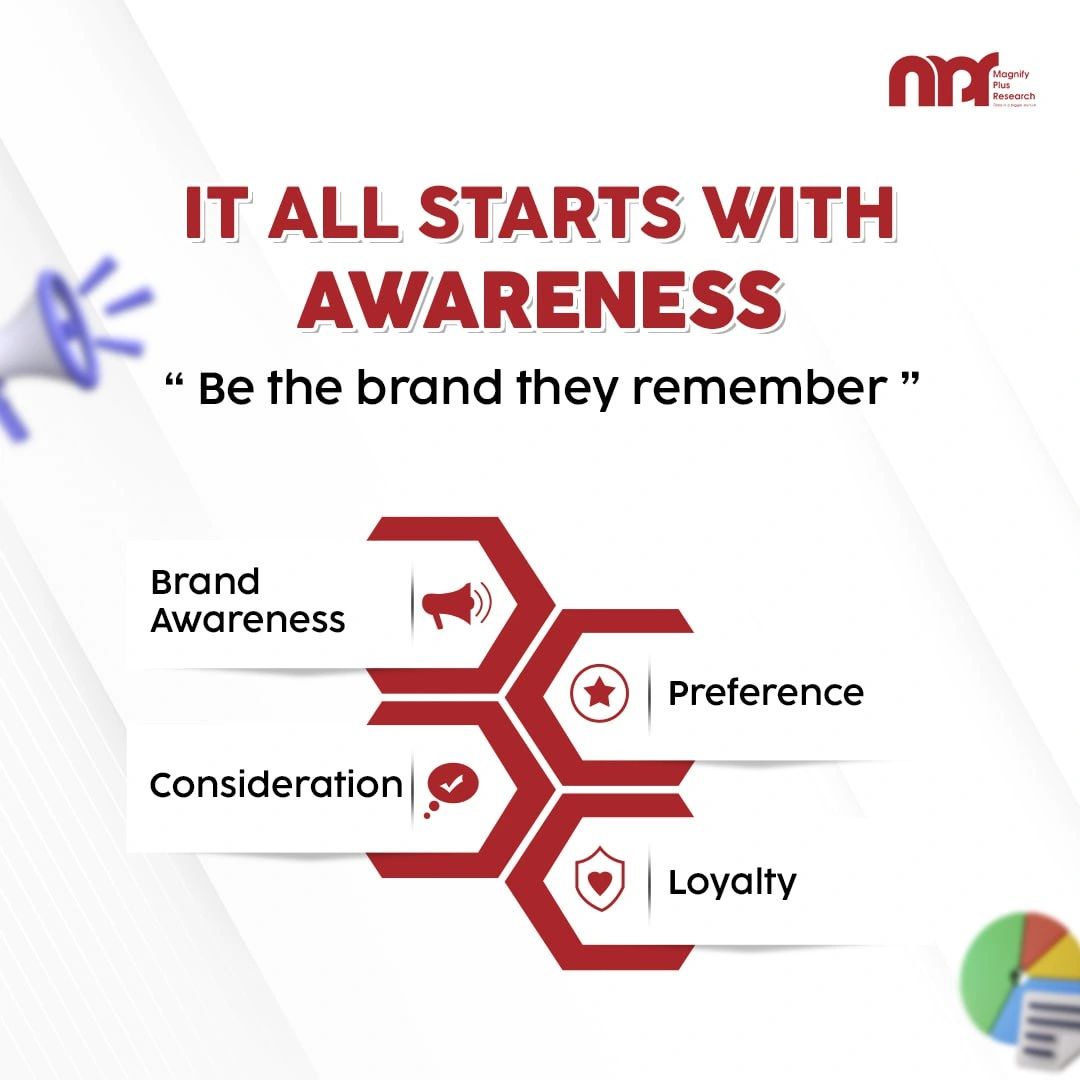
Is Your Brand Truly Recognized?

Why Brand Awareness Is the Foundation of Growth in Myanmar

In today’s crowded marketplace, customers don’t just buy products; they buy brands they recognize, trust, and remember.

So here’s the question every business owner and marketer should ask:

“Is my brand truly known? When people see it, do they notice it?”

If the answer is unclear, your brand may be invisible in the market, even if you’re running ads and posting daily.

What Is Brand Awareness and Why Does It Matter?

Brand awareness is not just about being “known.”
It’s about being top-of-mind when customers are ready to purchase.

When people recognize your brand instantly, they are more likely to:

  • Choose you over competitors
  • Trust your product quality
  • Feel confident in buying
  • Recommend your brand to others

In short, brand awareness creates familiarity, shapes perception, and builds emotional connection.

Why Awareness Is the Foundation of Sustainable Growth

Many businesses focus on short-term sales and immediate ROI. But without awareness, these efforts often fail.

Here’s why brand awareness is the foundation for long-term growth:

Awareness Drives Sales Later

Customers may not buy immediately, but they remember your brand when they’re ready.

Awareness Builds Trust

When your brand is familiar, customers feel safer buying from you.

Awareness Supports Loyalty

Recognition leads to repeat purchases and referrals.

Why Tracking Brand Awareness Is Essential

Tracking awareness is not optional. It’s a strategic necessity for businesses that want to grow consistently.

If you don’t measure awareness, you won’t know:

  • How your brand compares to competitors
  • Which campaigns truly build recognition
  • Where your marketing budget is best spent
  • How to strengthen your brand equity over time

Launching a New Product or Refreshing Your Brand?

Even if your product is excellent or your branding is beautiful, no one will notice you without awareness.

If people don’t recognize your brand, they won’t buy, and your efforts will go unnoticed.

Brand awareness is the key point in every industry, especially in Myanmar’s competitive market.

The Bottom Line

Brand awareness is not a luxury, it’s a necessity.

If you want long-term growth, a stronger market presence, and customer loyalty, you must prioritize awareness in your marketing strategy.

Want to know how strong your brand awareness is in Myanmar?

Magnify Plus Research can help you measure brand awareness, track performance, and guide smarter marketing decisions.

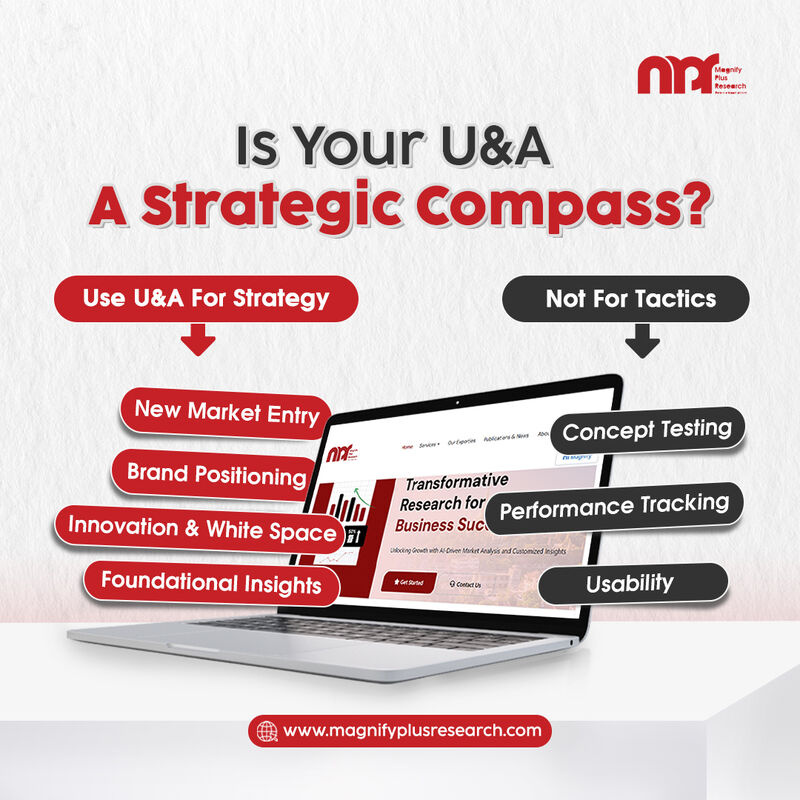
U&A Studies: A Strategic Tool, Not a Tactical Panacea

In our pursuit of consumer understanding, we must ensure our methodologies match our objectives. The Usage & Attitude (U&A) study is a powerful tool in our research arsenal, but its misapplication remains a common and costly pitfall.

A U&A is designed to establish a comprehensive, foundational understanding of a market: the what, how, and why of consumer behavior, needs, and perceptions. However, deploying it to answer specific, tactical questions is often an inefficient use of resources that yields underwhelming results.

To clarify its application, consider this framework:


Deploy a U&A for Foundational Intelligence:
This is its core strength. Initiate a U&A when you require a robust, evidence-based platform for long-term strategy.


Market Entry: Mapping a new category’s landscape, including usage occasions, drivers, and competitive perceptions.

Strategic Formulation: Informing master brand strategy, market segmentation, and positioning.

Innovation Pipelines: Identifying white spaces and unmet needs to guide portfolio development.

Knowledge Currency: Updating a market model that has become stale or incomplete.

Employ Alternative Methods for Tactical Objectives:
When your questions are narrow, your tools should be too.

For specific asset evaluation (e.g., a concept, price point, or packaging), a focused monadic or concept test provides cleaner, more direct diagnostic data.

For measuring brand health or campaign impact, a structured brand tracking study is purpose-built to monitor KPIs over time.

For optimizing a user interface or journey, UX/usability testing offers the behavioral granularity needed for design iteration.

The Researcher’s Mandate:
Our role extends beyond fielding studies; it is to be strategic advisors on insight generation. Recommending a U&A when a tactical test is warranted—or vice versa—undermines the integrity of our function and the impact of our work.

Let’s champion methodological rigor. The right tool, applied at the right time, is what separates data from genuine, decision-driving insight.

I’m curious to hear from fellow insights professionals. How do you guide your stakeholders on the U&A versus focused study decision?

hashtag#MarketResearch hashtag#ConsumerInsights hashtag#UXResearch hashtag#BrandStrategy hashtag#ProductDevelopment hashtag#DataDriven hashtag#ResearchMethods hashtag#StrategicPlanning

Customized Market Research for SMEs in Myanmar: Small Budgets, Big Impact

Marketing can feel like a gamble, especially when you’re running a small business and every kyat matters.
Many SMEs in Myanmar spend money on marketing without knowing what will truly work. And that’s why they often don’t see results.

But you don’t have to be one of them.

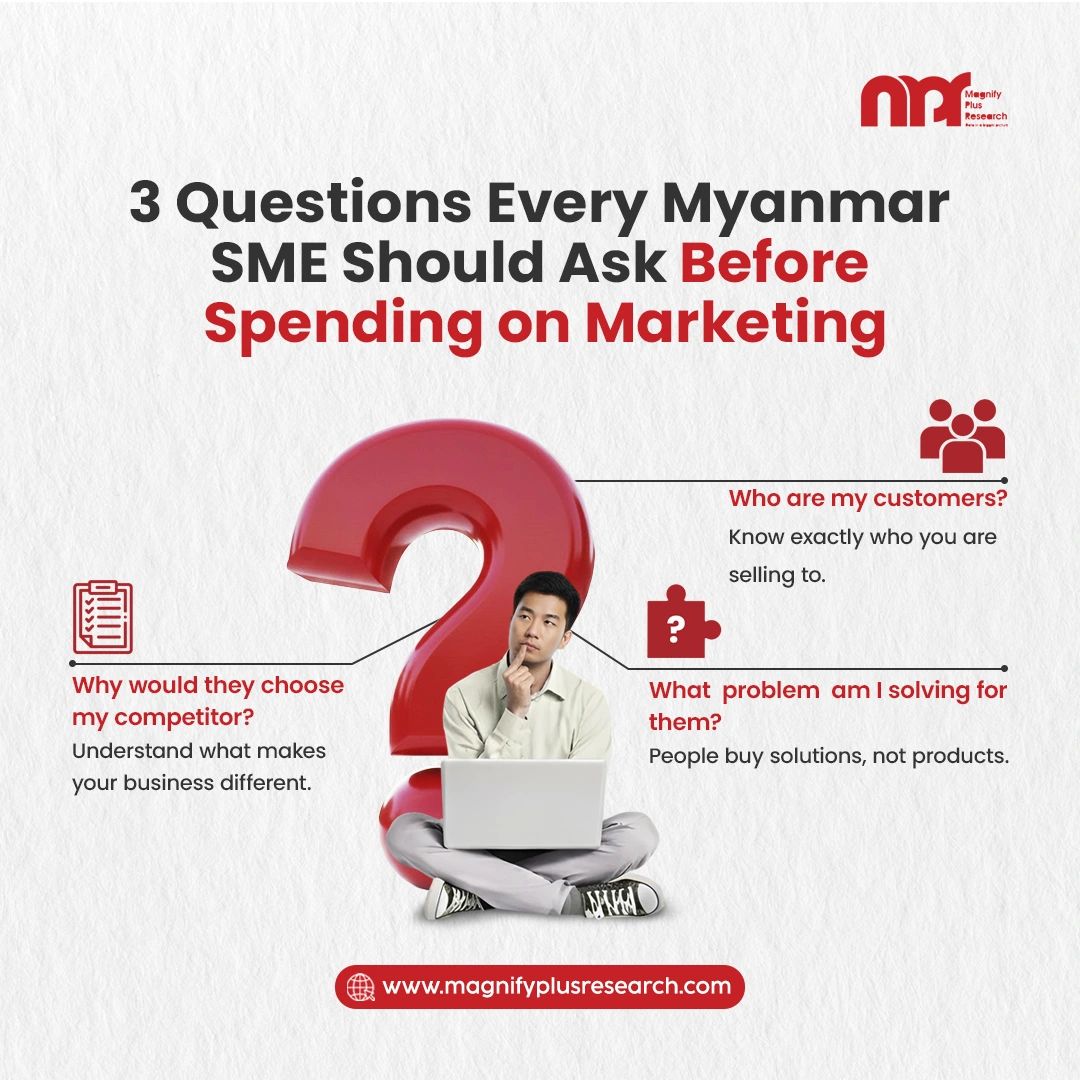
Before you spend another kyat on ads, promotions, or content, ask yourself these three simple questions:

1. Who are my customers?

This is the most important question and the one most businesses don’t answer clearly.

Who is your customer really?
Not “everyone.” Not “people who need this.”
But specific people with specific needs.

If you don’t know who you’re selling to, your marketing will always miss the target.

2. What problem am I solving for them?

People don’t buy products.
They buy solutions.

Your customers are not buying your product because it’s “good.”
They are buying it because it helps them in some way.

So ask yourself:
What problem does my product solve?
How does it make life easier for my customer?

3. Why would they choose my competitor?

This one is hard but it’s also the most valuable.

Your customer always has choices.
So why would they choose you?

What is your unique advantage?
What makes your product or service better than others?

If you can answer this clearly, you can build marketing that actually works.

Why These Questions Matter (Even With a Small Budget

You don’t need a huge budget to learn about your customers.
You can gain strong insights from:

  • A short survey
  • A few quick interviews
  • Observing social media comments
  • Checking competitor pages

Even small research efforts can help you spend your marketing money smartly.

Start with these 3 questions, and your marketing decisions will improve today.

Question for you: Which of these 3 questions do you find the hardest to answer?

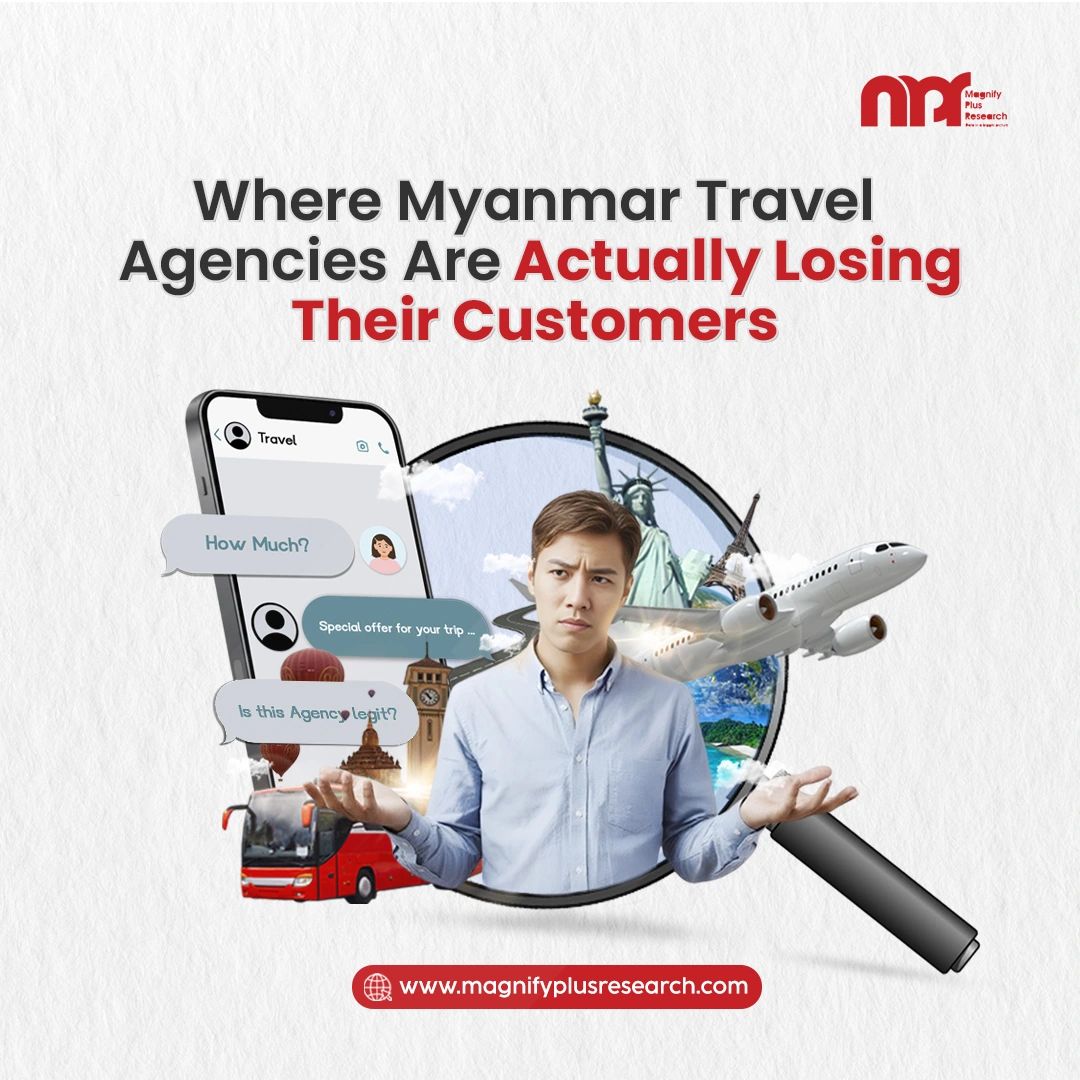
Where and Why Myanmar Travel Agencies are loosing their Customer

Why Do Customers Ask “How Much?” but Never Book?

Understanding the Trust Gap in Myanmar’s Travel Industry

Many travel agencies in Myanmar are facing the same frustrating challenge:
a high number of inquiries, but very few actual bookings.

Most agencies assume the problem is price.
However, Magnify Plus Research’s market insights reveal a different truth: the real issue is a Trust Gap.

Customers are not walking away because packages are expensive.
They walk away because they don’t feel confident enough to commit.

The 5-Stage Travel Decision Journey

Based on consumer behavior research, a traveler goes through five critical stages before making a booking decision:

1. Awareness – “I want to travel.”

This is the emotional stage.
The desire to travel is triggered by holidays, stress, or the need for a break.

Emotion-driven, not price-driven.

2. Consideration – “Where should I go, and with whom?”

Travelers start comparing destinations, agencies, and packages.

When there are too many options, decision fatigue sets in, leading customers to delay or abandon decisions entirely.

3. Trust – “Is this agency reliable?” (Highest Drop-Off Point)

This is where most potential customers disappear.

Common concerns include:

  • Are these hotel photos real?
  • Will the transport be as promised?
  • What happens after I transfer the money?
  • What if I get scammed?

If trust is not established, discounts won’t work.
No matter how low the price is, customers will not proceed without confidence.

4. Booking – “Is now the right time?”

Even after trust is built, customers may still delay due to:

  • Leave approvals
  • Family discussions
  • Budget timing

This stage requires gentle follow-ups and reassurance, not pressure.

5. Post-Trip – “Would I recommend this agency?”

After the trip, customers decide whether to:

  • Recommend your agency
  • Leave reviews
  • Book again

This stage fuels word-of-mouth marketing, the most powerful and cost-effective form of promotion.

Research-Backed Insights for Travel Agencies in Myanmar

Our consumer research shows that customers value Confidence and Clarity more than Price.

Here’s what agencies should focus on:

✔ Show reality, not just beauty
Use real hotel photos, actual vehicles, and past trip documentation instead of overly polished images.

✔ Make itineraries easy to understand
Clearly explain where customers will go, at what time, and what is included, preferably in a simple table format.

✔ Respond fast and professionally
Quick, clear replies on Messenger or Viber are often the first trust-building moment.

✔ Be transparent about refunds and cancellations
Clear policies reduce fear and hesitation around payments.

✔ Take feedback seriously
Customer reviews are not just opinions; they are trust signals for future travelers.

Key Takeaway: Trust Converts Better Than Promotions

Running promotions and boosting ads alone is not enough.

If you want higher booking rates, you must first close the Trust Gap in your customer journey.
When trust is strong, bookings increase naturally even without heavy discounts.

At which stage do your customers drop off the most?
Let’s discuss and turn insights into action.

The Role of Brand Health Research in Driving SME Growth during Recessions & Inflation

The current economic climate marked by a recession and high inflation, has posed significant challenges for small and medium-sized enterprises. However, research suggests that this may be an opportune time for SMEs to invest in their brand health as a means of driving growth and resilience (Drewniak & Karaszewski, 2016).

During recessions, consumers typically become more cautious with their spending, prioritizing essential purchases and seeking better value. This shift in consumer behavior requires SMEs to adapt by aligning their brand messaging and product offerings with these changing priorities. This is where brand health research proves invaluable, as it helps SMEs pinpoint the key aspects of their brand that resonate with customers and identify areas for improvement.

Investing in brand health during economic downturns also provides SMEs with a competitive edge. Many companies may choose to cut back on marketing and research efforts during challenging times, but those who continue to invest strategically can strengthen their market position. By maintaining a strong brand presence and staying top-of-mind, SMEs can capture market share from competitors who have reduced their visibility. As Vardar (2014) notes, a consistent and strong brand image fosters customer loyalty, which can translate into sustained revenue and profitability even when the broader market is in decline.

In addition to understanding customer sentiment, brand health research can uncover new opportunities for innovation and product development. By closely monitoring market trends and customer feedback, SMEs can identify gaps in the market and develop new products or services that meet emerging needs. This kind of agility is particularly valuable during a recession when consumer needs and preferences may be shifting more rapidly than usual. By staying attuned to these changes, SMEs can pivot quickly and capitalize on new growth opportunities.

Moreover, insights from brand health research can guide SMEs in optimizing their pricing strategies. In a recession, pricing becomes a critical consideration for consumers, who are more likely to seek out products that offer the best value. By understanding how customers perceive the value of their products or services, SMEs can adjust their pricing strategies accordingly. Offering promotions, discounts, or value-added packages can enhance the perceived value of the brand, helping to maintain customer loyalty and attract new customers even in tough economic times.

Another crucial aspect of brand health research is its ability to assess the effectiveness of marketing campaigns and other promotional activities. By continuously measuring brand awareness, preference, and loyalty, SMEs can gauge the return on investment (ROI) of their marketing efforts and make data-driven decisions about where to allocate resources. This ensures that even with limited budgets, marketing activities are focused on the most impactful strategies that drive growth and enhance brand equity.

In summary, brand health research is a critical tool for SMEs aiming to navigate the challenges of a recession. By providing deep insights into customer behavior, market conditions, and brand perception, it empowers businesses to make informed decisions that enhance growth and resilience. Investing in brand health not only differentiates SMEs from their competitors but also positions them for long-term success, both during the downturn and in the eventual recovery.

How Magnify Plus Can Help SMEs

At Magnify Plus, we understand that maintaining brand health is critical, especially during challenging economic times. Our comprehensive research approach leverages advanced tools and methodologies to provide SMEs with actionable insights that drive growth, resilience, and strategic decision-making. Here’s how we can support your business:

Consumer Insights & Online Behavior Analysis: Our research begins with a deep dive into the digital landscape, where we analyze online behavior, engagement, sentiment, and share of voice through our social listening dashboard. This analysis provides a comprehensive view of how consumers perceive and engage with your brand, enabling you to understand your audience better and craft targeted marketing strategies.

Real-Time Survey Analysis: To complement our social listening data, we conduct real-time surveys that capture audience perceptions, preferences, and brand appeal. This dual approach ensures that you receive a holistic understanding of consumer attitudes and can adjust your strategies accordingly to meet evolving customer needs.

Campaign Effectiveness Evaluation: Understanding the impact of your marketing campaigns is crucial for optimizing your efforts and maximizing ROI. We evaluate the effectiveness of your campaigns by analyzing online reactions and engagement metrics. By tracking these data points, we help you refine your approach, ensuring your marketing strategies resonate with your target audience.

Brand Net Score and KPI Tracking: We monitor key performance indicators (KPIs) and brand net scores to gauge brand health over time. This continuous tracking allows you to identify strengths to capitalize on and areas needing improvement, helping you refine your brand strategy to enhance customer satisfaction and loyalty.

Decoding Markets and Unveiling Insights: Our market analysis goes beyond customer behavior to include competitor analysis, market sizing, and path-to-purchase mapping. This comprehensive view helps you understand the market dynamics and identify growth opportunities, enabling you to develop targeted strategies that align with your business objectives.

Competitor Analysis: We gather and analyze data on your competitors’ conversations, marketing tactics, and customer sentiments. This intelligence allows you to identify opportunities for improvement and refine your own marketing strategy to stay ahead in the market.

Elevating Growth with AI-Driven Insights: Our AI-driven dashboard provides real-time updates and insights, empowering you to make proactive decisions that drive sustainable business growth. By identifying untapped market opportunities and uncovering new consumer segments, we help you develop a strategic growth roadmap tailored to your unique business needs.

By partnering with Magnify Plus, SMEs can leverage these insights to navigate the complexities of a recessionary environment, ensuring that their brand remains strong and competitive. Our approach is designed to help you understand your market better, engage more effectively with your customers, and ultimately drive growth and success, even in challenging economic conditions.

Current Flooding Situation Overview In Myanmar

INTRODUCTION

The recent flooding in Myanmar began in the first week of September, primarily triggered by heavy monsoon rains and the remnants of Typhoon Yagi. Central Myanmar has been the most affected, with regions such as Nay Pyi Taw, Bago, Kayah, Kayin, Magway, Mandalay, Mon, and eastern and southern Shan experiencing severe flooding. The floods have led to extensive damage, including disrupted road networks, transportation, telecommunications, and electricity. Despite some areas beginning to see receding water levels, most affected regions remain inundated, highlighting the severity of the situation

SITUATION OVERVIEW

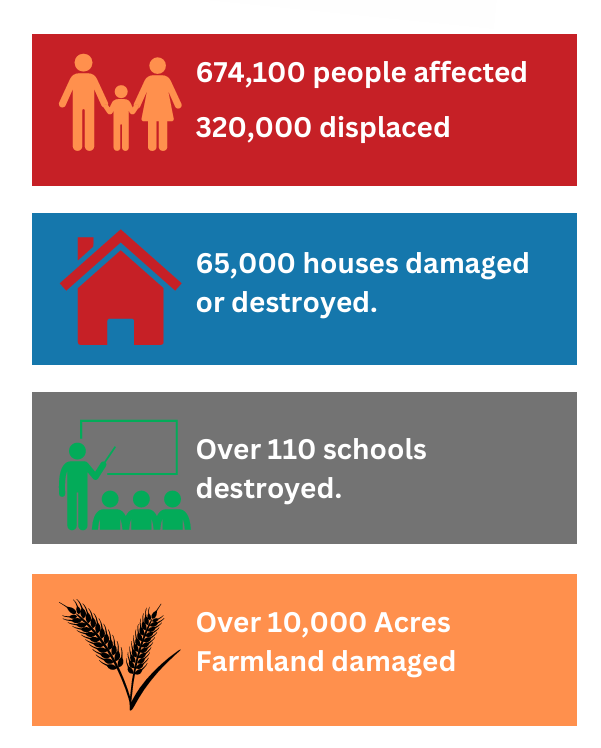
The recent flooding in Myanmar has had a profound impact across the country. Authorities have reported over 200 people died due to the severe weather, and over 320,000 people have been displaced, with more than 236,000 currently sheltered in around 187 relief camps. The disaster has caused significant destruction, including the loss of tens of thousands of homes and hundreds of schools. Critical infrastructure, such as roads and bridges, has been damaged, leading to widespread power and communication outages. The flooding has also resulted in severe soil erosion and environmental contamination, impacting agriculture and local ecosystems. Health risks are rising due to compromised sanitation and clean water access, further exacerbating the humanitarian crisis. The extensive damage and disruption highlight the urgent need for effective relief and recovery efforts to support affected communities and restore normalcy

EASTERN SHAN STATE

The current flooding in Eastern Shan State has led to widespread disruption and severe damage. 18,000 people in the region have been affected, with thousands forced to evacuate their homes. Several townships, including Keng Tung, Tachileik, and Mong Hpayak, have been hit hardest by the floods, resulting in many residents being relocated to temporary shelters

SOUTHERN SHAN STATE

74,000 individuals were displaced by heavy rains and flooding in Southern Shan State, with people’s livelihoods affected and houses destroyed. 14 townships, including Kalaw, Nyaung Shwe, Shwe Nyang, Pindaya, Hsihseng, and Pinlaung, have been among the hardest hit, with many low-lying areas facing severe waterlogging. The crucial source of livelihood has suffered immensely, with thousands of acres of paddy fields and vegetable farms flooded and crops destroyed. Infrastructure damage has also been significant in Southern Shan State. Several roads, including routes connecting remote villages to main townships, have been blocked or washed away by landslides, disrupting transportation and making it difficult to deliver aid

MANDALAY REGION

Mandalay Region – In the Mandalay Region, severe flooding has affected at least 10 townships, resulting in 76 fatalities and damage to approximately 26,700 houses. Yamethin Township, one of the hardest-hit areas, has reported at least 30 fatalities due to drowning, while more than 80 people remain missing. In Wundwin Township, due to the breach of the Sa Mone Dam, an estimated 40,000 acres of agricultural land have been submerged, severely affecting the region’s agricultural sector and threatening the livelihoods of many farming communities. The disaster has also impacted 110 schools, 80 state buildings, and 251 electric poles, along with numerous road networks and bridges.

KAYAH STATE

Kayah State has been hit hard by severe flooding, particularly in IDP camps and low-lying areas, leading to widespread displacement and infrastructure damage. Excessive water released from the Mobye Dam has affected nearly 9,200 people across four townships.

NAYPYITAW

In Nay Pyi Taw, the flooding impacted more than 60,000 people across Naypyitaw Council, Tatkone, Zeyathiri, and Pobbathiri. Heavy rainfall, exacerbated by the remnants of Typhoon Yagi, led to widespread waterlogging and overflow of local waterways.

BAGO REGION

The situation is severe across the Bago region, with an estimated 87,000 individuals impacted in six townships, including Htantabin, Oktwin, Phyu, Taungoo, and Yedashe. Flooding has significantly worsened, particularly in Taungoo Township, where around 1,200 households have been affected, and approximately 5,000 people have been displaced to 13 evacuation centers. In Taungoo, the floods have displaced thousands and led to tragic losses. Two local volunteers lost their lives while attempting to rescue affected residents, highlighting the dangerous conditions in the area.

MAGWAY REGION

In the Magway Region, the floods have severely affected 6 townships, leading to the evacuation of around 7,000 people from 15 villages near Yaw Creek, including residents from internally displaced persons (IDP) camps.

MON STATE

In Mon State, heavy rains and the rising water levels of the Bilin River have forced the temporary relocation of more than 900 people in Bilin and Kyaikhto towns. These individuals were moved to relief centers as a precautionary measure to ensure their safety amidst the worsening flood conditions

NEEDS AND RESPONSE EFFORTS

Local donors and private citizens, including celebrities, have rallied to support the affected communities. Many have raised funds and donated essential items such as food, clothes, and medicines. However, logistical challenges have hindered efforts to reach the most severely impacted areas. Some remote villages remain inaccessible due to ongoing flooding and damaged roads, limiting aid distribution.

Donations are being distributed in areas where access is still possible, but a more coordinated and large-scale response is required. Local authorities and humanitarian organizations are working to deliver aid. Still, additional support is needed from both the government and international organizations to ensure that relief reaches those in the most remote and severely affected regions. The focus now must be on overcoming access barriers and scaling up relief operations to meet the immediate needs of all affected communities.

PRIMARY IMPACT AND SIGNIFICANT CHALLENGES

The primary impact on the communities has been the loss of crops and agricultural fields, particularly paddies, damaged by mud intrusion. This has severely affected the income of these communities. A significant challenge they now face is rebuilding houses, needing more funds and building materials. Additionally, ensuring a sufficient food and water supply has become a significant concern in the aftermath of the flooding. Flood management in Myanmar also faces several challenges, including inadequate infrastructure, limited disaster preparedness, and the increased frequency of extreme weather events due to climate change. Addressing these issues requires a coordinated response involving immediate relief and long-term strategies for sustainable recovery.

HELPING FLOOD VICTIMS IN MYANMAR: WHAT CAN WE DO

The recent flooding in Myanmar has created an urgent humanitarian crisis, with thousands of people displaced and in need of basic necessities. Based on reports from affected areas, the most pressing needs include:

  • Food: Due to the widespread damage to farmlands and disruption of supply chains, many communities are experiencing food shortages. Immediate food relief is required, particularly in hard-to-reach areas where local markets have been submerged or destroyed. While aid is being delivered, the most urgent needs include dry foods and durable food supplies to ensure long-term support for affected communities.
  • Drinking Water: Contaminated water sources due to flooding have made access to clean drinking water a major concern. Many areas are relying on bottled water, but the supply needs to be increased.
  • Medicine: The risk of diseases, such as waterborne illnesses and infections, has increased due to stagnant water and the poor sanitation conditions in shelters. There is an urgent need for medical supplies, including antibiotics, basic first aid, and preventive vaccines. Additionally, healthcare access is limited in some affected regions.
  • Clothes: Many families have lost their personal belongings, and providing clothes and dignity kits, especially for women and children, is essential. These kits typically contain sanitary products, soap, and other hygiene essentials to maintain dignity and health in emergency shelters.
  • Shelter: Thousands of homes have been destroyed or severely damaged, forcing people to take refuge in temporary shelters. Tents, tarpaulins, and construction materials are urgently needed to accommodate the displaced population and to provide them with safe, dry, and secure living conditions.
  • Crops and Seeds for Replanting: Many farmers have lost their entire harvest due to the floods. Providing high-quality crop seeds, farming equipment, and modern technologies for farm repairs are essential to kickstart their farming activities for the next growing season.

SECONDARY DATA IS GATHERED BY MAGNIFY PLUS RESEARCH IN ASSOCIATION WITH MAGNIFY MYANMAR