

Consumer behavior in Myanmar in 2026 reflects rapidly evolving preferences shaped by digital adoption, generational change, and economic pressure. Understanding what actually drives purchase decisions in this market unlocks insights that uniform regional strategies consistently miss. For brands operating in Yangon, Mandalay, and beyond, getting the consumer read right is the difference between guessing and growing.
This article distills what Magnify Plus Research (MPR) and the wider Magnify Group see across our social listening, brand health tracking, and consumer pulse fieldwork in Myanmar. It is built for brand owners, marketers, and entry teams who need the picture without the fluff.
Myanmar Consumer Behavior in 2026: The Overview
Myanmar’s consumer landscape shows clear macro shifts driven by digitalization and economic realities. Urban consumers in Yangon and Mandalay have moved to mobile first lifestyles, while rural consumers blend traditional trade habits with new digital touchpoints. Inflation and currency volatility have heightened price sensitivity across all income tiers, with households leaning into promotions, smaller pack sizes, and trusted local alternatives.
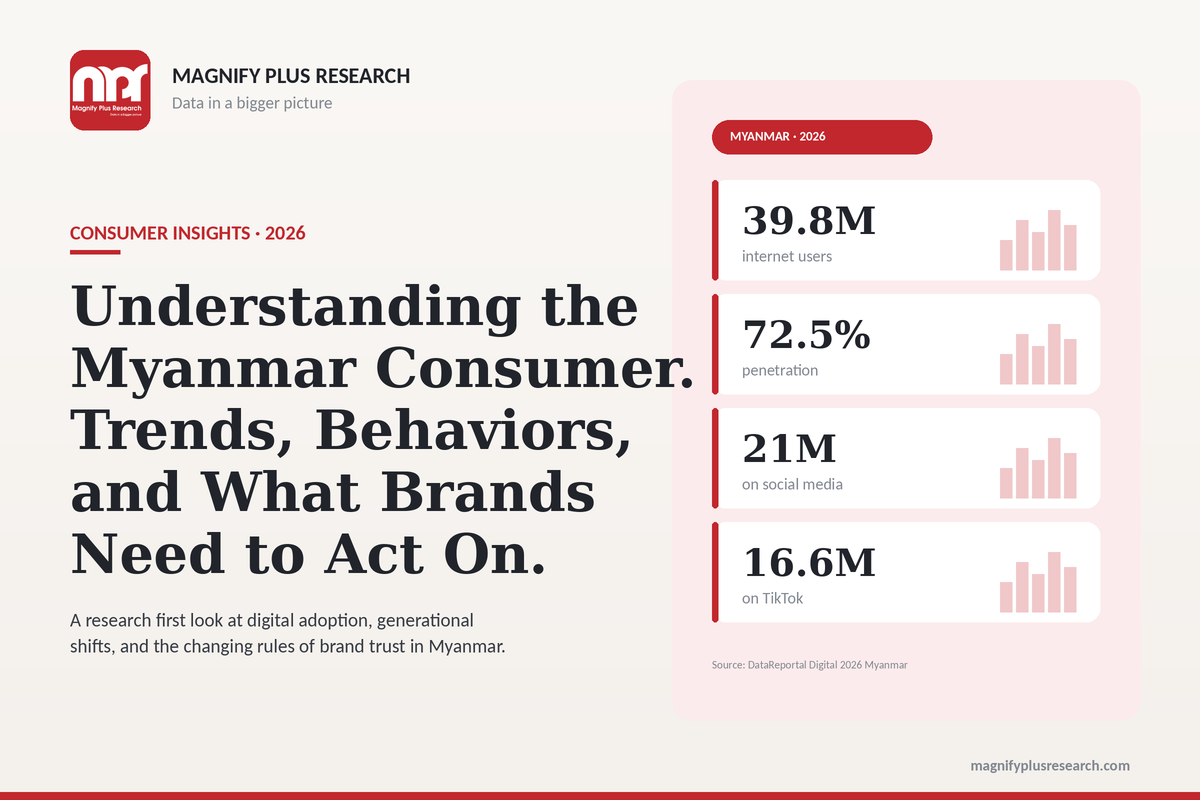
As of 2026, Myanmar has approximately 39.8 million internet users, representing around 72.5% internet penetration, alongside 21 million social media users and 62.5 million mobile connections (DataReportal Digital 2026 Myanmar). These are the baseline numbers any Myanmar consumer strategy now sits on top of.
Generational and regional differences create distinct customer journeys. Younger urban cohorts gravitate toward experiential, visual, and platform native brand experiences, while older and rural segments display more utilitarian behavior, prioritizing necessity, reliability, and value cues over brand storytelling. Understanding these splits has become essential. A national average without regional and generational breakdown almost always misrepresents the real consumer.
Consumer Behavior Models Applied to Myanmar
Two paradigms remain useful for framing Myanmar consumer decisions, utilitarian and hedonic. Utilitarian behavior emphasizes functionality, durability, and value for money. Hedonic behavior is driven by pleasure, status, and emotional satisfaction.
In Myanmar both modes operate at the same time, often inside the same household. A Yangon family will run a strictly utilitarian decision on cooking oil and laundry detergent and a heavily hedonic decision on smartphones, beverages, or fashion. The most expensive mistake brands make is assuming a category is one or the other. Decoding which mode dominates your category, in your segment, in your region, is the foundation of segmentation that actually targets.
Millennials in urban Myanmar are particularly fluent in switching between the two. They will pay a premium for category symbols of status and aspiration and ruthlessly trade down on everything else. Brands that recognize this “smart indulgence” pattern win share. Brands that treat them as either purely value seekers or purely premium shoppers tend to misprice the proposition.
Online and Digital Consumer Behavior
Myanmar is a mobile first, social first market. Consumers discover, evaluate, and increasingly transact through their phones, with Facebook still the gravitational center of the digital lives of most adults, TikTok now serving as the dominant discovery engine for Gen Z and younger millennials, and Messenger functioning as the de facto customer service and commerce channel for thousands of small and mid sized businesses.
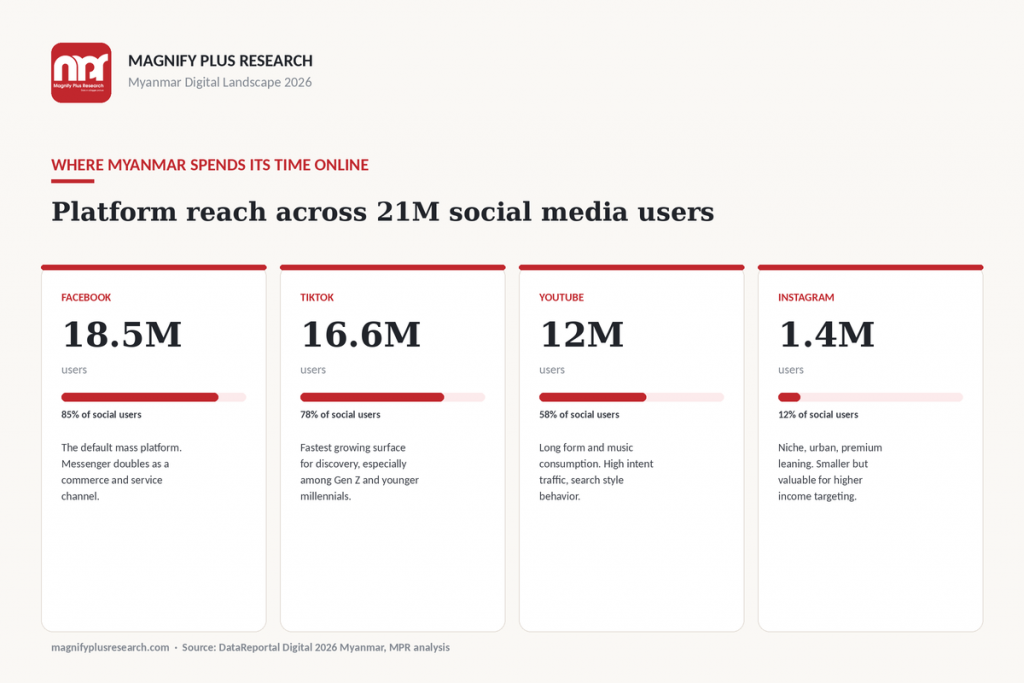

The platform split matters because consumer behavior is platform specific. A campaign tuned for Instagram will reach a small, urban, premium leaning slice. The same campaign tuned for Facebook and TikTok reaches a market wide audience. Search style intent shows up most clearly on YouTube and increasingly on TikTok, while social commerce and conversational sales conversion happen on Facebook and Messenger.
Three behaviors deserve particular attention in 2026.
Conversational commerce. A large share of Myanmar transactions still start as a Messenger or Viber conversation. Stated intent in surveys understates this, because much of it is informal and not captured in formal e commerce data. Brands without a strong conversational layer leave revenue on the table.
Video first discovery. Short form video on TikTok and Facebook Reels has become the primary product discovery channel for younger consumers. The implication for brands is direct. If your category story does not work as a 15 to 60 second vertical video in Burmese, your reach to under 35 audiences is compromised.
Mobile money normalization. Mobile money has moved from novelty to habit for a growing share of urban consumers. The payment friction story has changed, and pricing experiments that previously failed on cash only logic can now be reopened.
Generational Insights
Three generational segments behave meaningfully differently.
Gen Z and younger millennials. Digitally native, video first, authenticity seeking. Their journeys mix TikTok discovery, Facebook and Messenger consideration, and a final purchase that may happen online or offline depending on category. They respond to brands that talk like people, not like brochures, and they read inauthenticity quickly.
Older millennials and Gen X. A blended segment. Digitally fluent on Facebook and YouTube, more skeptical of platform native creator content, and more sensitive to brand reputation cues. Family decision dynamics carry more weight here, particularly in higher consideration categories.
Older and rural consumers. More utilitarian, more price sensitive, more loyal to brands that have earned long term trust. Traditional trade, word of mouth, and family recommendation still drive the majority of category decisions in this segment. National campaigns aimed at Yangon Gen Z routinely under index here, and brands that ignore this segment underestimate their addressable market.
The Brand Voice Shift Myanmar Consumers Are Telling Us About
One of the clearest shifts our social listening and consumer tracking has surfaced over the last several years is in how Myanmar consumers want brands to engage with social and cultural issues.
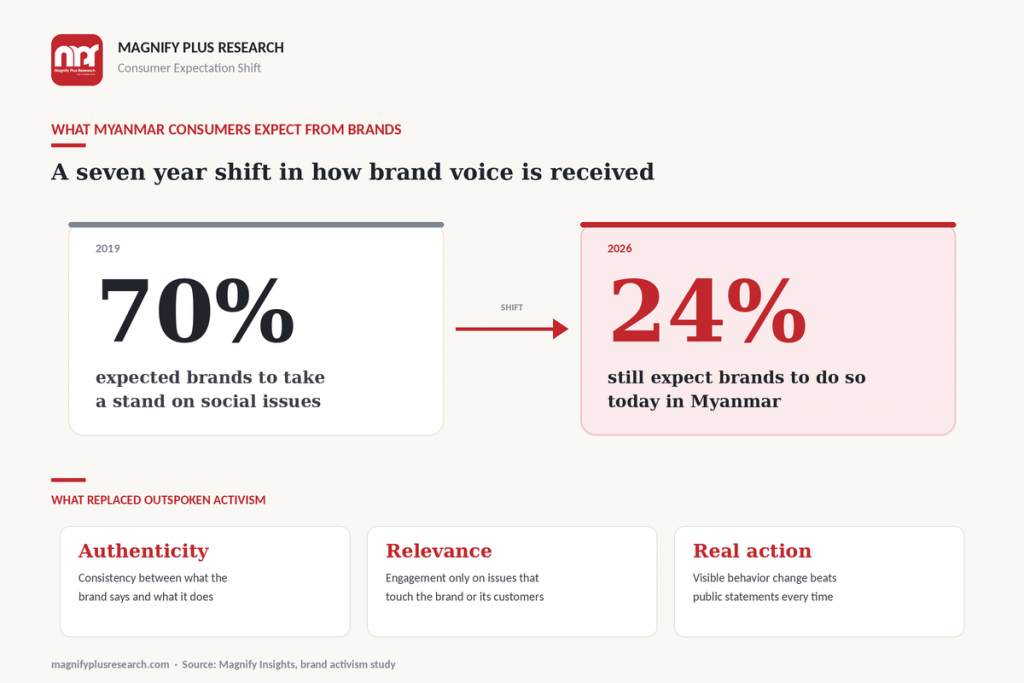

In 2019, roughly 70% of Myanmar consumers expected brands to take a public stand on social issues. By 2026, that figure has collapsed to around 24%. The expectation has not disappeared, but it has narrowed and matured. Three drivers have replaced the earlier appetite for brand activism.
Authenticity. Consumers reward consistency between what a brand says and what it actually does. Statements without behavior behind them are now read as opportunism.
Relevance. The expectation today is that a brand engages on issues that genuinely touch its category, customers, employees, or community. Brands jumping into unrelated conversations attract skepticism rather than goodwill.
Real action. Visible operational behavior, hiring, sourcing, pricing decisions, community programs, beats public statements every time.
The implication for brand strategy is direct. Brand voice in Myanmar in 2026 is earned through what you do, then communicated quietly, not loudly. Brands that lead with statement are inviting more scrutiny than they used to. Brands that lead with behavior are building durable trust.
Nudging and Behavioral Economics in the Myanmar Context
Subtle design choices, defaults, social proof cues, framing of price and bundles, increasingly shape Myanmar consumer behavior. App UX, in store layout, and on pack communication are all places where well designed nudges measurably shift conversion without raising spend.
Two practical examples our research surfaces repeatedly. First, social proof cues, “most ordered today,” customer count badges, real reviews in Burmese, materially outperform abstract claims of quality. Second, default options and pre selected sizes in conversational commerce flows on Messenger meaningfully shift average order value. Both are zero capex levers most Myanmar brands have not yet pulled hard.
Consumer Research in Myanmar: What Works and What Does Not
Reliable consumer research in Myanmar requires methodologies calibrated to local realities, indirect communication styles, regional variance, the gap between stated and actual behavior, and the dominance of informal channels in many categories. Three principles guide what we do at MPR.
Fieldwork in Burmese, by Burmese moderators. Translation flattens meaning, and politeness norms shape how consumers express opinions. Burmese moderation, in Burmese language analysis, surfaces the truth the translated version misses.
Regional coverage, not just Yangon. Our standard Consumer Pulse coverage spans Yangon, Mandalay, and Naypyitaw, with extended coverage for secondary cities and selected rural townships depending on study design. National conclusions drawn from Yangon only data are systematically biased.
Triangulation across methods. A representative survey tells you how big. Qualitative depth tells you why. Social listening, using Burmese language natural language processing, tells you what is happening in real time that neither survey nor focus group will catch. The most reliable decisions come from all three.
Our flagship continuous tracking product, Myanmar Consumer Pulse 2026, runs quarterly across the three major metros, capturing category and brand level signal that brand owners can act on without commissioning a custom study every time the question changes.
What This Means for Myanmar Brand Owners
If you own or run a Myanmar brand, four priorities flow directly from the picture above.
- Segment realistically by region, generation, and behavior mode. National averages hide the segments where you actually win or lose.
- Build for mobile first, conversational, video first behavior. Your distribution and your creative both need to assume the consumer is on a phone, in a Messenger thread, or in a vertical video feed.
- Earn brand voice through action. Consumers no longer reward statement. They reward consistency between what you say and what you do.
- Track continuously, not annually. The Myanmar consumer is moving fast enough that an annual U and A study, by itself, is no longer a sufficient picture. Pair it with quarterly tracking and continuous listening.
Frequently Asked Questions
What is consumer behavior in Myanmar? Consumer behavior in Myanmar describes how Burmese consumers select, evaluate, and purchase products and services, shaped by digital habits, family and community influence, price sensitivity, and strong regional differences between Yangon, Mandalay, and the rest of the country.
How is Myanmar consumer behavior changing in 2026? The biggest shifts are mobile first, video first discovery led by TikTok and Facebook, growing conversational commerce on Messenger, mainstreaming of mobile money, and a clear maturation in what consumers expect from brand voice on social issues.
What are the most important platforms in Myanmar in 2026? Facebook remains the largest reach platform at around 18.5 million users. TikTok has grown to over 16.6 million and is the fastest growing discovery surface, particularly for Gen Z. YouTube is dominant for long form and search style intent. Instagram is small but valuable for urban premium audiences (DataReportal Digital 2026 Myanmar).
Who does consumer research in Myanmar? A small set of research firms have the local fieldwork, Burmese language moderation, and regional recruitment networks needed for reliable Myanmar consumer research. Magnify Plus Research provides end to end consumer behavior research across Yangon, Mandalay, and Naypyitaw, with extended coverage available, integrated with the Magnify Group’s social listening capability for a triangulated picture.
Do Myanmar consumers still expect brands to speak on social issues? Far less than they used to. Our tracking shows expectation has dropped from around 70% in 2019 to around 24% in 2026. Consumers today reward authenticity, relevance, and real action over public statement.
How often should we research the Myanmar consumer? At minimum annually for a full read, and continuously through tracking and social listening. Conditions in this market move quickly enough that an annual snapshot alone leaves brands a step behind.
TL;DR
- Myanmar is a mobile first market of around 39.8M internet users, 21M on social media, with 16.6M on TikTok and Facebook reach over 18M (DataReportal).
- Generational and regional differences are wide. Yangon Gen Z is not the same consumer as a Mandalay millennial or a township based older shopper.
- Conversational commerce on Messenger, video first discovery on TikTok and Reels, and the normalization of mobile money are the three behaviors reshaping the path to purchase.
- Brand activism expectations have dropped sharply, from around 70% in 2019 to around 24% in 2026. Authenticity, relevance, and real action have replaced public statement.
- Reliable consumer research in Myanmar requires Burmese fieldwork, regional coverage, and triangulation across survey, qualitative, and social listening.
References
DataReportal. Digital 2026 Myanmar. https://datareportal.com/reports/digital-2026-myanmar
World Bank. Myanmar overview. https://www.worldbank.org/en/country/myanmar
Asian Development Bank. Myanmar economy. https://www.adb.org/where-we-work/myanmar
Magnify Insights. Brand activism expectation tracking, 2019 to 2026 (Magnify Group internal research).
Magnify Plus Research. Myanmar Consumer Pulse 2026 syndicated tracking, quarterly coverage across Yangon, Mandalay, and Naypyitaw.
Get started: Want to understand your Myanmar consumer with the rigor your decisions deserve? Talk to MPR about a consumer research programme or join Myanmar Consumer Pulse 2026. Email to business@magnifyplusresearch.com.